
Ellen Berryman is among an elite group of competitive 1970s pro skateboarders recognized today for being pioneers. But while some individuals are still very much entrenched in this scene and identity, Ellen or El, as she prefers to be called has cultivated her own path, one that led her to become an environmental consultant thanks to a passion for biology and witnessing environmental devastation when the housing boom of the 1970s, paved over miles of beloved sagebrush hills round her home.
Regardless, we’re here to celebrate El’s history in skateboarding which was formally acknowledged when she was inducted into the Skateboarding Hall of Fame in May 2016.


Photo: Ellen in 1976
El was introduced to skateboarding at age 15 by her skateboarding sister and journalist, Cindy Berryman and within a year, she was sponsored and riding for Bahne Skateboards, but it wasn’t so straight forward. El’s home life was not easy, as described in her essay for the book Lives on Board (2009, ed. Jack Smith) called “From Recluse to Footloose, and Back.”
The Berryman family were living in Encinitas, CA and Ellen and Cindy’s mother suffered from schizophrenia and their father was paralyzed from the waist down, although he did teach himself to walk, to the surprise of his doctor. El stated that she was mostly raised by Cindy, especially when their father returned to hospital for long stretches and struggled to support the family. Ellen was 13 when Cindy left for college, and she became reclusive and shy, although was coaxed to try gymnastics. The gamechanger was when Cindy returned home in 1975 and introduced Ellen to skateboarding.

Photo: Ellen skating the Reservoir, which was included in Cindy’s awesome article, “Let’s Hear it for the Ladies” in the August 1976 issue of Skateboarder magazine.
Ellen wrote that, “Cindy knew some skateboarders, and we would drive to Black Hill at La Costa to hang with them. I loved the feel of gliding across that fresh, smooth asphalt.” It was at La Costa that El first witnessed a skater perform a handstand, which prompted her to incorporate her skill as a gymnast. The Bahne Team, which included fellow female skaters Linda Delgado and Kim Taylor, were also frequenting La Costa. They recognized El’s talent and invited her to join the team. The group would meet up every Sunday morning at the Bahne factory for freestyle practise and then head to La Costa for slalom in the afternoon for approximately three hours of training.
Ellen took the cover of the National Skateboard Review for the 1976 June/July issue, which was taken by Jon Hansen. She was the first female skater in the 1970s to claim a magazine cover [see the link for all covers].
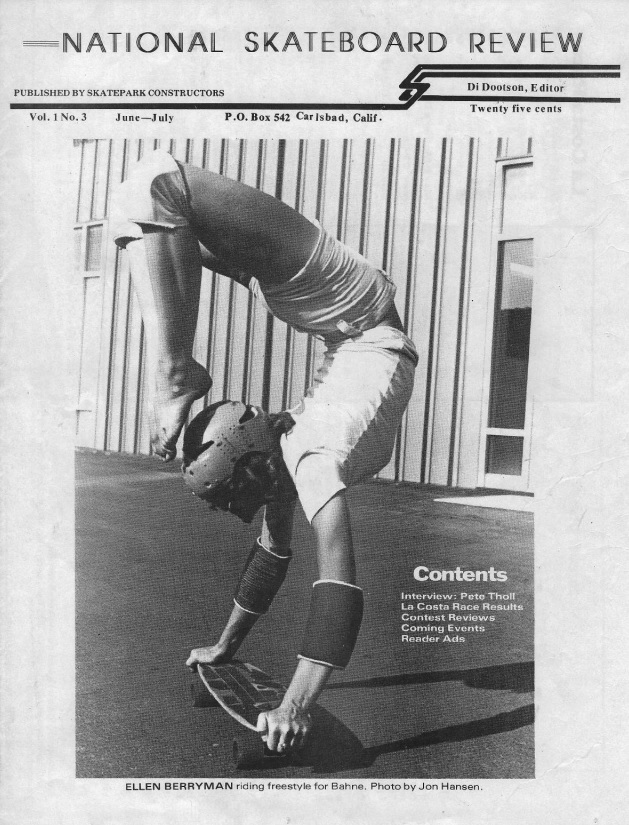
El described the Bahne Team as a kind of family. Paul St. Pierre acted as a kind of teacher and “would pack all the kids in a van like sardines and take us to contests and demonstrations up and down Southern California, Arizona and Nevada. On a trip to Las Vegas I did my first pool skating one evening beneath the flashing neon lights of the plastic fantastic.”
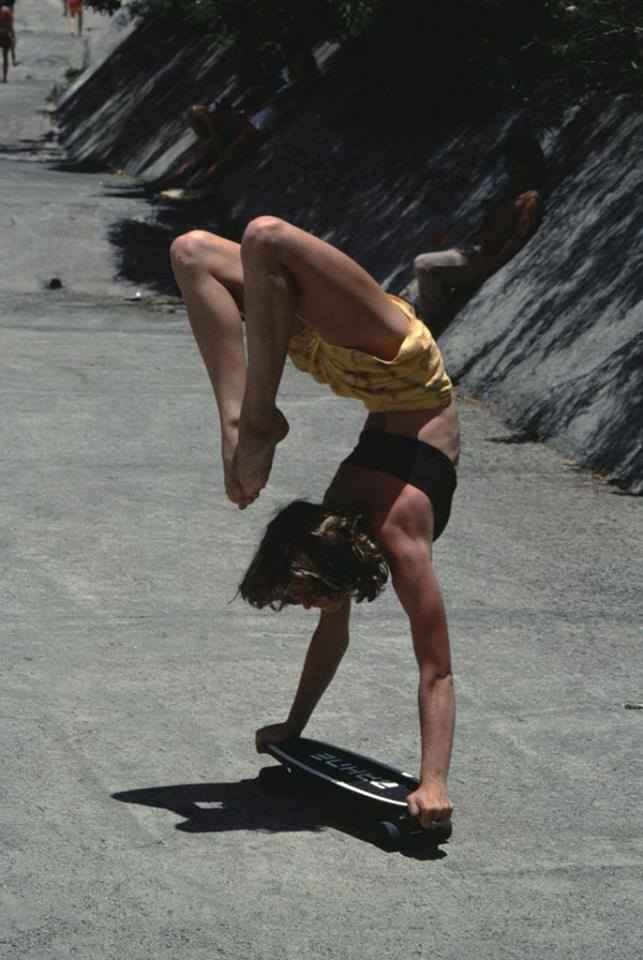
Photo: Warren Bolster, Oahu 1976
Ellen wrote that she realized she had a competitive edge in freestyle because she was among few women who could do a headstand (it’s believed that Linda Finley was the first, back in the 1960s). At her first contest in Balboa Park (Cindy thought it was Belmont Park), El came 2nd to the legendary Desiree Von Essen after only two months of skating, and then two weeks later took first prize in Tempe, Arizona.

And when Cindy moved to the North Shore of Oahu in 1976, El spent the summer with her, preparing for the first Free Former World Championships in Long Beach (which she won), and enjoyed the company of Cindy’s pro surfing friends.
Footage from 1976:
Ellen acknowledged that the gymnast Nadia Comaneci, who scored a perfect 10 in the 1976 Summer Olympics was the inspiration for her own win. The contest organizers used spotlights considering the arena floor was so massive. El wrote that it “made me feel like I was skating in my own traveling bubble – just me and the music. I don’t think I have ever been so in-the-moment as when I was performing like that. I won first place, and made national television for the first time, on ABC’S ‘Wide World of Sports.’”
It’s interesting to note that at the 1976 Free Former World Freestyle championships the Top 5 Men earned $2000 / $1000 / $750 / $500 / $250, while only the Top 3 Women received cash: Ellen Berryman ($600), Laura Thornhill ($300) and Ellen Oneal ($100).

Photo: Warren Bolster for Skateboarder (Feb 1977) from her 1976 Free Former win
El is often pegged as a freestyle purist but even back in December 1976 she explained that bank riding was her favorite because “Sometimes doing dangerous things is fun.”
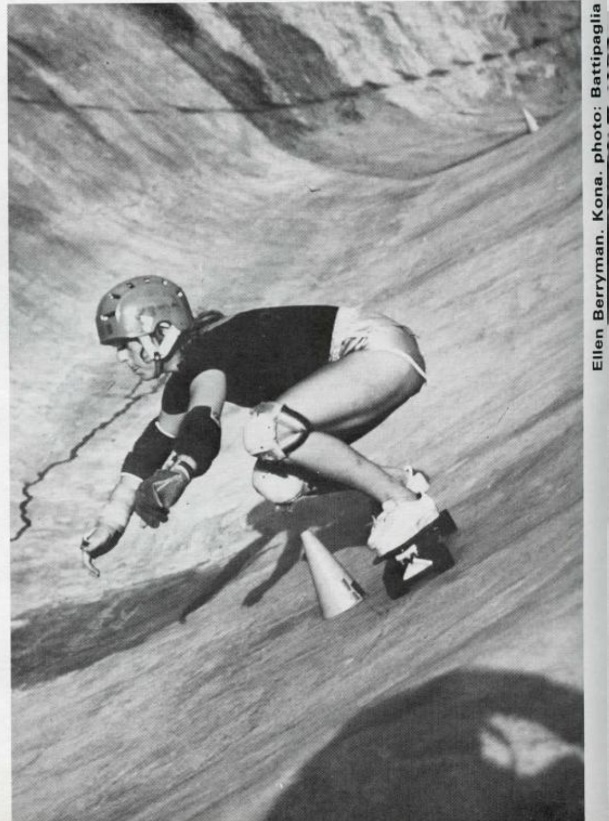
During her summer in Oahu, Warren Bolster took a series of photos of El at popular skate spots like the banks at Uluwatu, Wallows and Stoker Hill, which were used in her “Who’s Hot” profile for Skateboarder in December 1976.
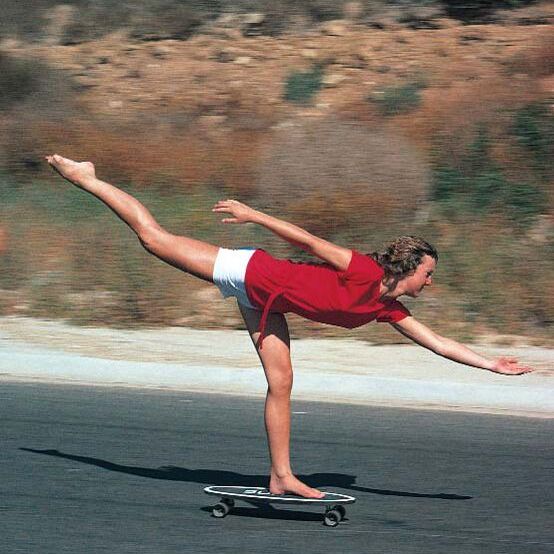


The article was written by her sister who shared how El was 16 and had only been skating for less than a year but already racking up contest wins, admiration from spectators and sponsors. Cindy also noted that Ellen was likely the first person (male or female) to perform the spider and the headstand into a scorpion – freestyle moves rooted in gymnastics.

Cindy credited a friend for giving El a “piggyback ride down Black Hill” for the initial motivation to skate and float down hill. And apparently, El’s friend and fellow skater, Robin Logan convinced her to try slalom on occasion.


Photos from 1977: El competing in slalom at Catalina, appearing in the June 23, 1977 issue of the L.A. Times, and various contest performances.
Jim O’Mahoney took some awesome photos of Laura Thornhill and El from August 15, 1976 performing a daffy on stage at the LA Coliseum during Jethro Tull’s “Too Old to Live” tour in front of 70,000 people. El described the experience in her Lives on Board essay. “How did I get here?… I’m supposed to be performing a solo on stage. So I stand here at the edge of the platform, about to go on. I’ve never seen so many people in one place… The platform is far too small to accommodate my freestyle routine. My knees go weak. I can’t do it, so I sit down on the platform step, put my head between my knees and make a motion for the next skater to go ahead of me.” But something prompted El to forge on, and she got up and did it!

El was getting noticed after her wins, so big sister, Cindy took charge when two men in suits showed up with a briefcase and demanded to sit down with the. Ellen recalled how, “Being from a small beach town and a blue-collar family, it was strange to have men with suits sitting on our living room sofa. I’m fairly sure my mother was pretty clueless about what was going on. They wanted to sign me on to a touring show called Skateboard Expo. To my good fortune Cindy took charge and made sure I was treated fairly.”
The Skateboard Expo was pretty epic, involving lighting effects, ramps, and choreography. “We even had our own touring live band and roadies, and we signed autographs after each show. Bodyguards became necessary after someone tried to pull of Robin Alaway’s shirt… It was the rock ‘n’roll lifestyle.” Here’s a great photo of the crew from 1977, which also included Robin Logan.

In preparation for the 1977 Long Beach Freestyle World Championships, I was delighted to read that El and her brother had hit up the UC San Diego library, where she “checked out a lot of books about choreography. I learned how to utilize space and turn my freestyle routine into more of a visual performance than a series of tricks.” Her brother, with his carpentry skills even built a ramp that resembled a wave, and once again, Ellen won!
She recalled how stoked the Bahne Team were, especially since her teammate, Bob Mohr had also won the men’s division. “The loudspeakers blared, ‘We are the Champions’ by Queen, a newly released song at the time, and we sang along, feeling every bit the champions of the world.’”


Photos: All of the images were from El’s 1977 Free Former win for various skateboard magazines by Jim Goodman, Neil Britt, Stan Sharp
This photo of Ellen and Bob is from their special day in 1977 taking home some massive trophies, and then in 1978 for an Op sunwear advertisement:

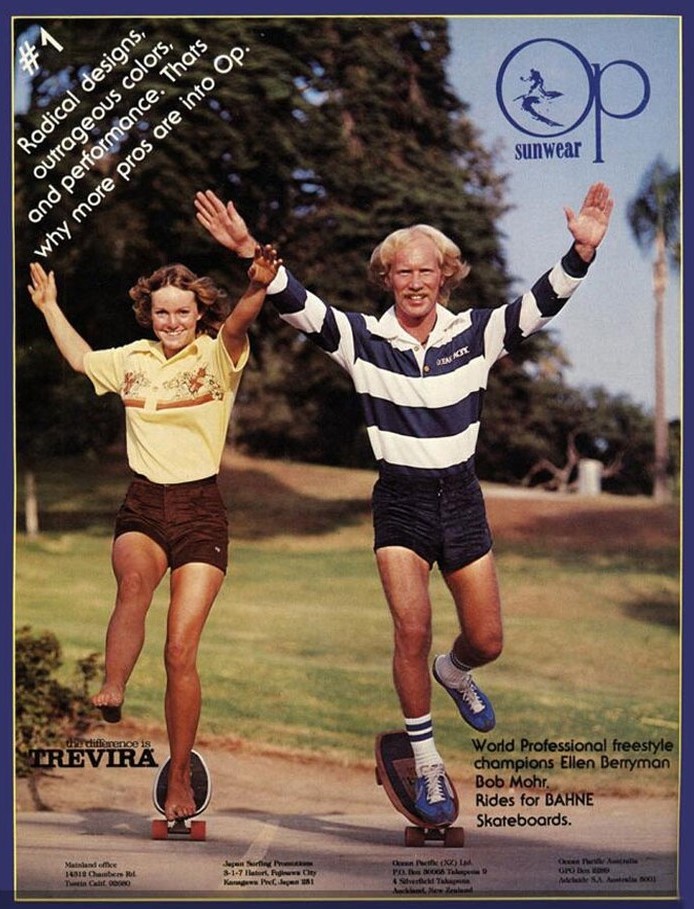

Warren Bolster would later explain in the book The Legacy of Warren Bolster: master of skateboard photography (2004), that Ellen “incorporated the most beautiful, photogenic, and artistic techniques into her floor 9or road) routines. A shot of her at the Los Angeles Sports Arena World Championships is truly one of my favorites.” He believed that El elevated skateboarding into a form of fine art.
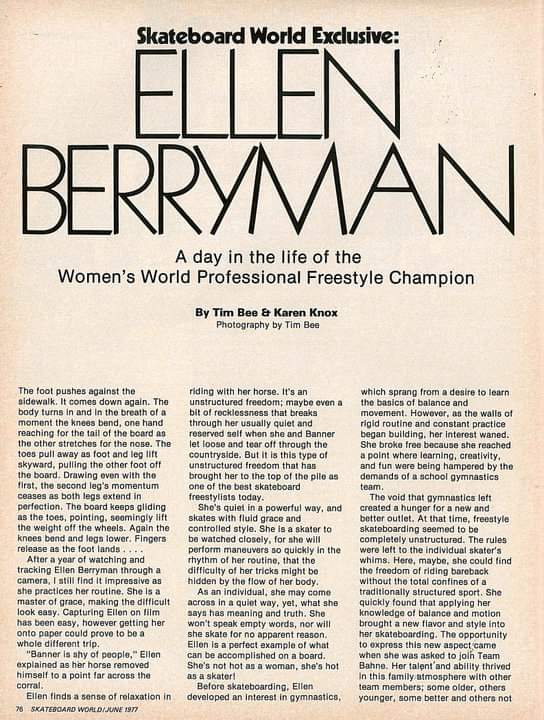


For the magazine, Skateboard World, El received a four-page feature in the June 1977 issue written by Tim Bee and Karen Knox (with photos by Tim Bee). It was shared that, El was a quiet individual but in a powerful way. “She is a skater to be watched closely, for she will perform maneuvers so quickly in the rhythm of her routine, that the difficulty of her tricks might be hidden by the flow of her body.” It was also made clear that El was supportive of more women in skateboarding and had a vision where contests were “more of a ‘creative show’ and not so much of a ‘stardom role.’” Perhaps the way contemporary skateboard companies celebrate their team on videos. And Ellen did act as a coach for another up-and-comer, named Kym Milburn.
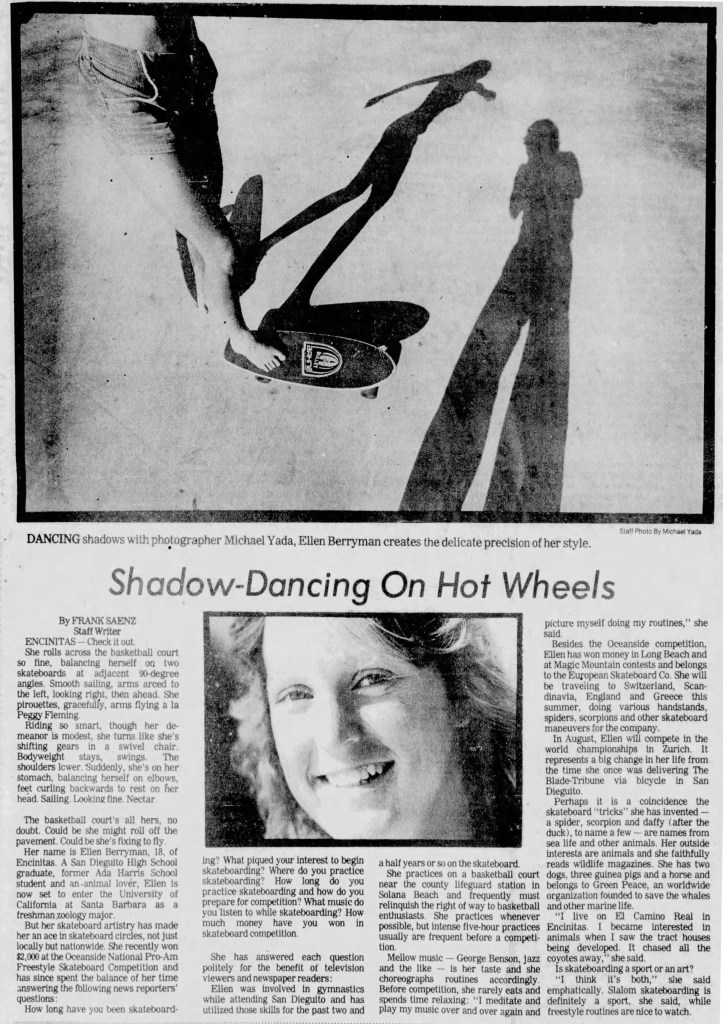
Above: Interview for the North County Times from July 2, 1978.
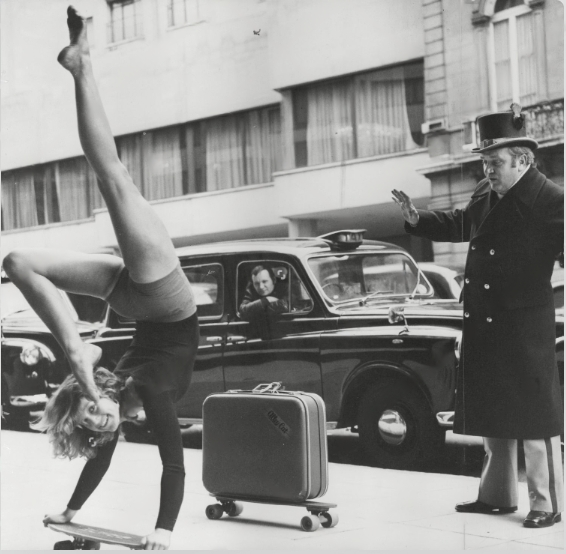
In 1978, El had a desire to travel so when an overseas company called Alley Cat offered her cash and a European skateboard tour, she went for it although, “It may have been a mistake leaving the Bahne Team and all the support I got there.” Apparently, El was on tour with a British female skater and an actress who didn’t actually know how to skate.
There are some pretty fun photos of Ellen during her travels, such as arriving at the Intercontinental Hotel in London, England (February 14, 1978) by Geoffrey White:

In Lives on Board, El reported that it was wonderful to appear on a UK TV show and be mobbed by cute kids wanting autographs but “not all the media was positive. I was shocked when a woman asked to interview me for a magazine, only to turn out to be a feminist who verbally attacked me for perpetuating the exploitation of women. In her eyes, I was just parading my body around in skimpy clothes. I guess I’d been naïve, because it sure was news to me that I was the latest pin-up girl. After that interview, my spirits plummeted.” And when her sponsors kept insisting that she perform in shorts, even when the weather was cold, El started to feel like the feminist reporter’s accusations may have been correct.
Reading El’s essay, I felt saddened that she was not only betrayed by a feminist in her bullying approach to condemn a teenager but also betrayed by her sponsor. This must have been a really isolating time for her. In fact, El wrote that she became run down by the relentless schedule and a severe sinus infection cut the tour short.
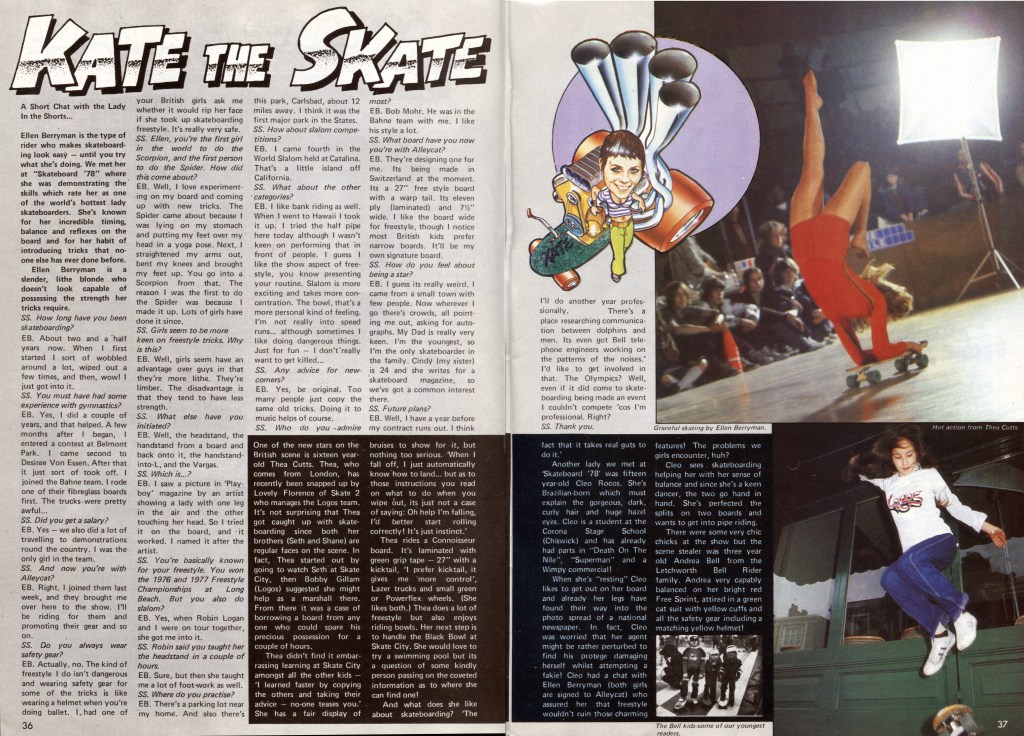
Photo: This article appeared in the “Kate the Skate” column (March 1978) for the British magazine Skateboard Scene
El received a 5-page featured in the May 1978 issue of Wild World of Skateboarding, written by Konrad Lorenz which even included a few photos of Ellen at the library, prepping a biology report. She said that “It is important to me not to let this skateboard stardom change my philosophies or goals. People often get carried away with the images they try to project, and in the process they lose their true selves.” Ellen credited Robin Logan as a great example of someone who was true to themselves as a “mellow, yet an aggressive skater.” While she regarded the Dogtown boys as “not nearly as hard core as they’re made out to be.” The article concluded with Ellen sharing some of her goals, which was to join an Earthwatch expedition to Guatemala and to study ethology.


In the July 1978 issue of the National Skateboard Review, El also wrote a fantastic article for a “Mini Women’s Section.”

She wrote that, “We know that there is absolutely no tie between a person’s sex and her capability to love what she is doing. Therefore, a lady can be as capable if not more capable than a man to skateboard.” El also didn’t buy the masculinity / aggression debate: “if you’re aggressive by nature, you must not let society prevent you from releasing this aggressive energy, whether you’re male or female… Any person can find his/her own style of skating that reflects his/her nature. You mustn’t be afraid of being original.” The article was followed by a profile on L.A. skateboard activist, Debbi Bennett.
In an interview from 2000 with Ken Hada, El’s sister, Cindy believed that the 1970s was a golden age for skateboarding in terms of the industry. She said, “I know that my sister, with her with winnings from contests and with sponsor. She bought a new sports car. She paid her way through college. She toured Europe with a skateboard company. She opened for The Beach Boys and for Peter Frampton and for Jethro Tull. The Beach Boys asked her to go on tour with them, but she couldn’t because she was still in high school. There was a lot going on. There was money in it.” Until there wasn’t.

Photo: Ellen performs during the Frampton concert, with a photo published in the February 1977 issue of Skateboarder magazine by Todd Friedman
The annual Free Former freestyle contest did not occur in 1978, and El explained that because she did not skate in shoes, she tended to avoid contests at skateparks that demanded she wear them. The Oceanside National Pro-Am contest would be her last contest, which she naturally won.

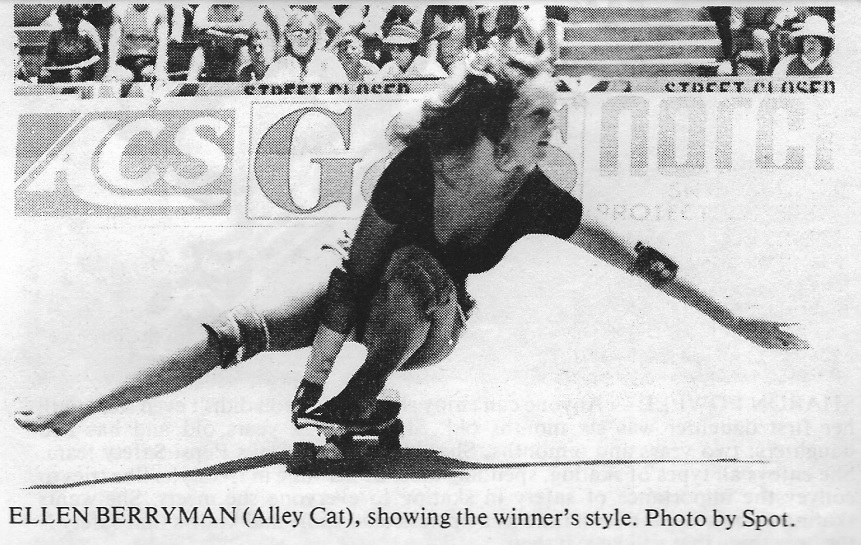

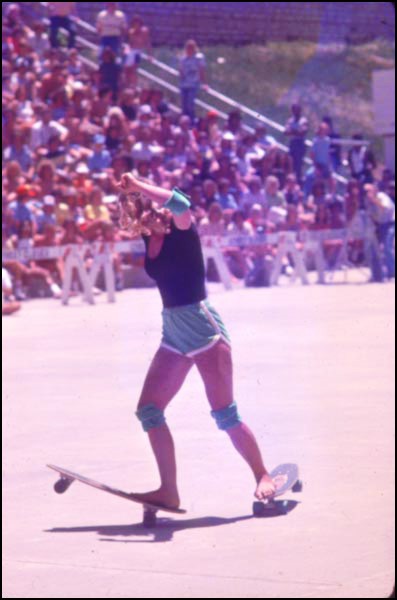
Photos: Oceanside Pro-Am 1978 by Spot and Jim Goodrich. El is skating for Alley Cat and the new rules required her to wear safety gear. The knee pads were custom made by June Postal.
There’s some nice group photos by Jim Goodrich and Spot of the top five at Oceanside including Ellen, Robin Logan, Julie Cheng, Ellen Oneal and Kathy Bomeisler.

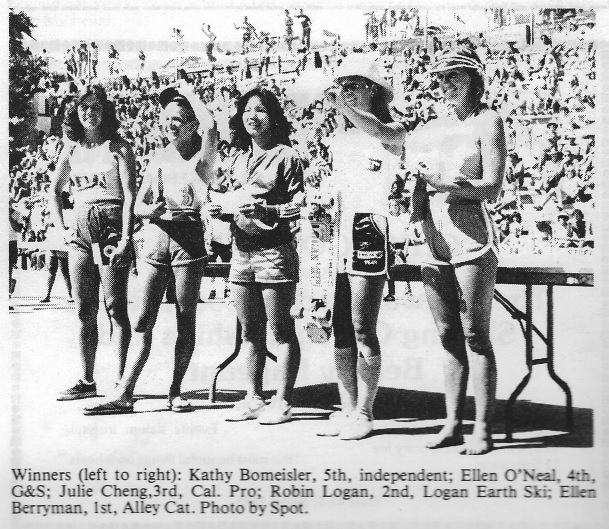
There were other opportunities, like a tour that took her to Canada but El reported that she was without a team and even decided to do some solo hitch-hiking from Banff to Canada, just to savour being alone. She had started to feel suffocated by fame.
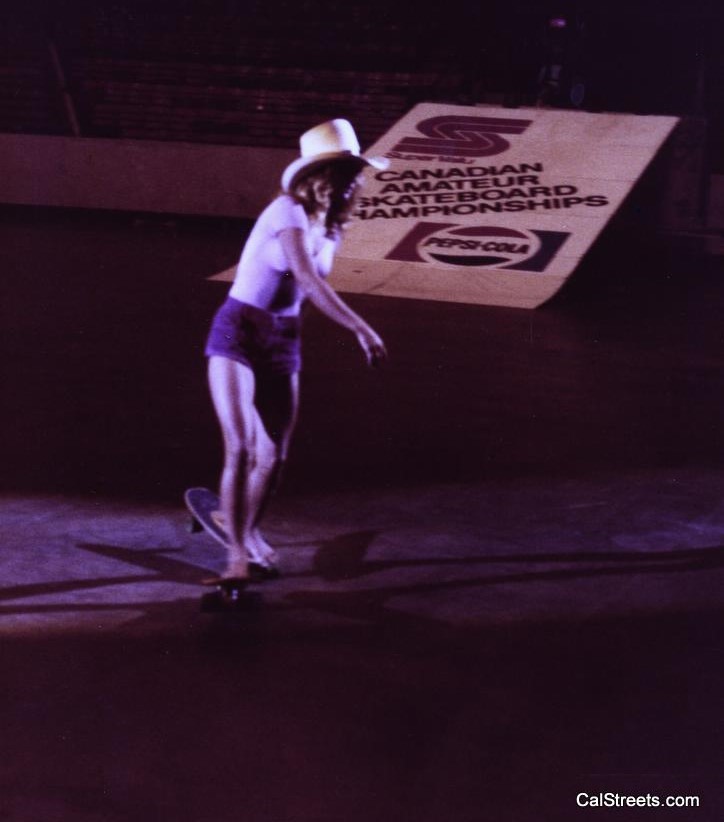
Photo: Ellen performing a demo at the Skatopia skatepark in Calgary, Canada in July 1978 for the Skatopia Pro Freestyle Invitational. She made the trek with Vicki Vickers and Tara Kaylor.
By 1979, El’s aspirations led her to college and beyond, and the skateboarding industry took a dive. El didn’t completely abandon skateboarding, explaining on Facebook that before she went to grad school, she took a break “and worked at Del Mar Skate Ranch, where a diminutive Tony Hawk skated all the time. I was the judge in several contests he skated in. He was good but not all that much better than the other kids who skated there all the time. I never encountered him after he achieved superstardom.”

El was one of five women who were featured on an International Skateboard Association (ISA) trading card in 1978, along with Deanna Calkins, Gale Webb, Kim Cespedes, and Rebecca Williams.
In May 2022, on Facebook, El explained that these days, her preference is to live in the present, rather than the past. Although, she still enjoys sharing a hint of her “ancient history” to friends who are unaware of her legacy in skateboarding, and she expressed respect for folks like Laura Thornhill who are still active in the scene.
In response to her post, El’s sister Cindy said she felt aligned but noted that a “shared history makes for some pleasant nostalgia, along with the bonds of friendship it created.” When a friend shared how excited a young skateboarder was after discovering vintage videos of El, she exclaimed, “I love it when I can be an inspiration to girls – thank you!!!” Pro skater, Deanna Calkins piped in saying, “I have a special place in my heart for you El, your friendship in our skating days meant a lot, I admired & learned many skating tricks from you, besides handstands! Our trip to Vail, Skateboard Expo show! Always wish you the very best.”
I really appreciate El’s perspective because it’s evident that she is living a fascinating life. She studied biology and became the founder and principal of Berryman Ecological working on environmental and conservation issues for decades, and now she is working as a principal of Inner City Fund (ICF), which is a global consulting and technology services company. Skateboarding is wonderful. It’s a great social connector and a fantastic outlet, but when it becomes an all-consuming core part of one’s identity it might be wise to check your priorities.

Photo: El is bottom right with a few friends in the mix including Kim Cespedes (far left 2nd row) and Judith Cohen (middle).
Ultimately, El recognized that she certainly established some fabulous friendships thanks to skateboarding like Judith Cohen, Claire Glavin, Di Dootson Rose, and the late, great Ellen Oneal (RIP) and that “without skateboarding, I may never have come out of my shell.”
When asked on Facebook if she still was skateboarding, El replied, “not really. I broke my arm at a skatepark a while back and the healing process was way more difficult than when I was younger. And I haven’t lived near any places to just cruise on sidewalks. Every once in a while I’ll get on my longboard when I find a good spot. Fresh asphalt still makes me drool.”

Listen to a full podcast featuring Ellen from October 7, 2020 with Ken Hada.
References:
- Bee, Tim and Karen Knox. “Ellen Berryman.” Skateboard World (June 1977): 76-79.
- Berryman, Cindy. “Who’s Hot: Ellen Berryman.” Skateboarder Magazine 3, no. 2 (December 1976): 90-91.
- Berryman, Ellen. “Mini Women’s Section.” National Skateboard Review (July 1978): 18.
- Lorenz, Konrad. “Ellen Berryman, Stylist.” Wild World of Skateboarding (May 1978): 56-60.
- Smith, Jack (Editor). “From Recluse to Footloose, and Back: Ellen Berryman.” Lives on Board: the Skateboarder’s Journal. Morro Skateboard Group, Morro Bay (2009), pp. 308-310.
 Womxn Skateboard History