
Leaf Treinen was originally from Hawaii before growing up in Eugene, Oregon where she became a factory-sponsored skateboarder in the late 1980s / early 1990s. In March of 1986, nearing the end of 8th Grade, Leaf began skateboarding and was aware of the local Willamette Dammitt contest, which took place for the first time on April 15, 1986. This contest would prove to be a gamechanger for Leaf and her skateboarding legacy.
Leaf is most recognized for being included in the classic Powell Peralta ad “Some Girls Play With Dolls. Real Women Skate” alongside Anita Tessensohn. Leaf’s one regret is that the ad didn’t show them skating (although Powell Peralta rectified this with Wendy Zaks a few years later in their ad from 1989) but shared how much the representation meant to her and female skaters.
I finally had a chance to connect with Leaf and have updated this post with the full transcript of her emailed reply on June 10, 2025 at the bottom. Please enjoy!
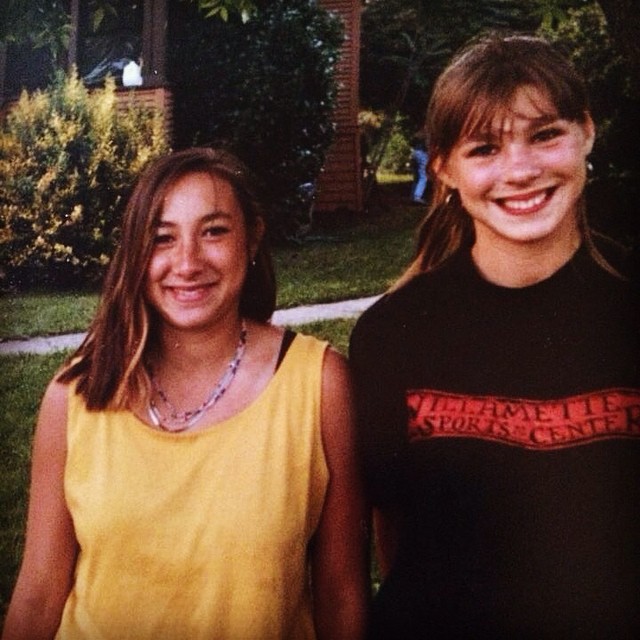
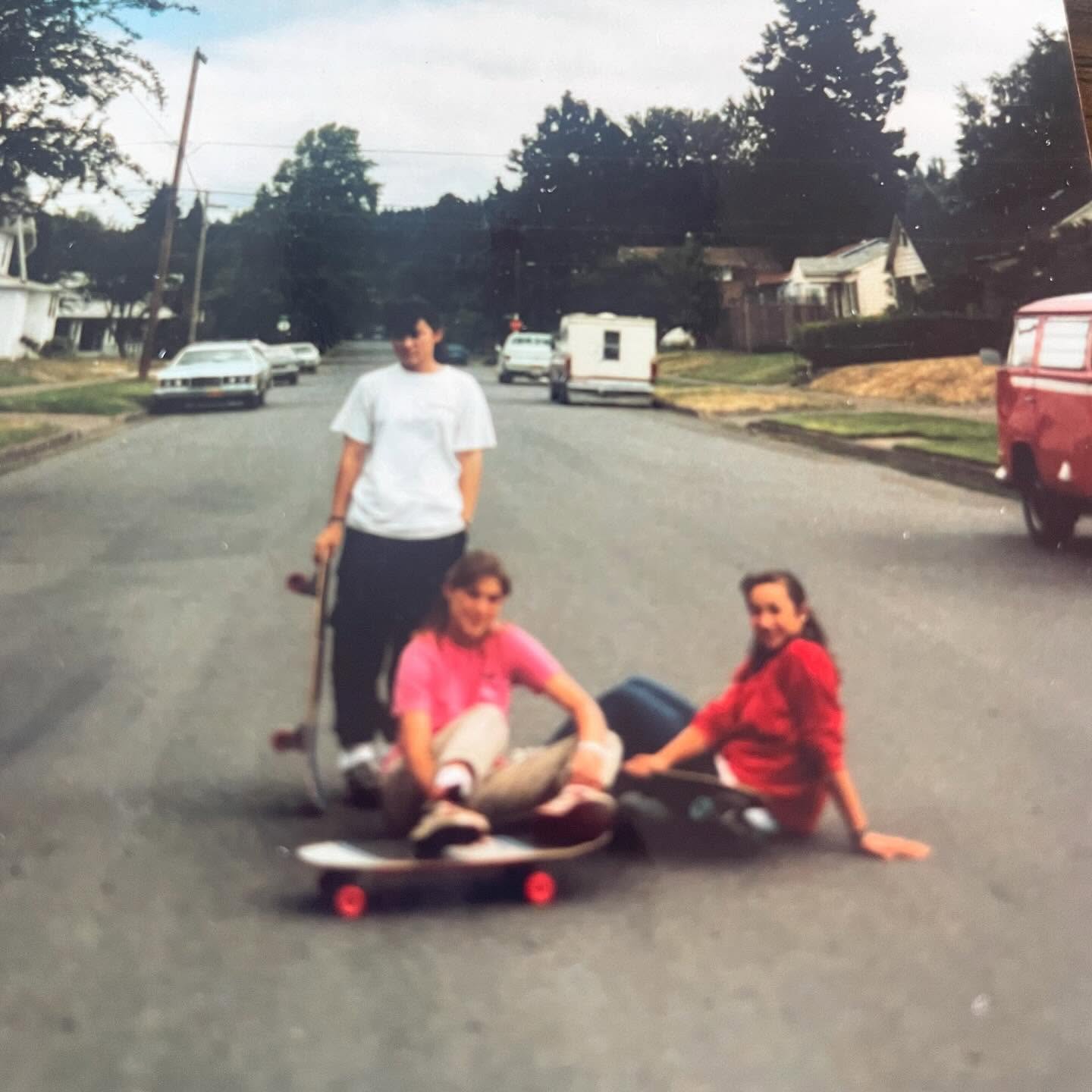
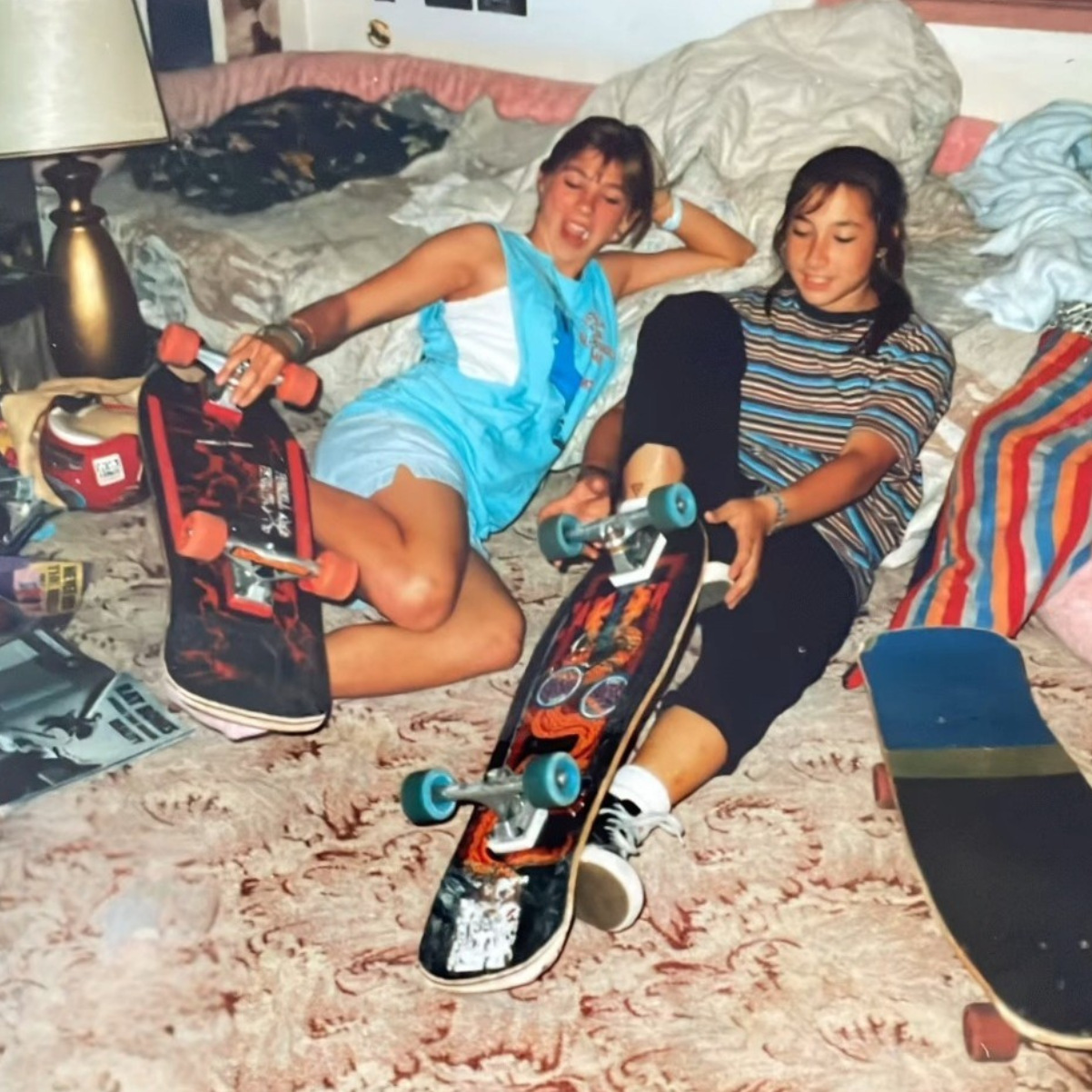
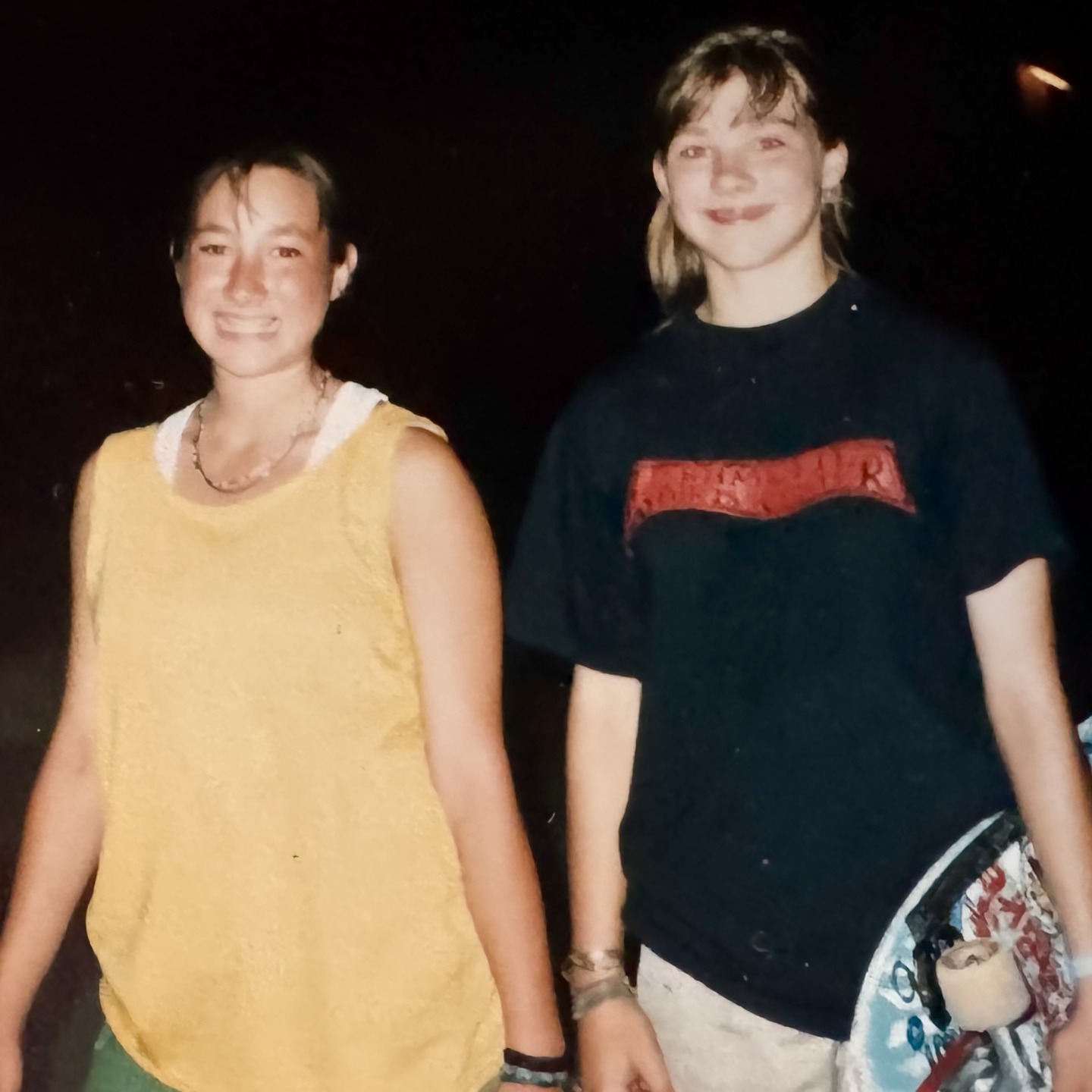
Photos: Leaf and Anita and friend, part of her Oregon skate crew in the 1980s, and getting stoked on their Powell Peralta skateboards
The photo for the ad was taken by Stacy Peralta in 1987 at the Willamette Dammit Skate contest in Eugene, but the two would have no idea in advance about the plan for the photo!

The ad appeared in print in the December 1987 issue of Thrasher and February 1988 issue of Transworld Magazine and were promptly cut-out and pasted to the walls of isolated women skaters around the world – as seen in the 1990 movie Grinding to Win (the first to film to revolve around a female skater).
There’s a short clip of Leaf launching off a kicker in the credits section for Vision’s Psycho Skate video from 1988. Leaf had only been skating for about 6 months at the time!
The two skaters were part of a crew of girls, which included the legendary snowboarder Circe Wallace, and according to Anita from a 2009 interview, “we used to travel around in a pack – terrorize the town” and they would also encourage each other to practise tricks – “if one of us got it, we all had to try it, we all had to get it. But we were all really different women.”
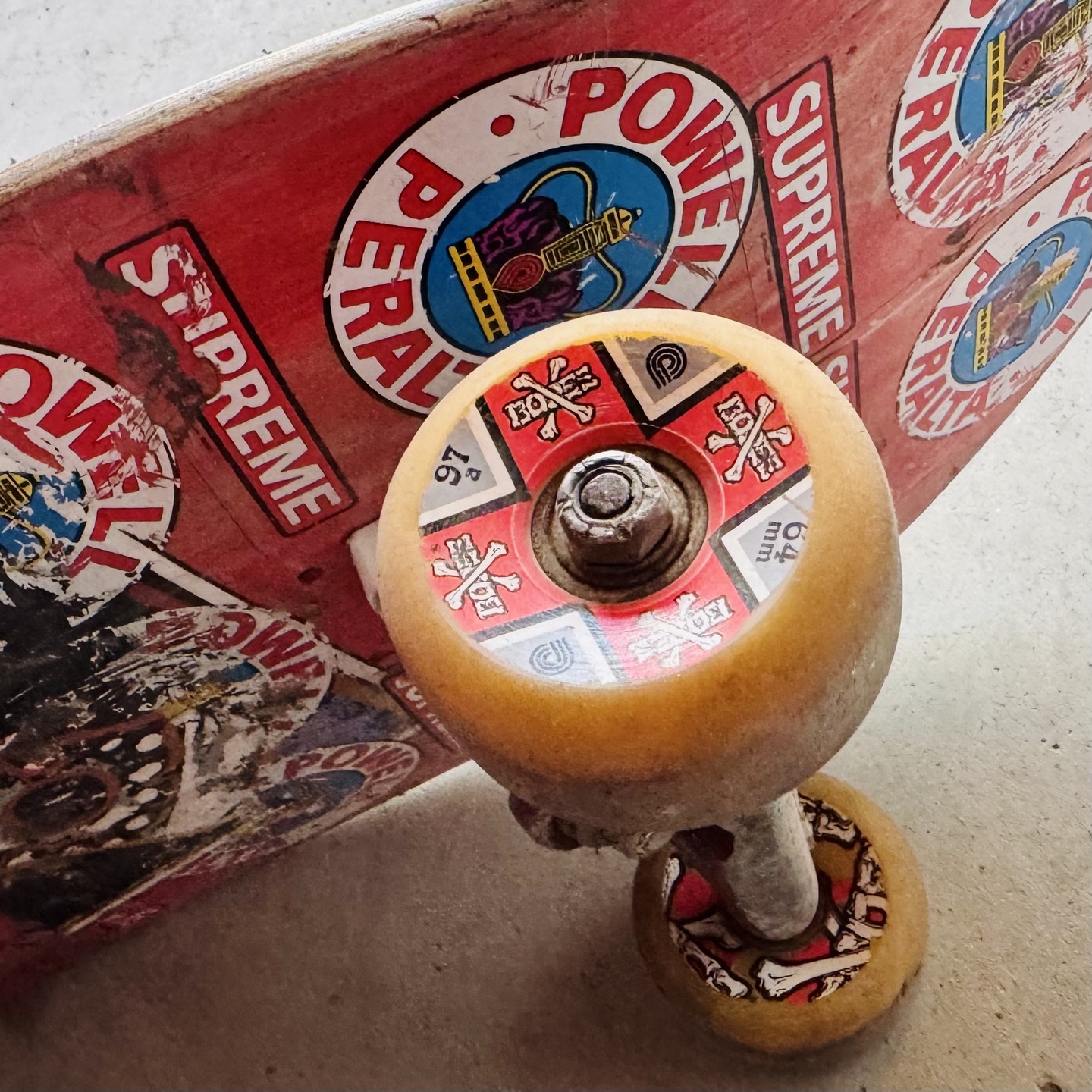
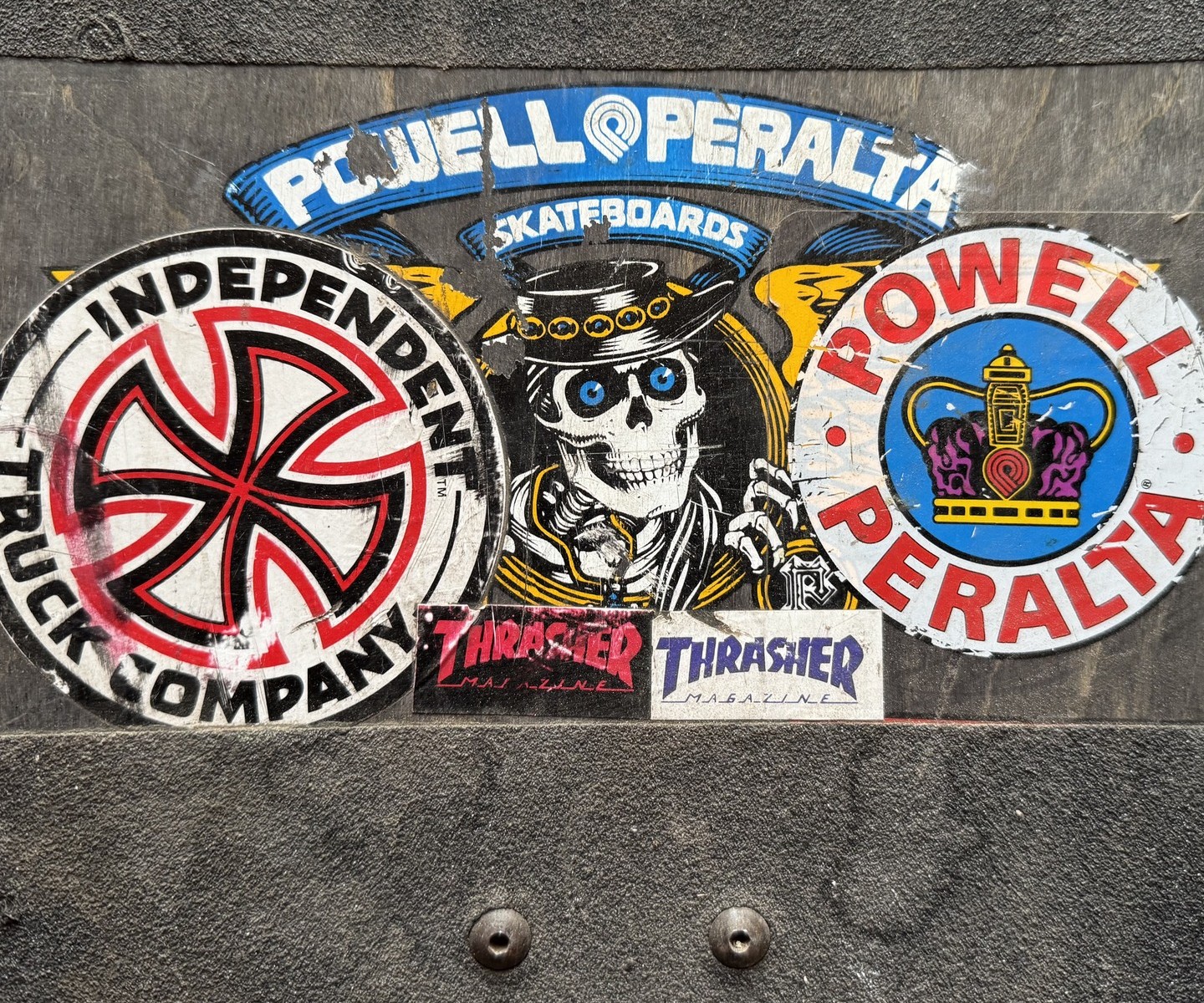
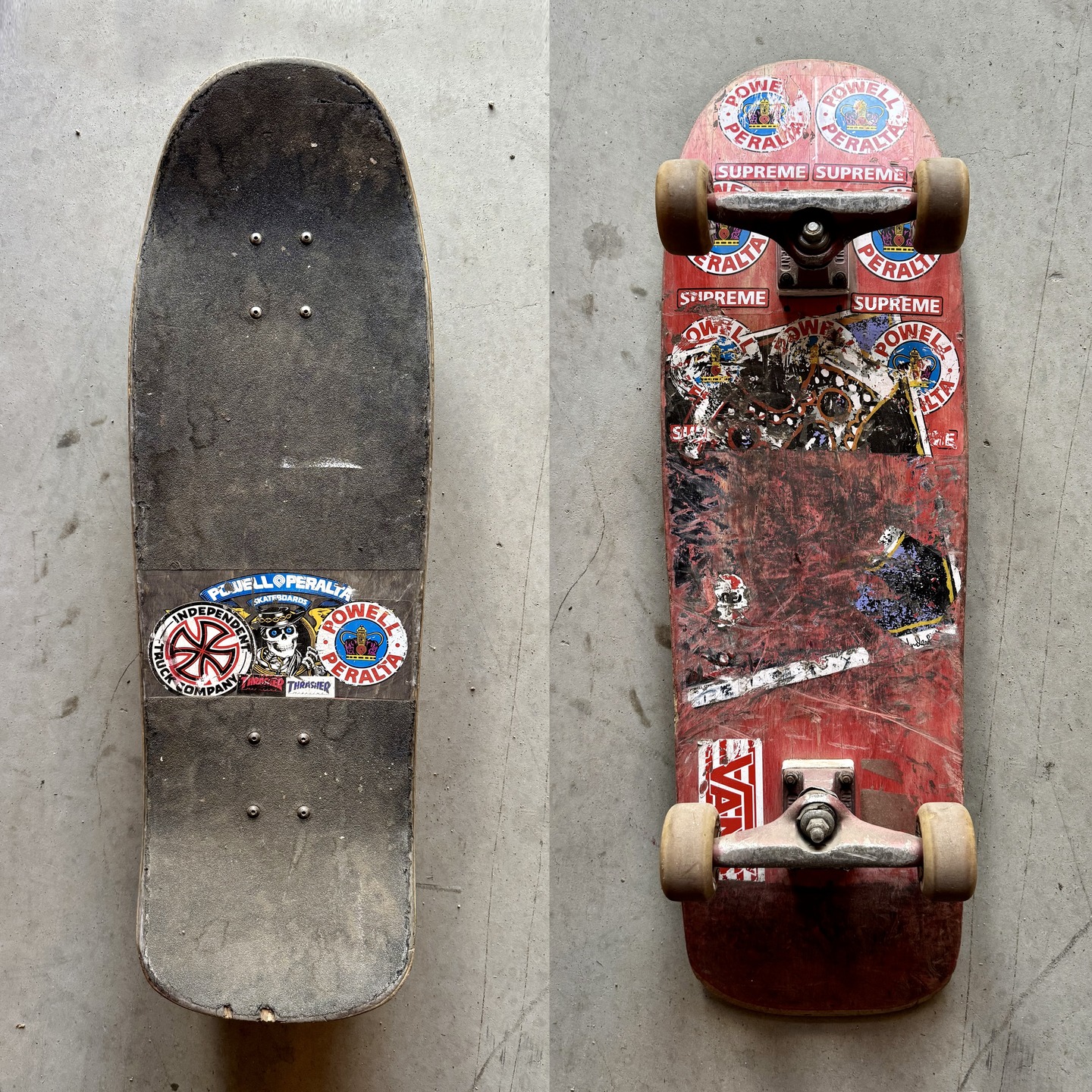
Leaf was officially sponsored by Powell Peralta, and her famous ad was more than just a publicity stunt. On Instagram, Leaf wrote: “I met Ray Underhill in 1987 after I had been sponsored by Powell Peralta for maybe a couple of months. He recently started a company called Knee Gasket. If you skated vert back in the 80’s or 90’s you would‘ve been familiar with them as an extra layer of protection to put under your knee pads. For me, the neoprene knee sleeve added so much comfort. I was grateful for his sponsorship. When his pro model came out I knew I needed to get one of his boards [above]. I loved the shape then, and I still love it now. This board still sees action from time to time. Ray was such a cool teammate and as so many know, a genuinely great person.”
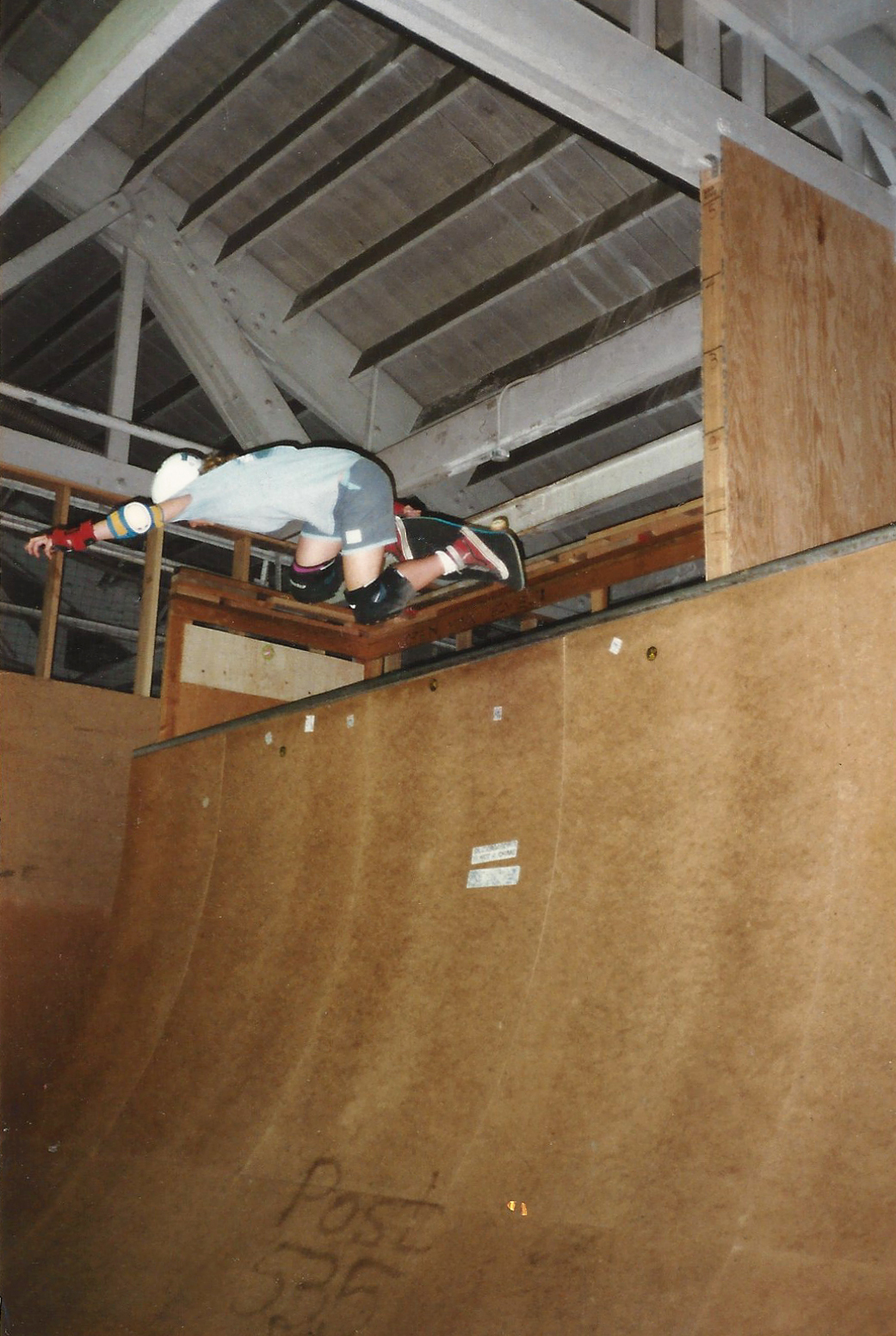
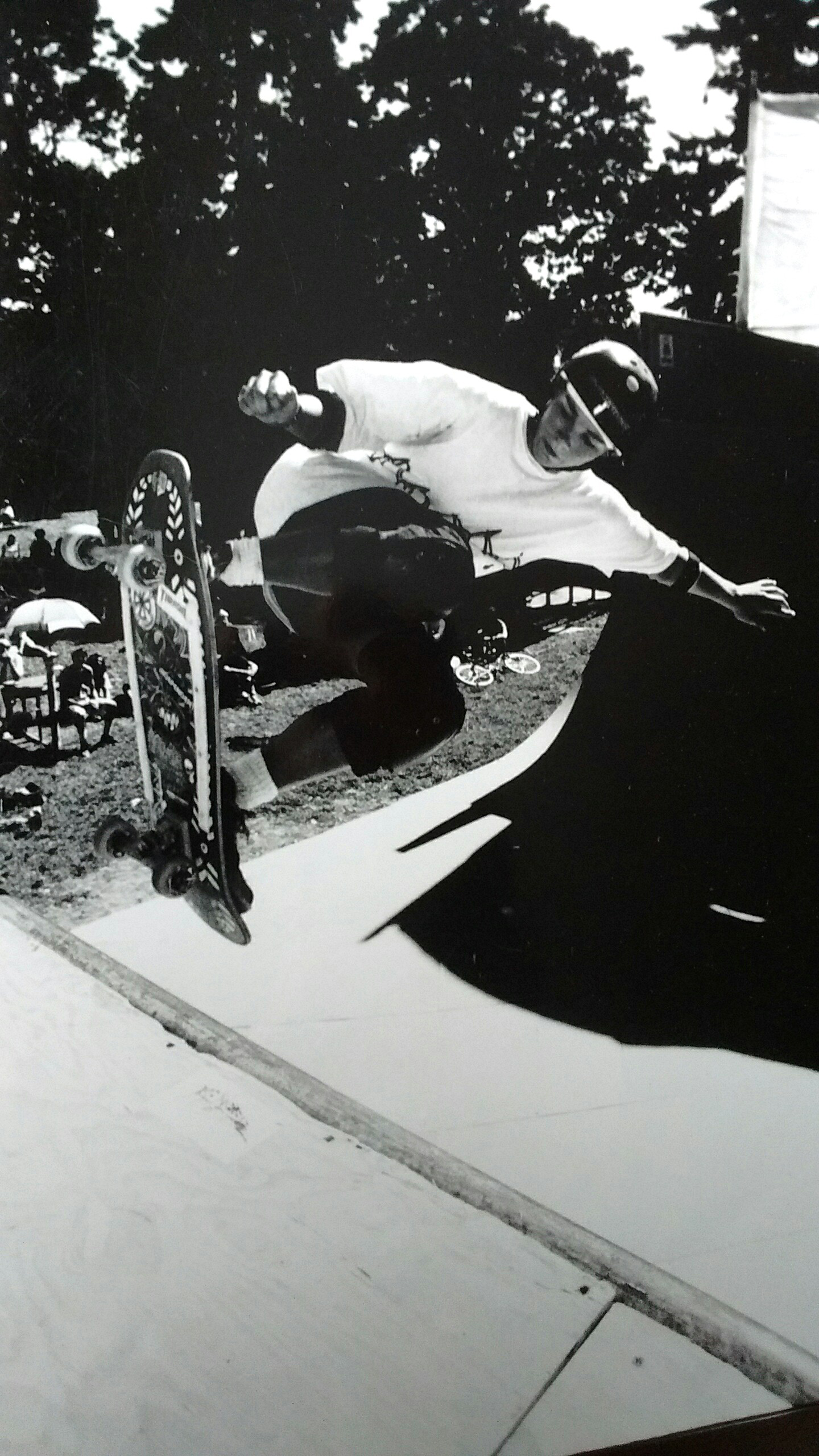
Here are some photos from Leaf’s collection of her skating vert, catching air and pulling off grabs. The black & white photo is from the NSA Northwest Regionals at Avery Park in Corvallis, Oregon, 1990.
Leaf was also a contributor to KZ Zapata’s zine Push, Push Then Go! with a photo of her grinding a curb in Eugene for issue #3, which was included in “The Girls Scene” section, and a drawing for issue #4 in 1988, perhaps to help visualize her progression because Leaf was discovering she had skills on vert.
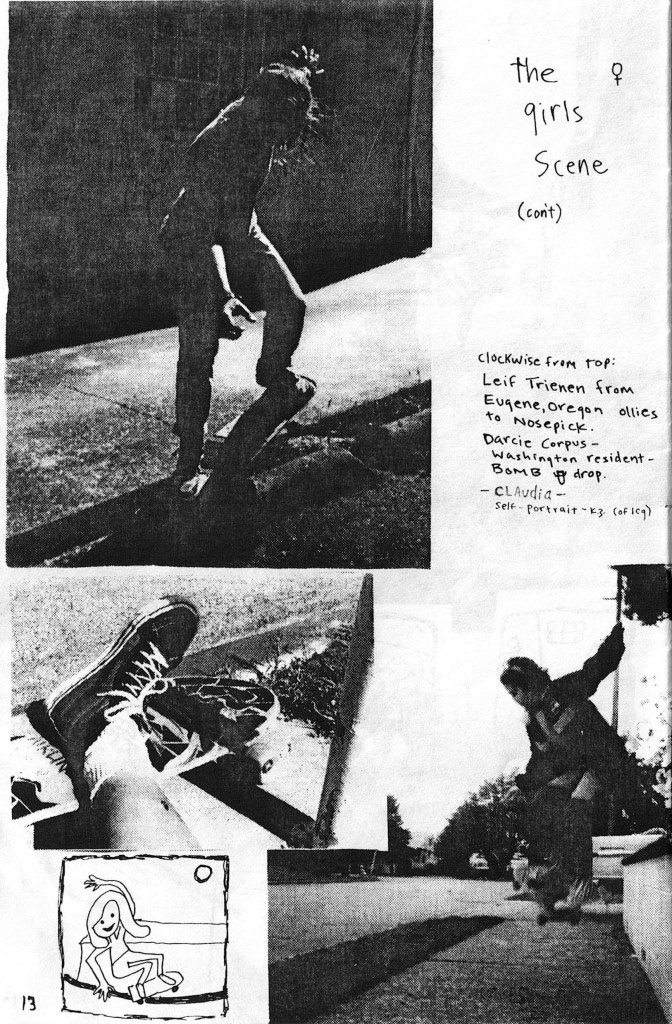
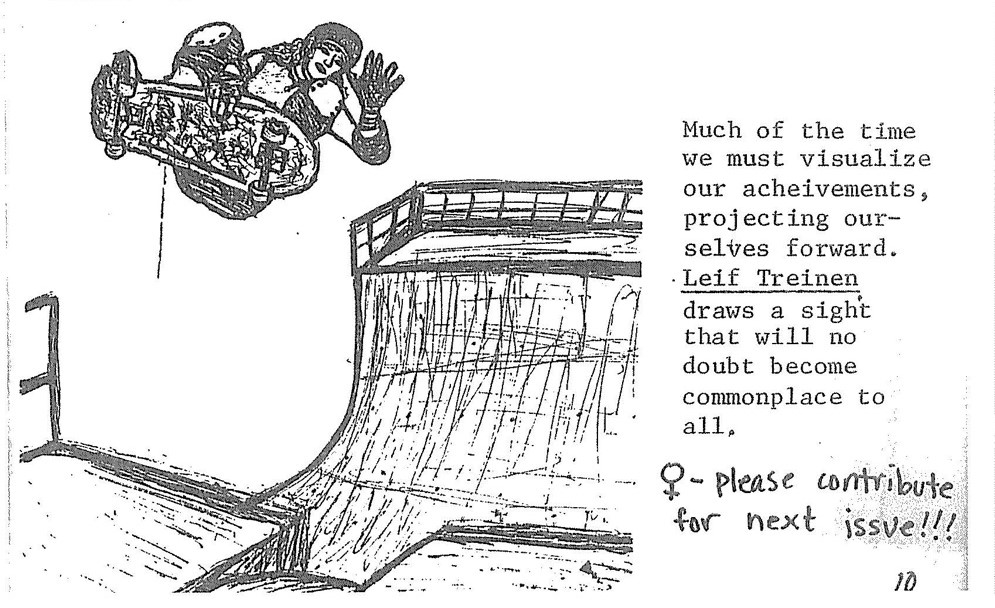
KZ wisely wrote, “Much of the time we must visualize our achievements, projecting ourselves forward. Leaf Treinen draws a sight that will no doubt become commonplace to all.” Which is so true, considering that we’ve just witnessed Arisa Trew (age 13 from Australia) throw down and land a 720 at the most recent Vert Alert contest, June 2023.

Leaf continued to skate, as she is listed in the VHS video “Board Crazy” (Greg James, 1990) within the section featuring “Mike’s Ramp locals” which was owned by Mike Ranquet. Mike had a vert ramp on his parent’s 5-acres of wooded forest in the Pacific Northwest near Seattle. I’ve watched the video a few times, but can’t quite determine which clip features Leaf – maybe she was in the background while others were interviewed?
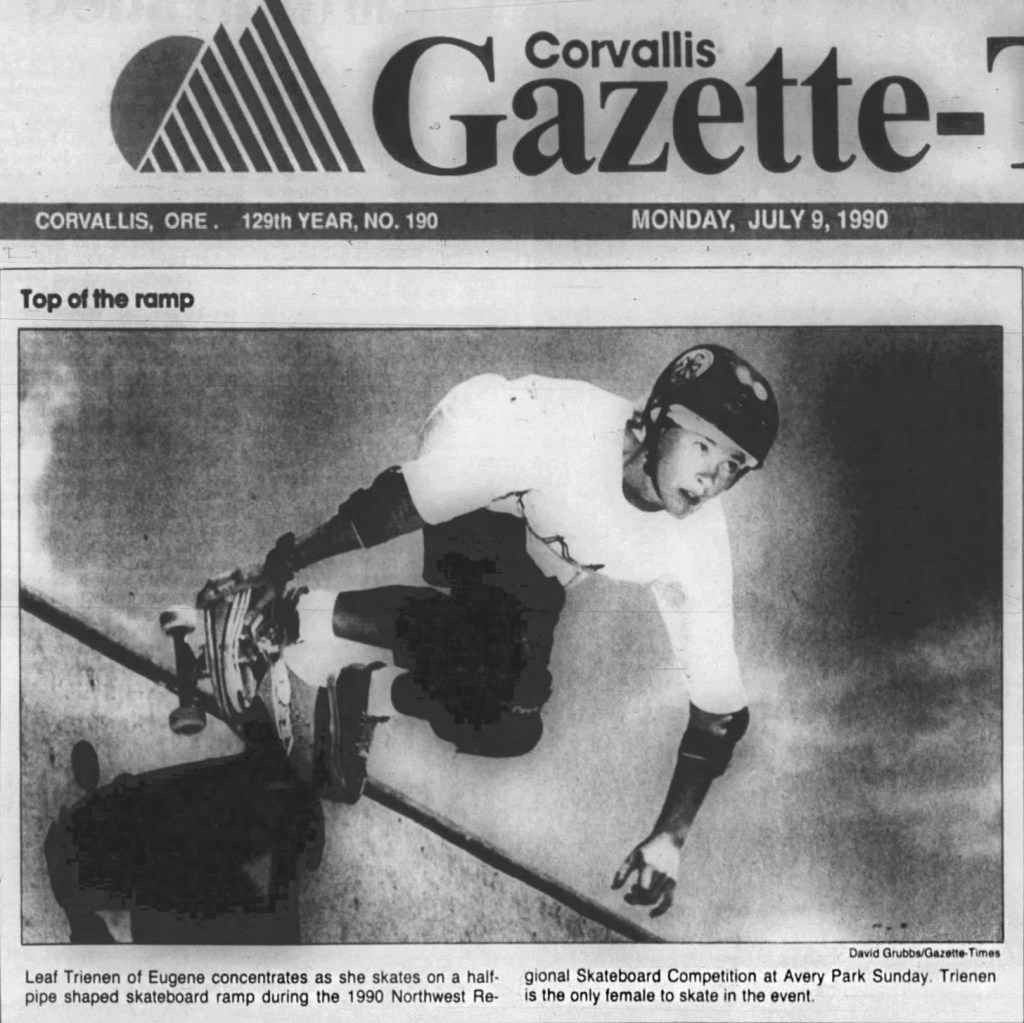
For the Corvallis Gazette Times in 1990, Leaf was celebrated for being the lone female competitor in the Northwest Regional Skateboard Competition at Avery Park on the vert ramp.
In the early 1990s, Leaf also took up snowboarding with intention and was a USSA Nationals qualifier in 1992 – 1993, living and training in Breckenridge, Colorado. She competed as an amateur and then became a product tester for Skiing magazine.
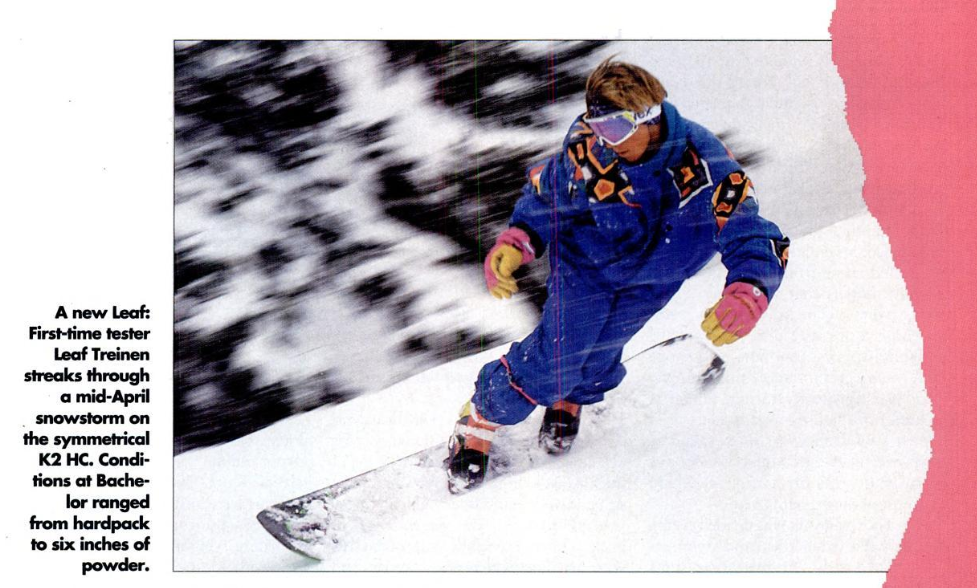

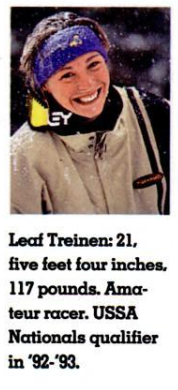
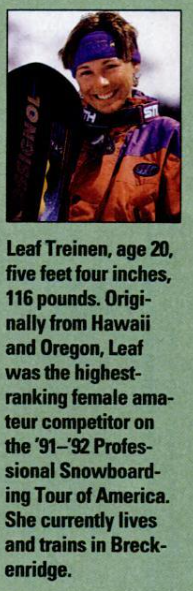
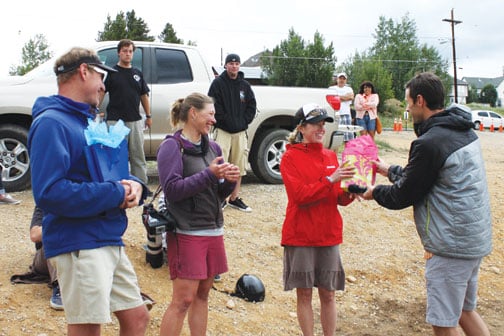
While Leaf isn’t active on social media, she was acknowledged for her efforts on the Huck Finn Park Committee, which helped spearhead funding for a new skate park in Leadville, Colorado. The official opening was July 27th, 2014. She is second from the left in this photo from The Leadville Herald newspaper.
Leaf has been busy with work, but we made a connection via email and I’m anticipating an update!
Here is the much-awaited reply from Leaf via email on June 10, 2025. You can also tune-in to “The Bones Brigade Audio Show” podcast which featured a reunion between Anita Tessensohn and Leaf from June 22, 2025, episode BBA S088.
- How or who introduced you to skateboarding, and why did it appeal to you?
Ever since I was a little kid, I was driven by curiosity and had a strong adventurous spirit; I saw nature as my playground. I was always into something, often climbing and jumping off of things. I swam a lot, rode horses and did a lot of exploring. I never worried about what girls or boys were supposed to do, mostly because I was unaware of those stereotypes. All I knew is that I really loved the outdoors and I loved to play.
I credit my mom for my initial introduction to board sports. My mom grew up with the surf and skate culture of the 60’s and 70’s. She used to side walk surf on a small board with little wheels like many kids did at the time, but her true passion was surfing waves. It was a dream of hers to surf in Hawai’i. My mom had an opportunity to go, so we moved to Moloka’i for a few years.
Our home was off grid and we could walk to the beach in a couple of minutes. I remember playing in the sand and watching her out in the ocean. She looked so free and happy out there. Her love of surfing, and being an active person made a lasting impression on me.
My introduction to skateboarding in its more modern form was in 1986, I was living in Oregon. I had just recently moved to South Eugene, the most urban section of the city from a rural part of town. Some kids started bringing skateboards to school acquired from a newly opened skate shop called Willamette Sports Center. They were outside pushing around, and practicing 180 and 360 spins on the tail. It looked really fun, and I couldn’t take my mind off of it. I asked to borrow a board, and after I played around on it I knew I needed to have one of my own.
My family saw a skateboard as too expensive, and I couldn’t work yet. So, some friends and I got the idea to pick up a wood shop class in middle school to build our own decks. I was so excited to work on it, but to my chagrin, my building skills…uh; let’s just say the finished result kinda sucked. I didn’t tighten the clamps on the press enough, so some of the laminations weren’t as close as they should have been. It was pretty horrible, the deck was full of spooged glue and big air bubbles.
Even though I never used it, trying to build my own board demonstrated to my family that it was important to me and not some passing fad. A month or so later, my mom and grandmother teamed up and got me a Santa Cruz special edition complete set-up.
- It sounded like there was a crew of female skaters in Eugene… did being part of a “girl gang” motivate you, and what was the response like from male skaters in the community or people in general in your town?
We did have a lot of girls skateboarding; most were using their boards as transportation, but as far as trying to learn tricks? There was a bunch of us – Anita being one of them – interested in progressing the first year. But mostly, we were just goofy girls… friends hanging out – being teenagers and going to school – studying, listening to music, making art, etc.
There was a lot of camaraderie, we fed off of each others’ energy, it was such an exciting time, but the overall interest in skateboarding from our girl friends faded, or friends moved away to other towns. Anita and I still had a couple of girl friends that would join us sporadically to skate, but eventually, it dwindled down to the two of us that skated with consistency.
Thankfully, Anita and I lived pretty close to each other, almost in the same neighborhood, so it was pretty easy for her and I to connect, go dork around and work on skate tricks. We really pushed each other. Sometimes we would learn tricks separately, and as soon as we mastered something it was a race to see each other, and show it off. We were always excited about learning new stuff. It was so much fun!
I don’t remember any issues between the sexes in our area while learning how to skate; basically we were just neighborhood kids just having fun. Most of my male friends treated me more like a sister anyways. They teased me, and toughened me up, but they also offered me a lot of encouragement.
I loved skateboarding and skated everything that was within my ability, whether it was street, banks, mini-ramp or vert. As my skating improved, I started to go through decks, so I got a part-time job at Willamette Sports Center, our local skate shop to help offset costs to my board habit.
I feel like I need to explain a little about Willamette Sports Center, because the shop played such a pivotal part in Eugene’s skate history, and really, without the existence of that shop, I might not have ever been discovered. I can’t speak for Anita, but without that shop, I don’t know if I would have skateboarded. I don’t know if I would have known the existence of skating and how cool it was.
The owners of Willamette Sports Center, Dänn (Don) and Scott deserve so much credit for putting Eugene, Oregon on the map as a skate destination and creating a nurturing atmosphere for our local skate scene. Willamette Sports Center served as the hub where kids could purchase not only skateboards, but also have access to Thrasher and TransWorld Skateboarding magazines. They had a TV that played skate videos such as the Bones Brigade Video Show to videos showing the National Skateboard Association contest runs. We could actually see how tricks were performed. You could even rent the videos! That was a big deal, because you could rewind the video and watch how people did the tricks over and over.
In mid April 1986, Willamette Sports Center hosted their first pro skate event. It was a streetstyle demo/contest that brought high level national pros like Steve Caballero, Christian Hosoi and Bryce Kanights to name a few, to rainy Eugene, Oregon. A Thrasher mag article has a story in the June 1986 issue. I think that this event was the fuel to the fire that really blew up the skate scene in Eugene, and inspired so many to get involved. I had just started skating, and I wasn’t yet tuned into the complexities of tricks or who the pros were, so I wasn’t at this contest. I had heard about it, and it sounded so exciting, so I made sure to go to the next one.
Fast forward a year later, the National Skateboard Association apparently sanctioned only one street style event for the entire year. Willamette Sports Center, Stacey Peralta and Thrasher put on the Willamette Dammit Streetstyle Contest during June 1987. An article appeared in Thrasher, October 1987, called the Oregon Trail that is worth reading, it summarizes some of the skate politics of the era, and has a recap of the Willamette Dammit event. There is also a little video footage on Youtube of the contest, it can be found with the search terms Willamette Dammit and Vision Psycho Skates. This was the event where Anita and I were sponsored.
Willamette Sports Center invested heavily into skateboarding by sponsoring an am team, putting on demos and contests. They also built an indoor vert ramp, called the ‘Cage Ramp,’ because it was in a shared warehouse space that separated the rented spaces with wire mesh instead of solid walls. The skateshop and indoor ramp made it easier to connect with local skaters and visitors from other towns.
As cool as our skate scene was, it wasn’t without problems. We had neighborhood launch ramps, but for street skating, we were utilizing private property, community parks or school campuses, and that created conflict. Skaters as a group of people in our area were still met with mixed feelings. Just like every other town, we got yelled at and were seen as a nuisance. Businesses, schools and other municipalities directly affected by street skating saw skaters as destroying their property.
As skateboarding became more popular in our area, some places tried to ban skateboarding outright. Sometimes we would get chased by security or police, but I don’t remember anyone getting arrested when we did get caught. Mostly, I think we received the standard warning/threat that if we were caught again, they would write us up a trespassing ticket…I never received one. Occasionally, I would receive a lecture that I shouldn’t be hanging out with riff raff kids.
In my experience, drunks were probably the most dangerous people to contend with as a skateboarder, college guys being the worst. I lived close to the University of Oregon, and one of my standard and quickest skate routes going home went through student housing. I had an instance where three dudes actually got up and chased me. Talk about a quick adrenaline rush. I pushed as fast as I could to get the hell out of there. It was dark and raining, and fortunately, one slipped on some wet leaves causing all of them to stop pursuing me.
The experience was maybe only thirty seconds to a minute long, but it felt more like 10 minutes. It’s crazy how adrenaline distorts time. I feel like they chased me because I was a skateboarder, not because I was a girl. I don’t think they could have discerned who I was with my clothing and it being so dark out.
- I’ve heard mixed reports on the vibe towards female skaters in the 1980s, especially a stereotype that skateboarding was “too punk” for girls… did that kind of attitude ever affect you?
Hmm, I wasn’t personally affected by too many negative attitudes as a female skateboarder. Especially as a beginner, I was pretty naïve and just skated with my friends. Also, since my mom grew up with surfing and skateboarding in So Cal, I didn’t really think anything of it. I was under the impression that skateboarding was available to anyone who wanted to do it.
I grew up and skateboarded with the Northwest scene, specifically Eugene and Corvallis, Oregon, both college towns. Our skaters were still influenced by the content of the skate mags and videos of the time, but most of us didn’t grow up with the history, localism and rivalries that characterized 80’s SoCal skate culture. Although somewhat urban, we had nothing like the L.A. Basin with such a vast and diverse population.
Our access to nature was immediate; Eugene and Corvallis were more like forested suburbs surrounded by farming communities. Our weather was shittier – it rained a lot – I think that this might have created a more sharing attitude in regards to skate spots and hospitality. Not to say there weren’t attitudes in our area, and I don’t want to sound Pollyannaish about it, but I don’t remember heavy vibes against anyone in our area.
The skate contests in our region were always fun, a large gathering that turned into a big party. They were very inclusive. I still have a flyer from a vert contest that took place in Corvallis, Oregon that included the following texts: Non- Discrimination, Trees and Fresh Air and even a River to play in. 10 feet transition, 1 ½ ft of vert, masonite, and metal coping. A cartoon (Viking Character) tells cartoon (character Charlie Brown), “Sorry Charlie, you’re not from this cartoon, you can’t enter.” Charlie Brown replies, “But all I want to do is skate!”
Skaters in our region traveled up and down the I-5 corridor from Eugene to Seattle regularly. We would go to contests, but often, we would just skate the local scenes. Some houses became regular crash pads for these travels. Once I was a sponsored skater; my home became one of them. Thank goodness my mom was cool to let these people stay, considering that most of time they were guys. I think she viewed them as “my brothers,” and saw them as pretty neat people – which of course they were. I look back fondly on these experiences.
When I contemplate the idea of skateboarding being “too punk” for girls, my mind conjures up a few ideas. There was skateboarding and skateboard culture. Skateboarding was pretty innocent on its own, but the culture was definitely rebellious and associated with punk rock music dominated by young men. Also, the very act of skateboarding in the 80’s – especially street skating – was seen as an illegal activity in the form of trespassing and vandalism. Skaters were persecuted and harassed. You kind of had to be tough to deal with these situations. I don’t think a lot of parents wanted their daughters – especially young ones – involved with what was perceived as trouble, or associated with rebellious behaviors. So, I believe girls already had a leg down without parental support.
Also, skateparks or ramps were in limited supply, and what parks we did have quickly became very crowded aggressive snake sessions. It’s not exactly a polite or nurturing atmosphere. In these situations, you can’t be a beginner and expect the session to slow down. You have to have enough ability and self confidence to hold your own in these types of environments.
In my experience, I noticed that most of the girls that took up skateboarding were teenagers, or even older. Granted there’s more independence from parents, but at this age, I think learning to skate can be more of a challenge; there’s a worry of getting injured, there’s more schoolwork, plus it’s a messy time – navigating one’s identity through awkward social constructs. I don’t remember seeing young girls skating with the rest of the “grom” kids. I think it’s a shame, because if girls as young children were skating then, there might have been more progression in women’s skating overall. We could have had contests where girls competed together, but that wasn’t the reality.
However, as I put out that idea, I feel like I need to say that it doesn’t really matter how old you are to skate, what matters is that you believe in yourself to do your own thing, to not be distracted by other’s opinions on what you should or should not do.
Regardless, learning skateboard tricks is tough and there is no getting around slamming in order to progress, so it does take a certain type of person to deal with the injuries and pain that can occur, no matter what parts you are born with or your age. I think it’s fair to say that it really sucks to see someone get hurt, whoever it is.
Some people have a competitive drive and intensity, and others not. We can’t just put everyone into some neat little box as much as we might want to for simplicity. I just wish that people could just be supportive of one another no matter who they are, and leave out the negative attitudes. Or, at least if someone’s having a bad day, have the ability to say sorry.
Circling back to my own experiences, I rarely had any real trouble from other skaters. If I did, it usually came from a very small number of young men – usually people I didn’t really know – in the form of minor verbal slights with a touch of misogynistic behavior, or gossip behind my back. As an example, a guy skater in California complimented me for skating, but in the same breath said he didn’t want his girlfriend to skate, because she would be bruised fruit.
That statement definitely bummed me out, because I interpreted that remark in my head as, “well, that’s cool that you skate, but bruises and cuts make girls less attractive, like somehow you can’t be both.” Yet, I also found it funny, because here’s this guy thinking he’s anti-establishment, but he’s still being guided by some bygone era cultural stereotype of girls being too weak and delicate… a need to be put on some sort of pedestal, to be dressed a certain way, to be looked at and taken out in public as an accessory.
Unfortunately, our local cultures dictate our circumstances and attitudes. The people that we grow up around have such a huge influence on our emerging identity, and often, unconsciously, those prevailing attitudes affect how we interact with others in life. In aggregate, the majority of my experiences with male skaters were positive; they were really cool people that were generally supportive and offered me lots of encouragement.
Mostly, what I realized is that girls weren’t really visible; it was rare to see one skate. As an example, I went down to San Diego, California to visit my dad during spring break. At this point I had only skated for a few months, but my board was pretty trashed, so my dad took me to a local skate shop to get a new set-up. The guy putting my board together said it was cool to see a girl into skateboarding, and suggested that I should go check out a CASL contest (California Amateur Skateboard League) taking place over the weekend, that it might be a good place to connect with people.
I went to the contest and watched from the sidelines. It was pretty cool to see all the skaters skating around, but I didn’t see any girls, there weren’t any, not even one was entered into the contest. I thought to myself, “how weird is that?” I thought that southern California was the hotbed for skateboarding.
After the contest was over, I went to a registration table and met Sonja Catalano. I asked her about CASL and if girls participated in any of the events. She told me that a girl named Lori Rigsbee usually did, but wasn’t there for this one. Sonja encouraged me to sign up, become a member and try out some competitions. I explained that I was only a visiting, but I became a member anyways so I could receive newsletters. To say the least, I was disappointed not seeing any girl skaters, but at the competition no one vibed me out, or made fun of me.
After I received my first deck from Powell during summer ’87, my family sent me to skate camp in Visalia, CA. It was really funny, because when I showed up for camp, the staff was surprised. My name didn’t give them any clue suggesting that I was a girl. They kind of had an, ‘oh shit moment,’ like what are we supposed to do with a girl?
Apparently, I was the only girl attending out of maybe 150 male campers and a staff of sponsored ams and pro skaters. I had special accommodations, my own room and bathroom. Everyone treated me very well, I met a lot of great people, and I never felt unsafe. It was such a blast, but I wondered at the time why no other girls attended.
Eventually, I met some girl skaters in other places, but the reality is that they were few and far between. I always wondered how many existed at the time. Only in the present do I realize that there were a lot more girl skaters ripping it up, hidden in their own local scenes.
I feel slightly disappointed, because plenty of women skated and were promoted in the previous decades. Patti McGee was on the cover of Life Magazine doing a handstand on a skateboard in the ‘60’s. So many women were proficient in events like slalom, and freestyle, plus they were ripping up pools! This was all in the 70’s. The ‘80’s, well; I guess it was just different. I’m not sure why women didn’t receive at least some coverage.
- After finding that drawing in the zine Push Push Then Go! I was wondering how you found the zine because without the internet, it must’ve been tricky to connect, so I’m really curious about how zines built a network.
A lot of zines were built through mailing lists, word of mouth, and getting distributed at events like contests or demos. I think that because we didn’t have the internet, we were more action oriented; road trips became a necessity to meet people and connect at events or skate spots. From there, we would exchange phone numbers and addresses. People were prolific letter writers then. If we saw something that might interest someone, we would send it on down the line in their direction. Letters were also way cheaper than talking on the phone. Ha, long distance anyone? It was expensive!
Karen Zapata reached out to me in 1987; she wrote me a letter that she got my name from the Women’s Skate Club mailing list. I don’t remember who put that together and how I found it. I’m guessing that I became aware of it through some skate friends or CASL (California Amateur Skateboard League).
Karen created Push Push Then Go!, a small handmade zine that featured male and female skaters. In her words, “It was a labor of love and quite expensive to put together.” She told me that it was difficult to get girls or women skaters to submit anything for her magazine and appreciated any submissions. We tried to physically connect, but our schedules never quite meshed.
All I can say is that if wasn’t for people like Karen of Push Push Then Go!, or Lynn Kramer from Equal Time, I’m not really sure I would have known about other female skaters that could do more than push down the sidewalk from other areas. I still have some of these old skate zines in a box of mementos from that time period.
- What was it like once the “Some Girls Play with Dolls. Real Women Skate” ad suddenly appeared in Thrasher!?
My first day of work was at the Willamette Dammit Pro Streetstyle Skate contest held June 1987. I can’t remember the work aspect of the day, but I know that Tommy Guerrero won, Natas got second, and Mike Vallely got third. After the contest ended, the place turned into this crazy high energy skate session with people darting in every direction. It was exhilarating – it became this huge demo filled with pros and sponsored ams. I asked my bosses if Anita and I could skate, they said go ahead, so we quickly grabbed our boards and jumped on in. I think eventually all bystanders that wanted to skate joined in on the fun.
At some point, Stacey came up to us and said he wanted to talk to us privately, I was stunned, dumbstruck. So, Stacy, Tommy Guerrero, Mike Vallely, Craig Stecyk, Anita and I went to a nearby convenience store like 711 or Dairy Mart. Behind the store, Stacy gave us Tommy and Mike’s boards to ride, and at some point we were standing against the back wall of the store. Stacy and Craig were talking to us while taking pictures, Mike and Tommy were joking around. Within a month we started to receive gear.
After the summer was over, Anita moved to the L.A area to pursue skateboarding at a higher level. So many things changed. I was so excited for Anita, but I really missed her. The rest of our sponsored skate lives became two separate journeys instead of a shared one. At this point, the girl skateboard scene in Eugene was pretty much dead. I had another girlfriend that street skated occasionally, and I had a girl friend about an hour away in Corvallis, Oregon that would skate too, but I didn’t have any other girls at my level anymore. So, at this point I was skating mostly with guys.
I first became aware of the ad through a letter that Anita wrote a couple of months before the ad came out. She was at some tradeshow in Long Beach, and Bryce Kanights told her, “Hey you’re a celebrity; you and that other girl are in the December issue of Thrasher, Some Girls Play with Dolls: Real Women Skate.” I couldn’t believe it. I was over the top excited, but also nervous about what it would look like. Anita and I never knew one of the photos from that contest day would eventually become an ad. Talk about a surreal experience.
I first saw the ad at the skate shop that I worked at. I was overwhelmed with so many different feelings. I was excited, but also somewhat stressed out about it. I was slightly disappointed that Anita and I weren’t shown as skaters – actually skateboarding. My co-workers and friends razzed me for awhile, all in good fun of course. My mom was also stoked, because Vallely’s board said, “My Moms’s Cool,” on it – which of course she was/is.
I have to say, it’s weird to go from being anonymous to being recognized by people you don’t know. At contests, I occasionally would be asked for autographs, which I immediately struggled with, because I didn’t think of myself as a “celebrity.”
I was just another person that happened to skate. I never thought I would become a sponsored skater, I happened to be at the right place at the right time with an opportunity.
Within a month of the ad, I started receiving fan mail. In the letters from girls, they wrote about their love of skating, of learning tricks, but also of feeling frustrated, of being misunderstood, and/or intimidated. They were excited that women like Anita and I existed, that they weren’t alone. Seeing our ad gave them hope and inspiration. I also received mail from guys, and a lot of them said that they wished that there were more girl skaters. Some wished I would be their girlfriend or that their girlfriend skated.
Retrospectively, I had no idea the ad with be so iconic, but I’m happy that girls found it as a form of encouragement and motivated them to skate. Overall, the ad was very positive and opened up a lot of doors for me, especially accessing “hidden” skate spots.
- How did Powell Peralta show support through sponsoring… was there skate tours or demos?
I didn’t have a signed contract or anything like that. When Anita and I got sponsored, I think Stacey Peralta told us to contact Todd Hastings, who was the team manager at the time for our future needs. From there, Todd and I basically had monthly conversations that focused on what tricks I was working on, where I was skating, and what I needed. I received product like equipment, clothing and stickers regularly, so it always felt like Christmas. I was so stoked!
Powell Peralta covered my contest expenses as needed, but because I was still a teenager in school, and living in Oregon, it made it difficult for me to participate in demos, or attend any special functions with them. In the ‘80’s we didn’t have smart phones, the internet, or easy access to record videos. California was ground zero for any skate company, and if you wanted any video parts, participate in their demos or get mag coverage, you pretty much needed to be where the action was, which was there.
I had only one real road trip with the team, and it involved the notorious black Powell tour van. A bunch of ams were going to the NSA Western Regionals in Arizona. I had an opportunity to rendezvous with the team at the Upland Skatepark and go with them. I wasn’t entered, but I thought I would get a chance to at least skate the ramp and the street course. At Upland, I met up with our team manager, Todd Hastings, and he said, “I have a surprise for you!” Out comes Anita, I was so ecstatic to see her! Then, off to Arizona we went.
Once we got there, Anita and I were informed that because we weren’t entered in the contest, we would not be allowed to skate any of the features. We were so pissed! I guess I understand, but we thought we could go during off hours, and do like a demo or something. Surprisingly, contests at the time were pretty structured with lot of rules. Anita and I still had a great time going, and street skated with team members when they weren’t practicing or competing. It was the only time Anita and I went on a Powell team trip together.
I also rode for two skate shops, Willamette Sports Center in Eugene and Allskate in Corvallis, both in Oregon. They were probably just as important as Powell, and played a significant part in my life as a skater. I participated in their local demos and contest, but they also provided me with considerable support when I went to regional events too. My other product sponsors were Independent Trucks thanks to Fausto Vittelo, Rector Protective Gear thanks to Micke Alba for that connection, and Knee Gasket thanks to Ray Underhill.
I’m also very grateful to my family, my past and present friends and anyone else who helped me out. I could not have done any of it without them.
- Did snowboarding end up replacing skateboarding, or were you still pursuing both into the 90s… were there more opportunities in snowboarding?
Where I lived and pretty much most of the northwest, well… let’s just say, it’s notorious for its unpleasant winter weather. We could experience constant drizzle lasting many days, to overcast gray skies, or snow storms. Indoor or covered skate spots were in limited supply. I will say though that some of my best street skate sessions were in the rain at night under large lights at the U of O campus. Curbs were so slippery, I could grind and rail slide a lot further without the normal friction, albeit I was soaking wet.
As snowboards became available in our skate shops – if one could afford the gear and lift tickets – it made sense for skaters to do both sports. We had two local ski areas that had night skiing, and that allowed us to go after school and on the weekends. Snowboarding was a good outlet that allowed us to practice our skate tricks. So, I snowboarded for a couple of years and just had fun with it.
I started snowboarding in the 88/89 winter season; I had no intention of pursuing any form of competition with snowboarding, because I was already busy with skating. That changed for me in 90/91, I was attending college, and some of my friends were already going to snowboard contests. A number of them had turned pro and were doing quite well.
At this point, snowboarding was really progressing as a sport and women had their own category. They were even winning money, which was unheard of in skateboarding. I found that appealing. After being nudged by some friends, I entered my first contest and won a couple hundred dollars. It basically covered my travel expenses. From that point, I decided to quit college, and purse both board sports.
Unfortunately, and simultaneously, Powell Peralta was also going through major changes. Stacy Peralta left Powell Peralta in 1991, and without his influence the team fell apart. As everyone involved with the skate industry knows, a number of team mates founded new companies. I heard through the grapevine that high level pro skaters (all guys) were struggling to make ends meet no matter what company they skated for.
I questioned my future as a sponsored skater, plus I wasn’t pro. If high level guy skaters couldn’t make it, I wondered if I had any chance as a young woman. It’s one thing to skate for companies and receive product as a teenager, but I was a young adult, and living on my own. I didn’t have the safety and shared resources of living with my family anymore. My time and monetary resources were limited. Still unsure of my direction, I continued to skate and received equipment from Powell, but I decided to put more effort into snowboarding.
In the 91/92 season, I moved to Breckenridge, Colorado and actively trained as an am for snowboarding in halfpipe and racing. I competed in more regional events, attended the PSTA (Professional Snowboard Tour of America) contests, and even qualified for a World Cup event in Aspen, Colorado for halfpipe and giant slalom. I obtained snowboard sponsorships and rode for Rossignol, Raichle, Effe Sports Wear, and Island Water Sports which was a skate and snowboard shop.
Needless to say, life was crazy busy. Through all of this, I had a full time job; I was in a committed relationship with a pro snowboarder who traveled globally for Burton, and I was still trying to skate. I wasn’t taken out by an injury that required surgery. Basically, I burned out physically and mentally. I thought of myself as a very strong person, and really thought that I could handle it, but I stretched myself way too thin to excel at either activity. I had no time to recover, and was susceptible to whatever colds were going around. I succumbed to what is now coined as over training syndrome. By the end of the 1992/1993 season I was completely burnt out, I stopped competing and my life as a sponsored athlete was pretty much over.
- And… really just open to any reflections / stories / memories about skateboarding and how it might’ve impacted your life and outlook.
Skateboarding has been such a positive force in my life and will always have a place in my heart for it. It literally changed my life forever. It gave me so many opportunities for travel and meeting so many cool people that I am forever grateful for.
I’m happy that female skateboarding participation is growing – that it’s evolving and continues to do so. There are so many amazing women skaters out there that are truly incredible gifted athletes.
My connection to skating and snowboarding has been a lifelong journey. From helping in the successful launch of a snowboard company that is still doing well to this day, to being part of a four person team that raised over a million dollars to revitalize a city park.
Within the park we built an award winning 21,000 square foot concrete skatepark featuring bowls and a designated street area. I must give a shout out to the Tony Hawk Foundation for giving our project funding and the credibility to secure high dollar grants.
Currently, I skate here and there as time allows, but my body can’t recover as fast as it once did, so I try to be mindful about what I do. Also, when I engage in activities like mountain biking, it’s always through the lens of a skater.
I think that it’s difficult for a lot of skaters, or anyone attracted to ‘extreme’ sports to function in the regular 9-5 world. Generally speaking, and from my own experiences, I’ve found that all of us have our quirks; we’re a little weird, love adventure and we seek out creative experiences. I also think that once you’re a skater, even if you don’t skate anymore, your brain is always tuned to the urban landscape in search of a cool skate spot.
I have so many more stories, but I’ll end it here. So, cheers to all that follow their own drum beat!
Reference:
- Treinen, Leaf. Personal email interview. June 10, 2025.
 Womxn Skateboard History