
When the editor of Thrasher reached out and offered to feature the archive in an upcoming issue, I was nervous considering that, the magazine wasn’t exactly an ally for women in decades past. And while I don’t condemn the publication, there have been moments in its history that demonstrate just how fragile and insecure the male-dominated skate culture can be. Fortunately, Michael Burnett was well aware that Thrasher had a precarious past – it wasn’t a shocking revelation for him.
*Read the full interview here online or find it in the May 2025 issue
Thrasher has provided me with plenty of fodder for critique since it first appeared on the scene in 1981. In some ways, it’s an easy target because the magazine reflected the attitudes of their audience and advertisers who wanted to manipulate and capitalize off a naive market, to make them think they were being “rebellious” or “anti-establishment” when in fact, as privileged white boys, they often replicated mainstream patriarchy just re-packaged.
At the same time, Thrasher has also been a crucial resource for my project considering that the bulk of its inventory has been fully digitized which has meant that I could pore over its contents scouring the magazine for clues, letters, the occasional photo, and bask in the glory of Bonnie Blouin during her reign in the mid 1980s as the first female Thrasher columnist.

In many ways, I’m eternally grateful for Thrasher because even though there was plenty of toxic advertisements, snide comments, offensive photos, and a general disdain for female skaters in the past, at least they published our letters of frustration and rage, and sometimes in the music section there were girl bands and badass punk women in the mix.
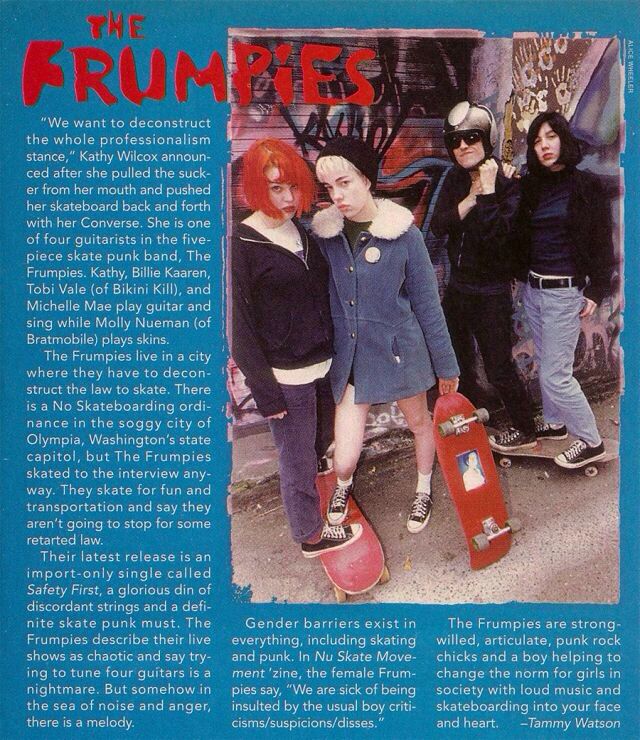
Photo: example of a Riot Grrrl band, The Frumpies being featured in Thrasher (July 1994).
In contrast, a magazine like TransWorld (1983-2019) was mostly scrubbed of any pornographic material and tame in comparison, but they were worse than Thrasher and Big Brother magazine combined for their barebones acknowledgment of female skaters, which is surprising and incredibly disappointing since the magazine was co-owned by Peggy Cozens. There were certainly individual men associated with TransWorld who advocated for women and squeezed in the occasional photo of a girl skating, but the enterprise overall was not aligned let alone pro-active. It remained a boys’ club and perpetuated that mentality.

Note: the only TransWorld cover that featured a female skater came about in November 2016 with Lizzie Armanto by Bart Jones.
I know many people have some intense opinions about the former Thrasher editor, Jake Phelps. I’m not interested in weighing-in considering that he is no longer alive. I get the sense he had his personal demons to contend with. But, so far, I’m seeing some significant changes in how Thrasher is operating today under the guidance of Burnett. He’s been playing a bit of catch-up, with interviews of legends like Alexis Sablone, Marisa Dal Santo and Elissa Steamer, but I don’t mind!
I like to go through each issue with colourful post-it notes to flag the photos of female and non-binary skaters, the advertisements they appear in, the articles about their roadtrips and events like Wheels of Fortune hosted by Skate Like a Girl.
And I appreciate how Thrasher online is a great source for videos and news featuring diverse skaters, their signature boards, and accomplishments. It’s encouraging and while the magazine pages are still dominated by men, I don’t feel completely alienated by it. I like how there’s now intentional questions directed at the male pros asking them point blank who their favourite female skaters are! Even Nyjah Huston gave a tip of his hat to Elissa Steamer, Vanessa Torres, Rayssa Leal, Funa Nakayama and Fabiana Delfino (May 2025 p.87), as opposed to his negative statements in 2013, which he apologized for.
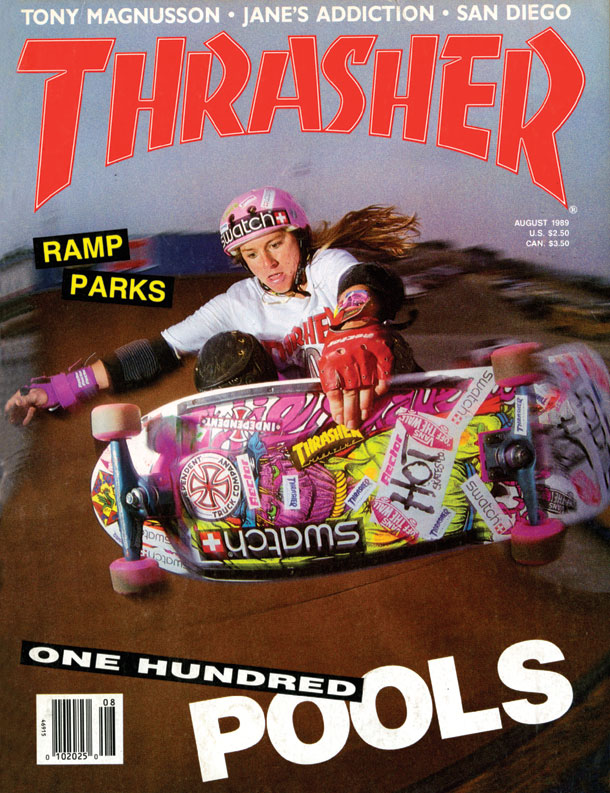


Plus, if I made a graph showing the frequency of female skaters on the cover of Thrasher (which was less than one a decade… Cara-beth Burnside 1989, Jaime Reyes 1994, no one in the early 2000s, Lizzie Armanto 2017) you’ll see a significant uptake after 2020. In fact, there’s been six in under a five-year window (including the first woman of colour: Samarria Brevard), so hopefully that trajectory continues to evolve and improve. I’ve also noted that in Burnett’s early days on staff with Thrasher as a photographer and columnist, he was behind several key articles, including early interviews with Elissa Steamer.
Perhaps I’ve been swayed partly because in early February, Burnett called me up for a chat and I really enjoyed talking with him. And now there’s a two-page interview about this project in the May 2025 issue of Thrasher! Michael even sent me a box with some Thrasher gear and copies of the mag. It’s all really weird and wonderful. I am not a talented skater and never imagined that I would be acknowledged in such a way, let alone as a 47-year-old librarian while living in a town that’s boat access only, light years away from the California core scene. Ahhhh!


I’m grateful to Burnett and have enjoyed the appreciation on social media about the article, but I am under no illusion that I would ever write for Thrasher. Instead, I’m now part of the crew at Closer Skateboarding magazine edited by Jaime Owens, and it’s been a privilege so far. Jaime reached out last fall to see if would be interested in offering a regular column that focused on women’s skateboarding history. The magazine itself has a different vibe. The paper is heavy and thick and is published quarterly. The essays are lengthy and reflective. It reminds me of The Surfer’s Journal. I also get a sense that the readership is older, and they want something of substance and even appreciate a bit of nostalgia.
My goal with the column isn’t to duplicate a bio from this site, but rather to create some nuance and be present in the essay, sharing how the connection with a female skater unfolded and weave in their story to the greater skateboard community. For issue ten I celebrated Cyndy Pendergast and my next round will be Kim Adrian!


With the political upheaval in the United States, I’m feeling more convicted in my belief that history and representation matters. It’s obvious that anyone who isn’t a white, cis male billionaire like Trump and Musk is under attack, especially women, 2SLGBTQ+ people, anyone of colour, especially those living in poverty. It’s insane. And the fact that federal institutions are bending to his will to eliminate and erase diverse histories is heart-breaking. Although, I would like to believe (and I know for a fact) that there are rogue individuals preserving and combatting these discriminatory efforts, opposing fascism and operating out of love, not hate.
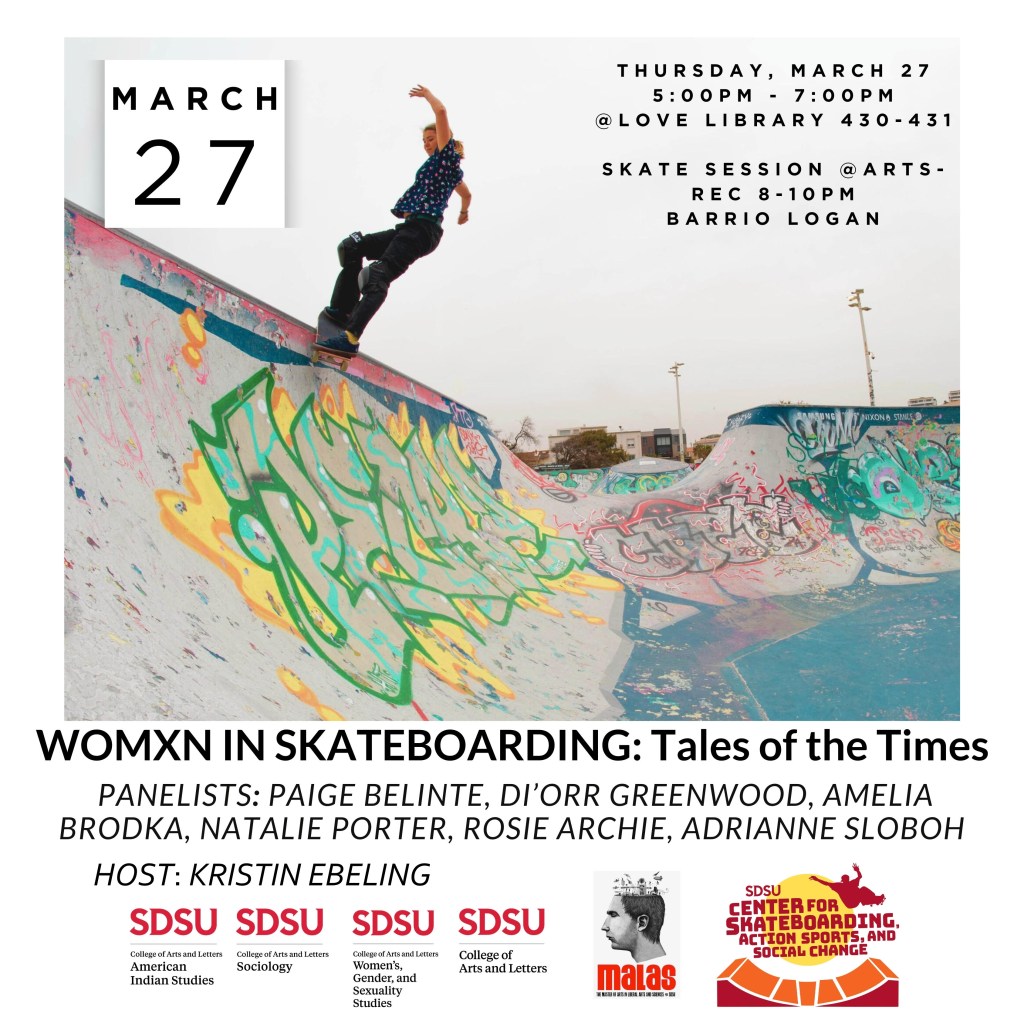
It was a joy to be able to speak to some of these concerns via Zoom for a women’s history month panel with the SDSU Center for Skateboarding, Action, Sports, and Social Change last week alongside Rose Archie, Adrianne Sloboh, Amelia Brodka, Di’Orr Greenwood and Paige Belinte, hosted and moderated by Kristin Ebeling. What a dream team!
So far, 2025 has been a real rollercoaster of emotion and I know many people are suffering from this onslaught of distorted power and the funding of violent political leaders enacting the most extreme cruelties (and that’s both overseas and close to home).
It’s hard not to become paralyzed and overwhelmed with fear, shame and hopelessness. Instead, every day we have to step up and deliver kindness, compassion and use whatever skillset we have to make this world a better place. A special shout-out to my friends working for the Smithsonian Museum (please see: The Guardian – “‘It reminds you of a fascist state’: Smithsonian Institution braces for Trump rewrite of US history” (March 30, 2025).
Be defiant, be rogue, and preserve the truth, in all its complexities and diversity, through any means possible!
[Update: a virtual edition of the interview became available on Thrasher on June 2, 2025]

 Womxn Skateboard History