
In the late 1990s and early 2000s, Jessie Van Roechoudt was someone to look up to and revere if you were Canadian, especially if you were a female skater. Beyond being talented on a skateboard, Jessie was a photographer, creative writer, well-traveled, and always articulate in her views. She emphasized the importance of inclusion and acceptance in skateboarding, in contrast to the often-inane dialogue around authenticity as it pertained to being of a particular gender during these decades when the mainstream skate industry struggled to openly embrace diversity.

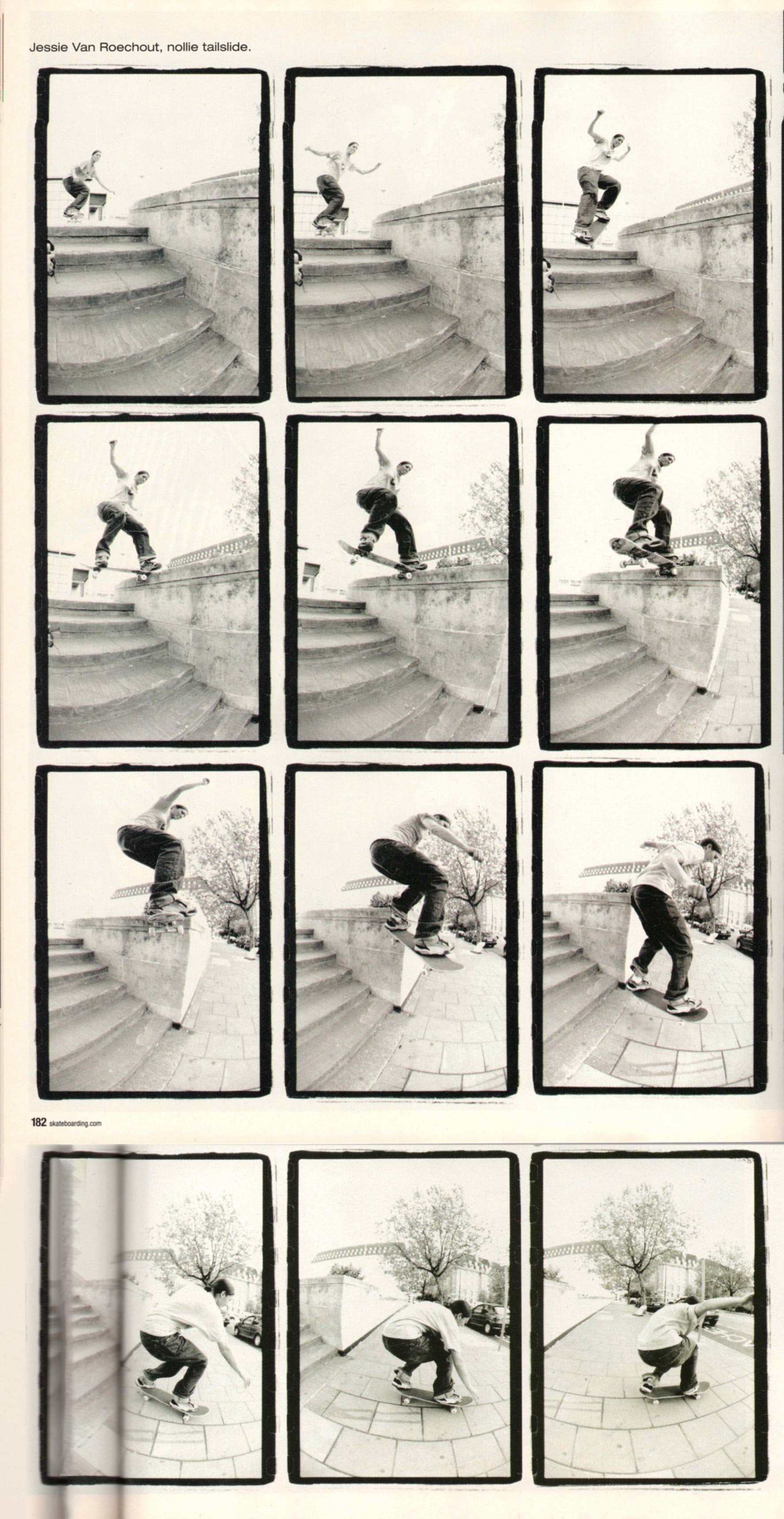
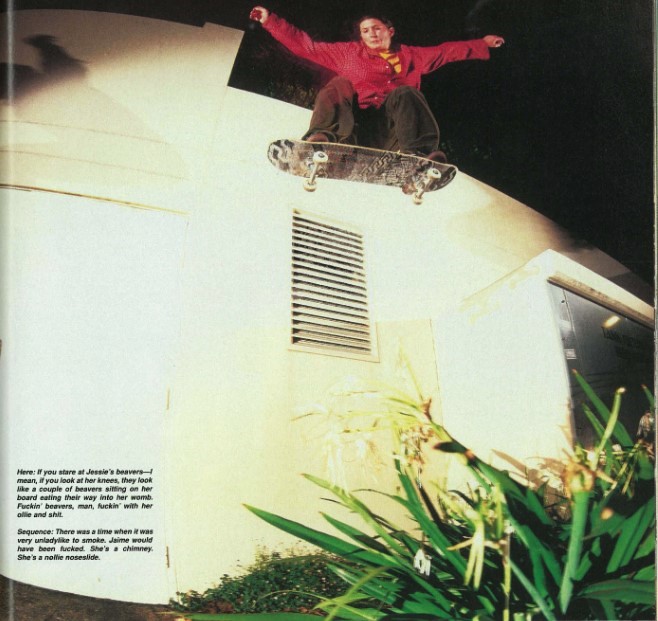
Photos: a portrait of Jessie on the left from 1998 by Christy Bush and then her nollie tailslide sequence that appeared in the January 2002 issue of TransWorld by Chris Ortiz.
There’s a rich history of Canadian women in skateboarding, but even though legends like Pam Judge (G&S amateur) in the 70s and Sophie Bourgeois (Powell Peralta amateur) in the 80s were representing, Jessie was the first female Canadian professional with a signature board.
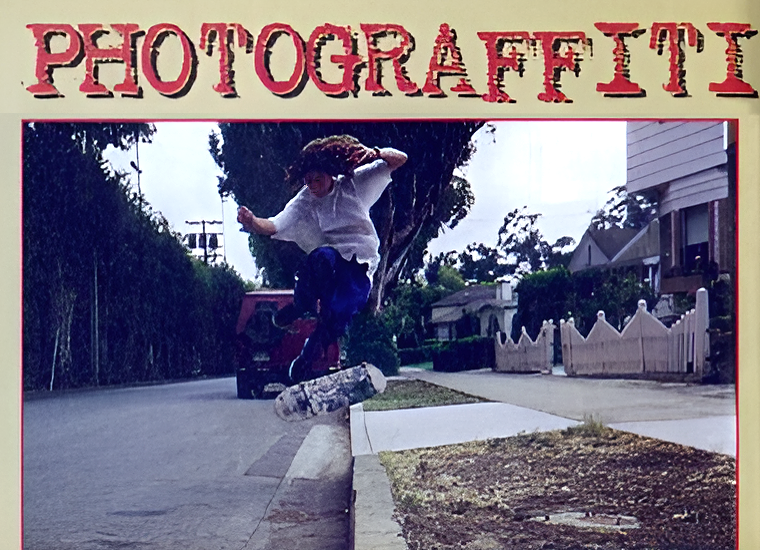
Jessie was sponsored by Rookie, Billabong, Bones wheels and bearings, Venture trucks, Vans, FTC, First Division wheels, and Dakine and appeared in the pages of magazines like SLAP, Push, Check it Out, Limited, Skateboarder, Heckler, SG, COLOR, SBC, TransWorld, and even Thrasher (although they mistook her for a guy in the Photograffiti section in the December 1993 issue, taken by her sister, Madeleine).
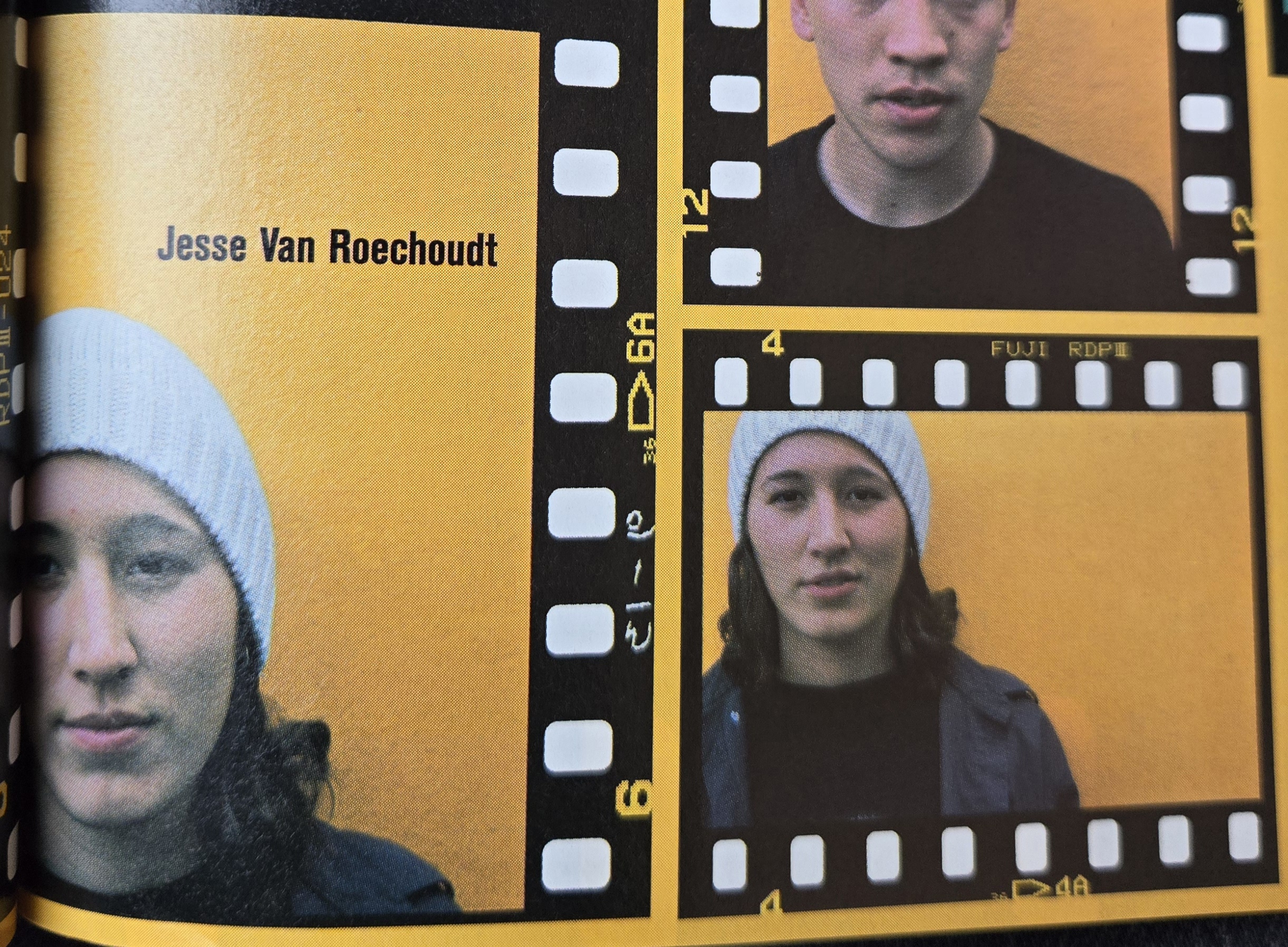
Jessie began skating in Winfield, BC (north of Kelowna) after finding a banana board in a garbage dump around age 7, although without any direction, her experience was limited to rolling around on the backyard deck. At age 10 in 1988 since she scored straight A’s on her report card, Jessie was rewarded with a skateboard purchased at Go Skate skateshop in Santa Cruz during a trip with her mom who was a flight attendant. Jessie chose a Tony Hawk mini, Bones Brigade era in fluorescent pink with black rails, and in a podcast with Quell she said she wished she still owned the board. There was also a local summer camp that included a demonstration from local “pros” who showed the kids a few basics, and that’s when Jessie learned to ollie and witnessed a kickflip.

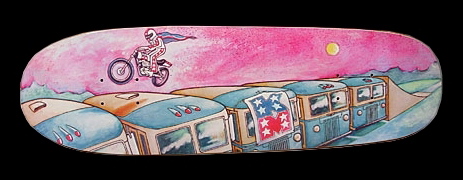
It was in high school, around age 14 in 1992 / 93, that Jessie actively pursued skateboarding. In Slap, Jessie described getting hassled by the local skaters when they heard rumour that she had a board, and it became a kind of joke to them. Knowing that her current set-up was dated, Jessie decided to save up and mail-ordered a “Kris Markovich Everslick with Evel Knievel jumping over some cars on a motorbike. I took the board to school and started skating with the other skaters at lunch hour and just got really into skating. It was all I wanted to do” (Whiteley). Jessie would wake at the crack of dawn to practise flip tricks in her parents’ garage, lunch breaks, after school, whenever she had a spare moment. For a self-described tomboyish introvert, skateboarding became her number one.
By 1994, Jessie was keeping up with everyone hassling her and didn’t feel personally targeted, recognizing that giving off vibes was the attitude of the day. Jessie was aware of a few other girls who skated in her high school but they were older than her and from other towns, and she lived a half hour away from any legitimate skate spot. Along with her friend, Dan, “we would just do flatground tricks in the dirt until I got my driver’s license” (Whiteley). With the ability to drive, Jessie was able to start accessing better spots and skateparks, beyond the sketchy ramps that she built with Dan.
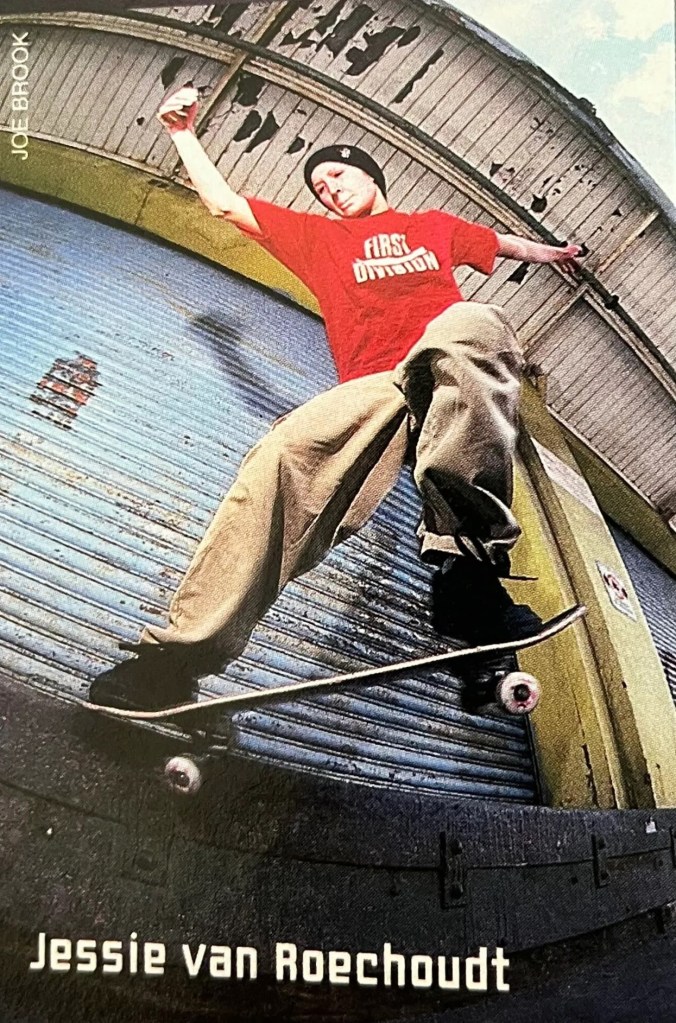
Photo: Skateboarder Summer 1998, Joe Brook.
In her profile for “Skatelife” on Skateboard.com with Patrick O’Dell, Jessie said that her most memorable skateboarding experience was “skating on these banana boards in the rain at a high school dance. The dance was a 70’s theme and they had these old skateboards there as decoration. My friends and I weren’t into the dance so we just took the boards and skated in the school parking lot.” And when asked if her parents were supportive, she said, “My mother always supported me, but sort of implied that skating was something that I needed to grow out of. I think she has come to terms with the fact that it is not going away any time soon. My dad was quite against me skating at first, but now he is totally supportive of it” (O’Dell).
In an article “Jessie Van Roechoudt: Pro Skater” by Rachel Swan, which appeared in the San Francisco Bay Guardian, it was explained that, while skating a park in 1996 a skate team from SF came through her town and the team manager noticed Jessie’s ability and handed her his business card. The next time she was in San Francisco, Jessie followed through and started to receive flow from this company through her local skateshop.
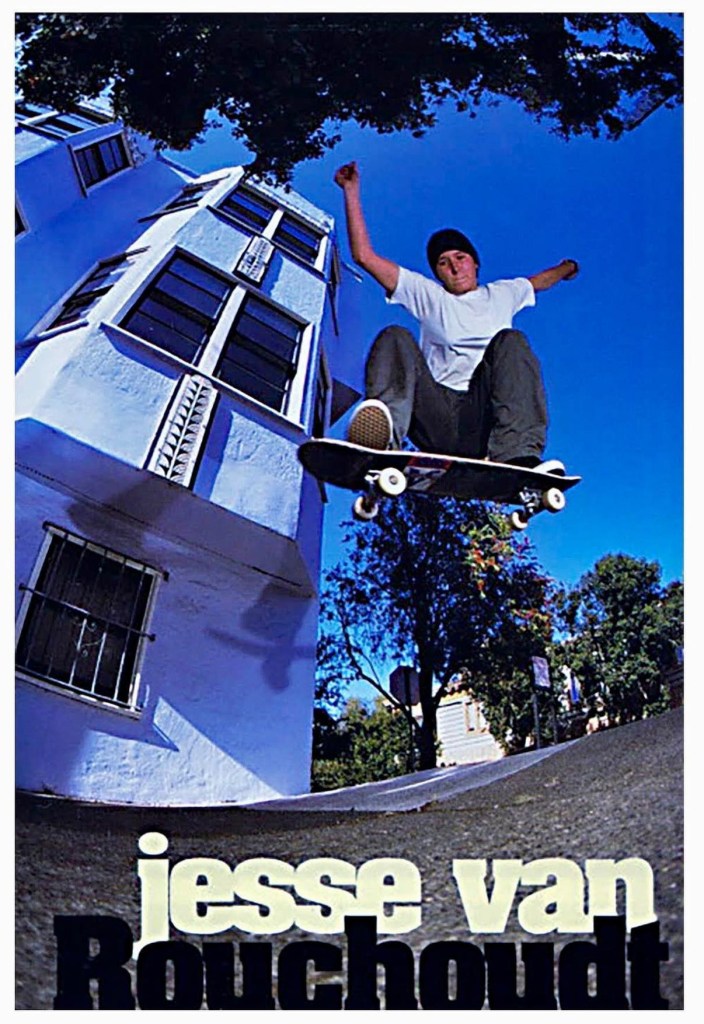
In 1997, a German magazine called Limited published a photo of Jessie by Gerhard Stochl.
Immediately after high school, Jessie headed to San Francisco knowing that it was the heart of skateboarding at that time. And after a brief stint at a Canadian university, Jessie decided to take her studies to SFSU thanks to a scholarship and immerse herself in the scene. She was sponsored by the legendary FTC Skateshop, and expressed gratitude to Kent Uyehara, remembering visiting the store when it had transitioned to Haight and Shrader streets, in its first location as a full skateshop (versus being a sporting goods store run by Kent’s parents). And, to Adrian Koenigsberg, Jessie reminisced about skating the green benches of Union Square, getting busted by the cops, and bombing hills with 100 skaters all scattering to the next spot or plaza on down to the waterfront.
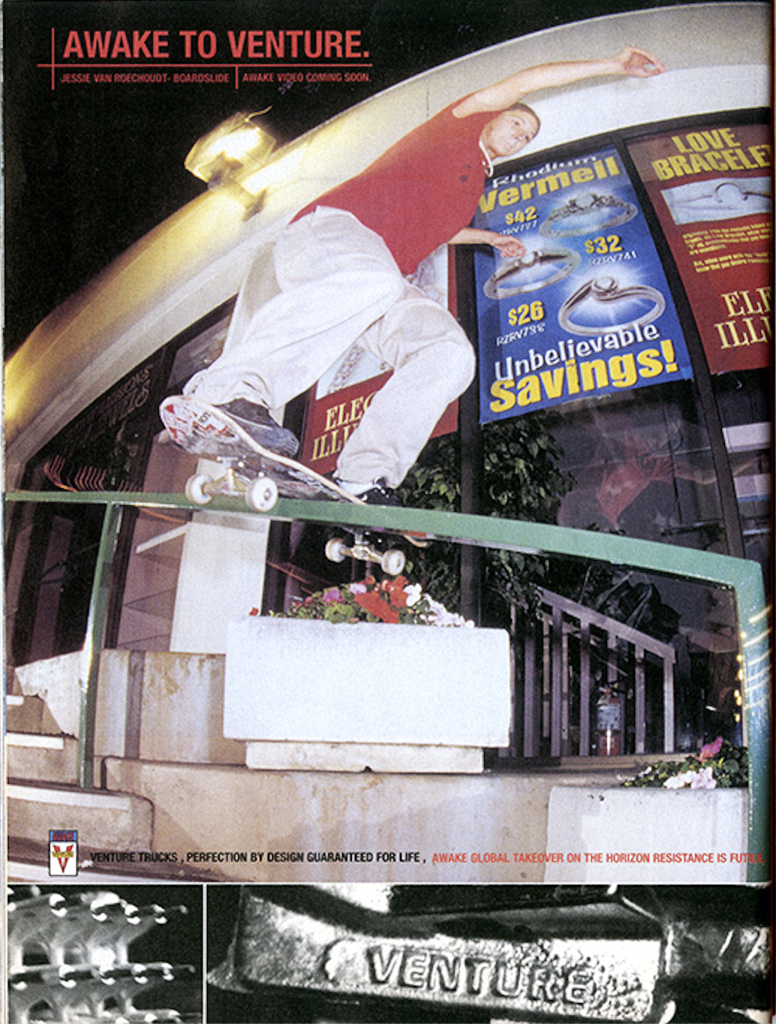
Photo: Venture ad that appeared in Thrasher November 2000 by Joe Brook
Jessie enjoyed being a YMCA skate camp counselor in Visalia along with fellow SF skater Alison Lee, whom she met at Union Square in the green benches era. And then, she connected with the female owners, Catharine Lyons and Elska von Hatzfeldt (Sandor) of the New York based company, Rookie at the ASR Trade Show in San Diego in 1996.
Jessie wrote a fantastic article about Rookie for Quell Skateboarding, which was published in Jenkem magazine (2021), reflecting on the impact this company had, not just for women, but for the skateboard industry as a whole. Jessie recalled how Catharine and Elska “saw me skating and gave me a business card with an old-fashioned landline number on it. They said if I was ever in NYC, I should give them a call… Then, through several random unlikely circumstances, I ended up calling them, which ended up being one of the best decisions that I’ve ever made.”
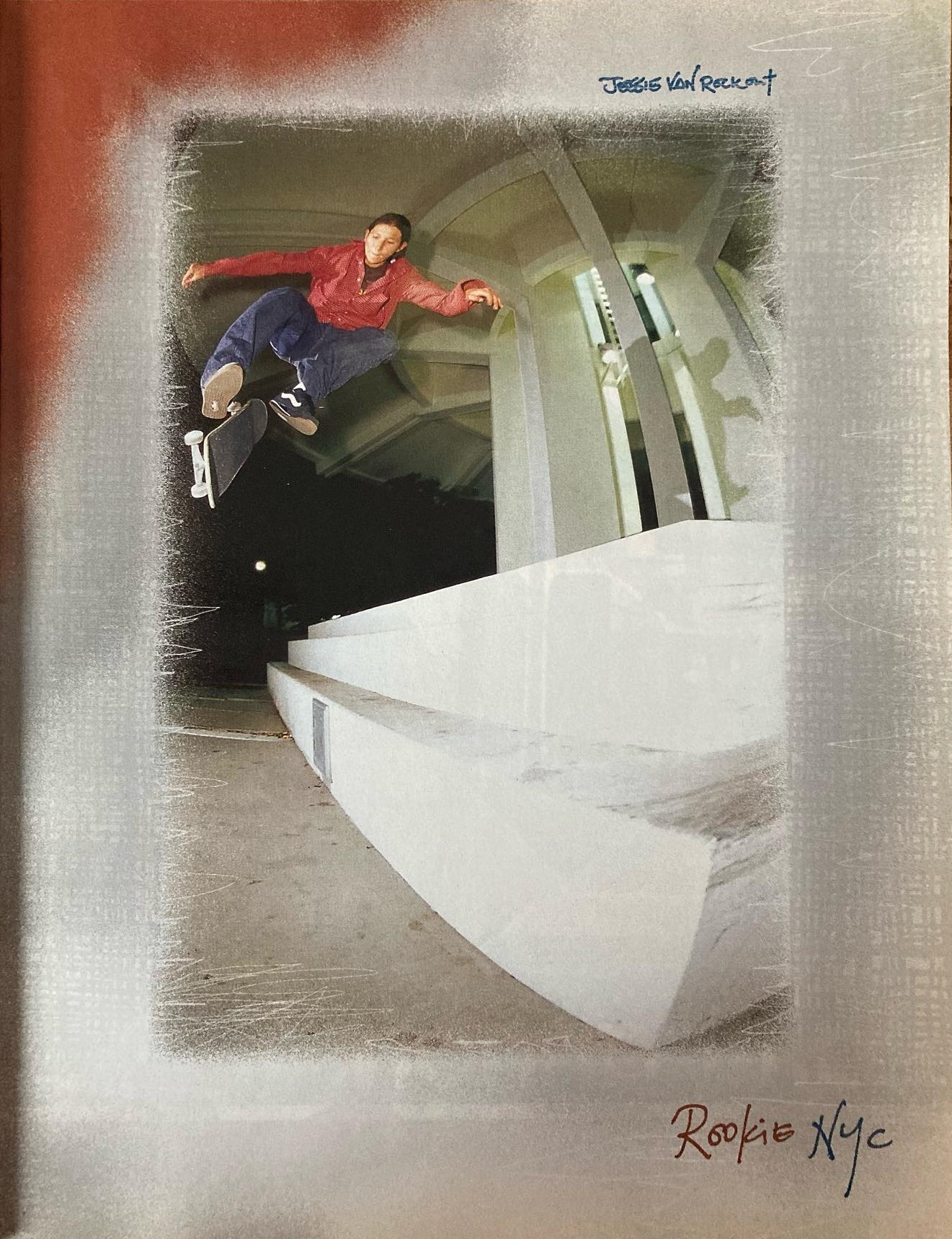
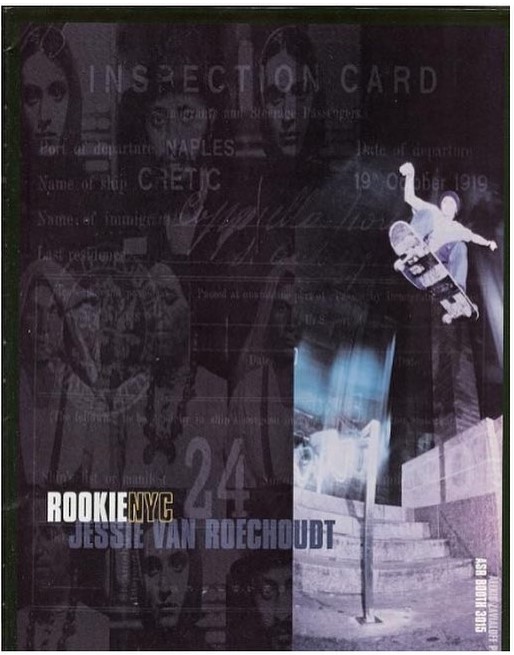
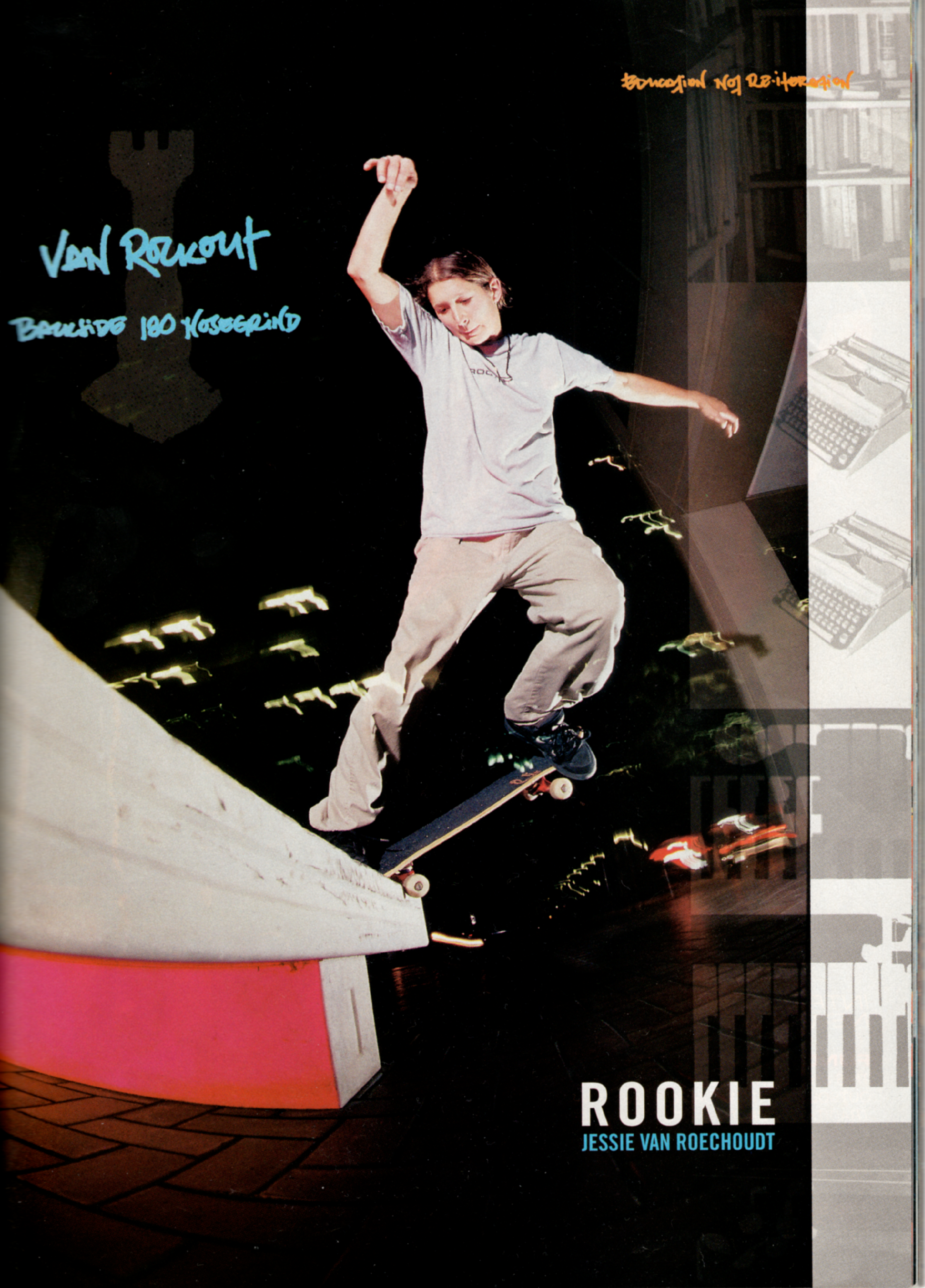
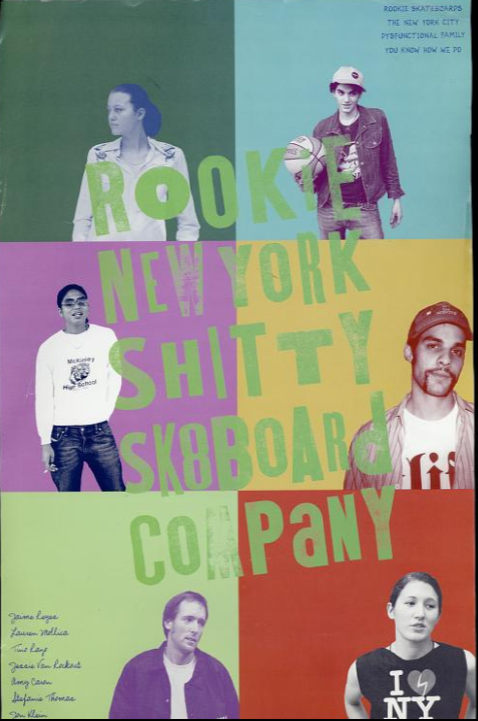

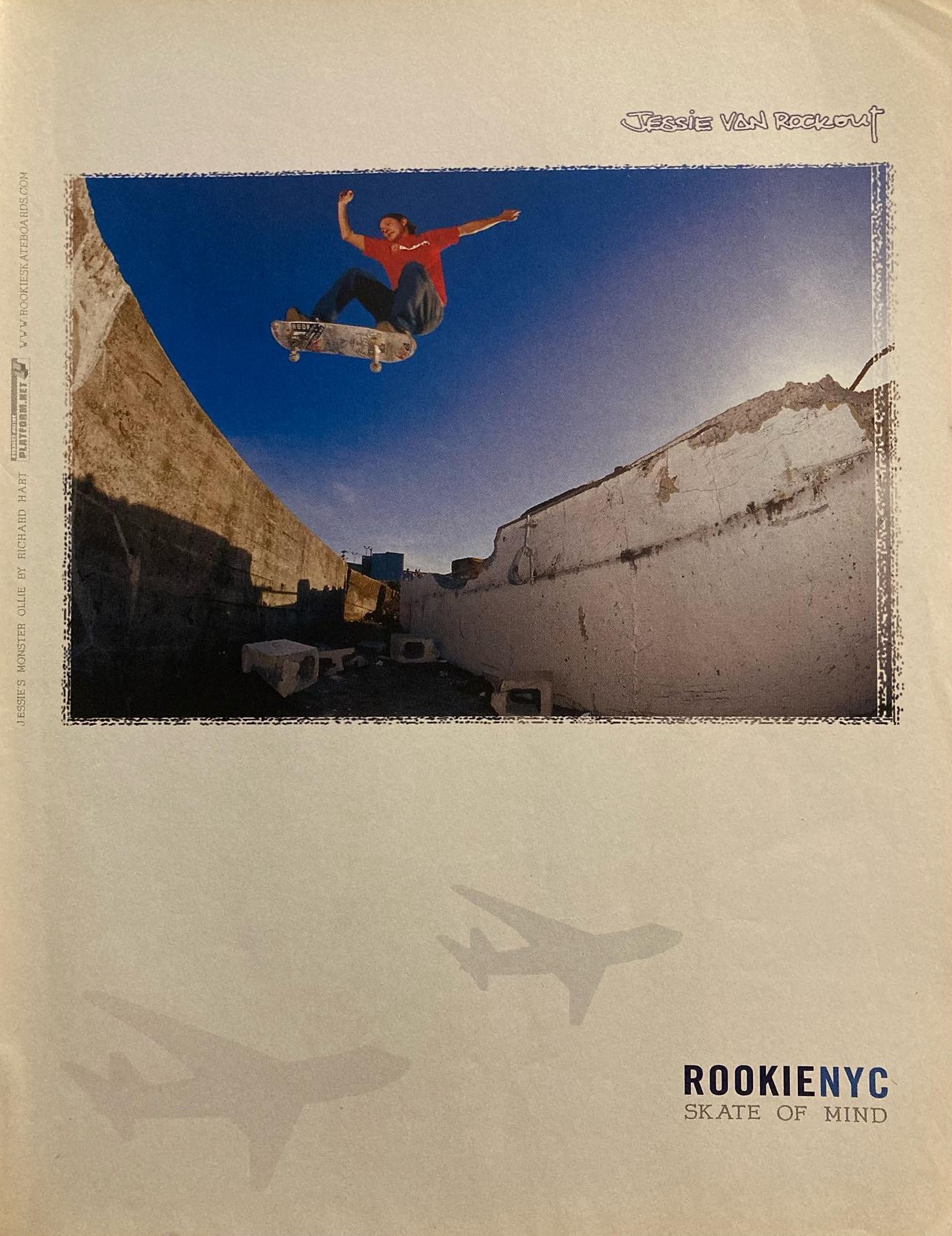

Rookie photos: Giovanni Reda, Joe Brook, Richard Hart.
The circumstance involved being on a cross-country roadtrip, ending up at JFK with a bunch of change in her pocket while in-line for airport security, and boldly deciding to use a payphone to call the number on the card, which happened to be the X-Large skateshop at the exact moment that Catharine was working! Jessie was then whisked into town by the A-train, introduced to the NYC skate scene, stayed with the Rookie team, and then officially recruited as a sponsored rider.
The photo below is the first photo that Jessie shot with the Rookie crew in NYC, when she joined the team, October 1996. It was published in Fabula and taken by Alexis Zavialoff:
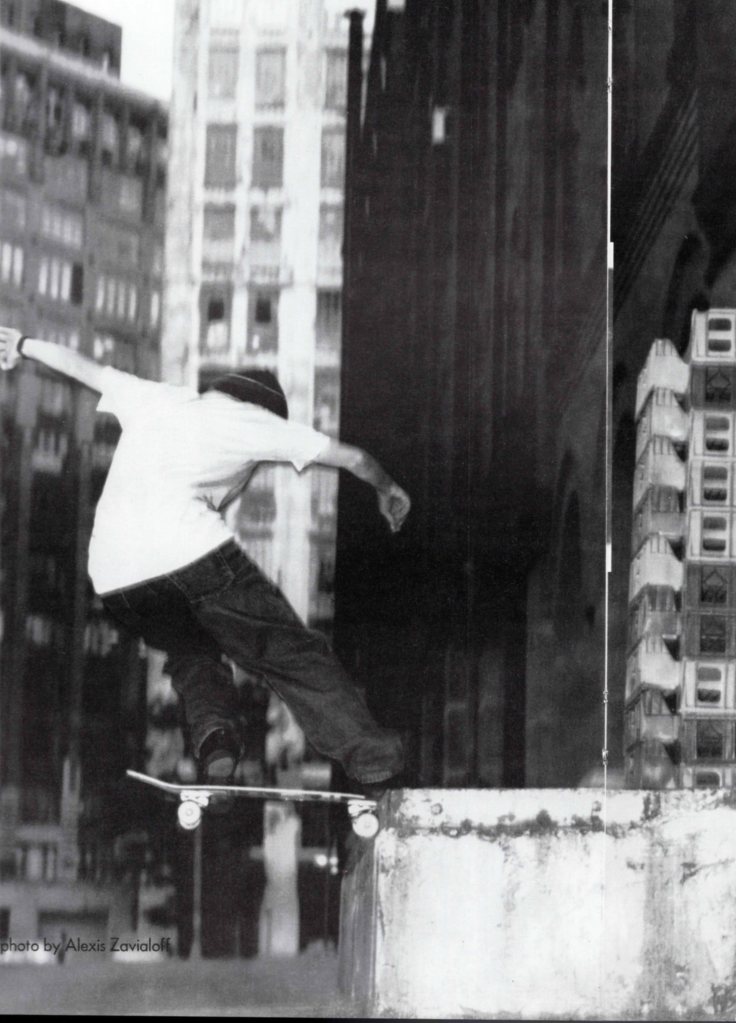
In her Quell Party interview, Jessie repeatedly stated that going with Rookie was hands-down the coolest thing she ever pursued and sang the praise of Catharine and Elska for their dedication, juggling multiple jobs to make their company dynamic, stylish and inclusive – way better than just a California juggernaut sending her products and a cheque in the mail. Rookie was memorable.
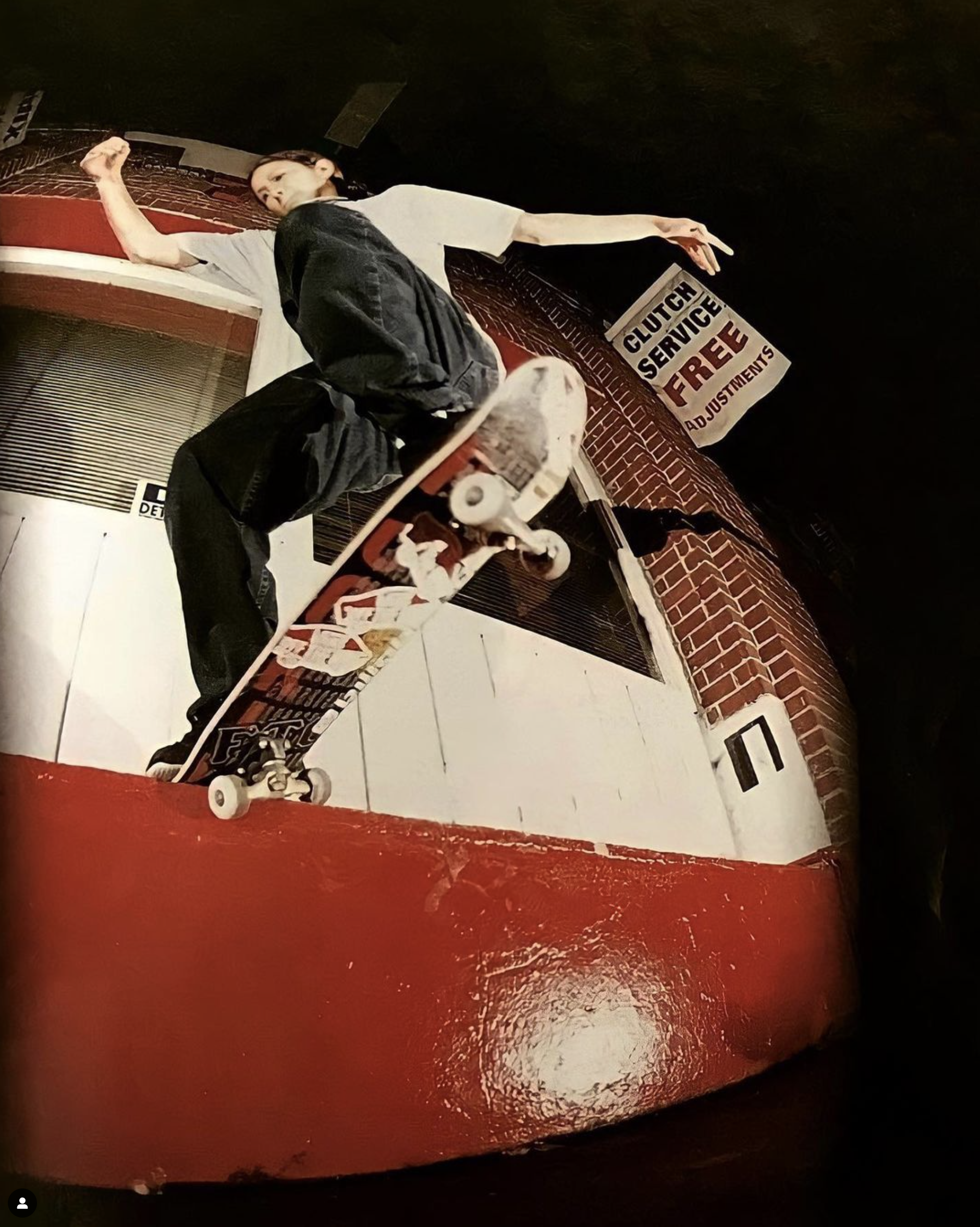


Photos by Richard Hart, as seen in Rookie ads.
Many of Jessie’s photos are taken at night because she preferred skating street when the “city is yours.” She said, “At four in the morning the city becomes your playground… You’re cruising the streets with the mist in your face, going over driveways and bumps. My friends and I bring out lights and a generator and rig it up” (Swan).
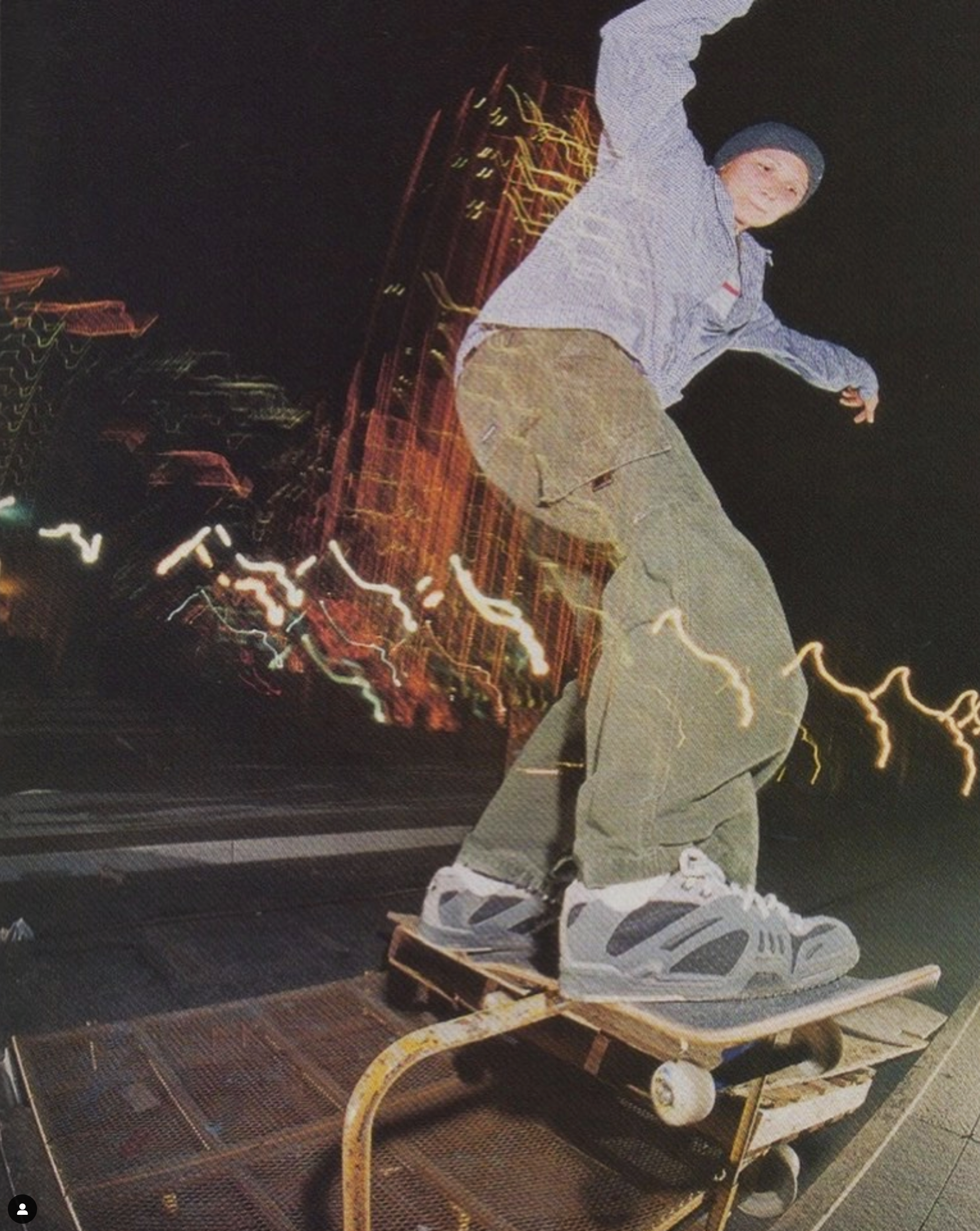
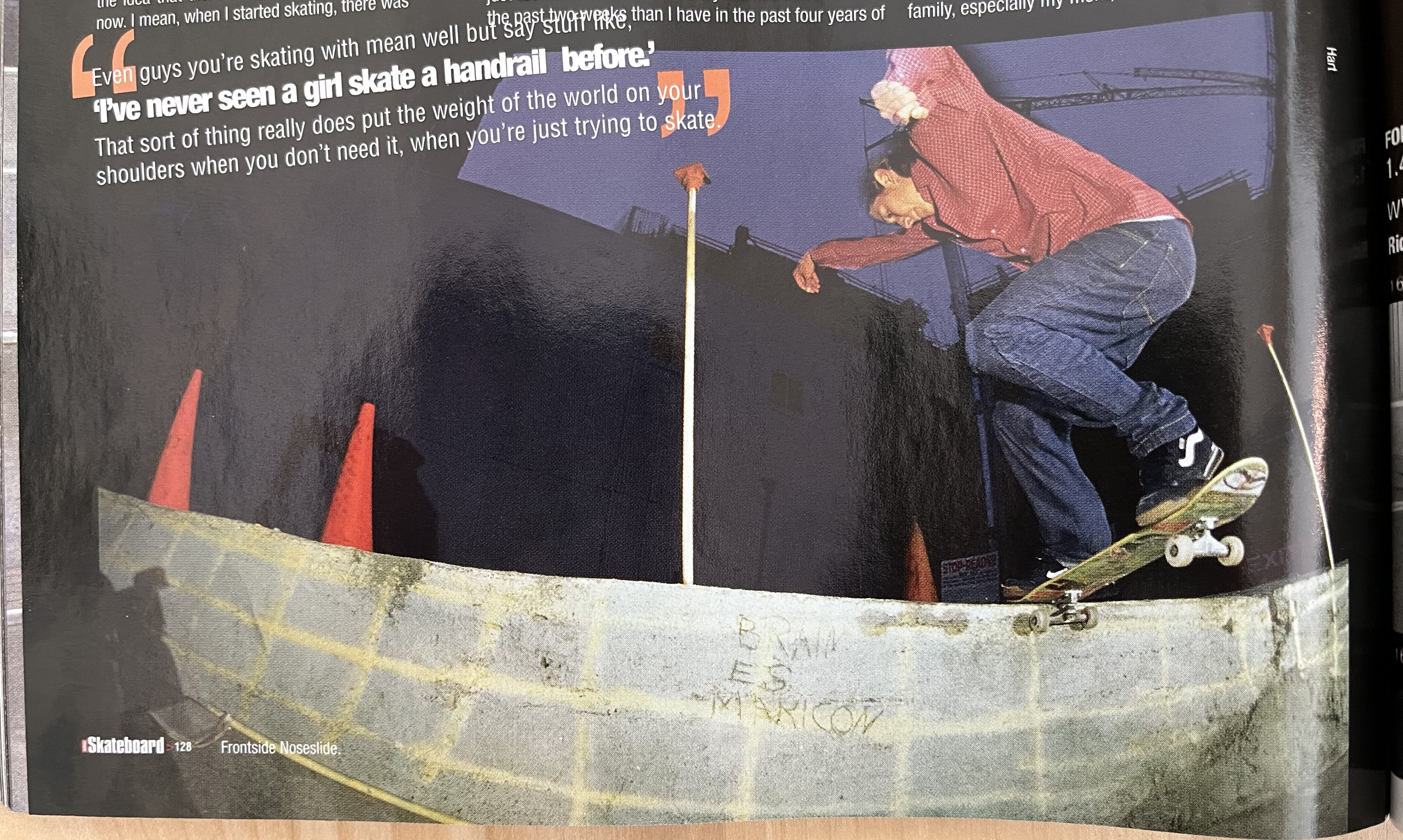
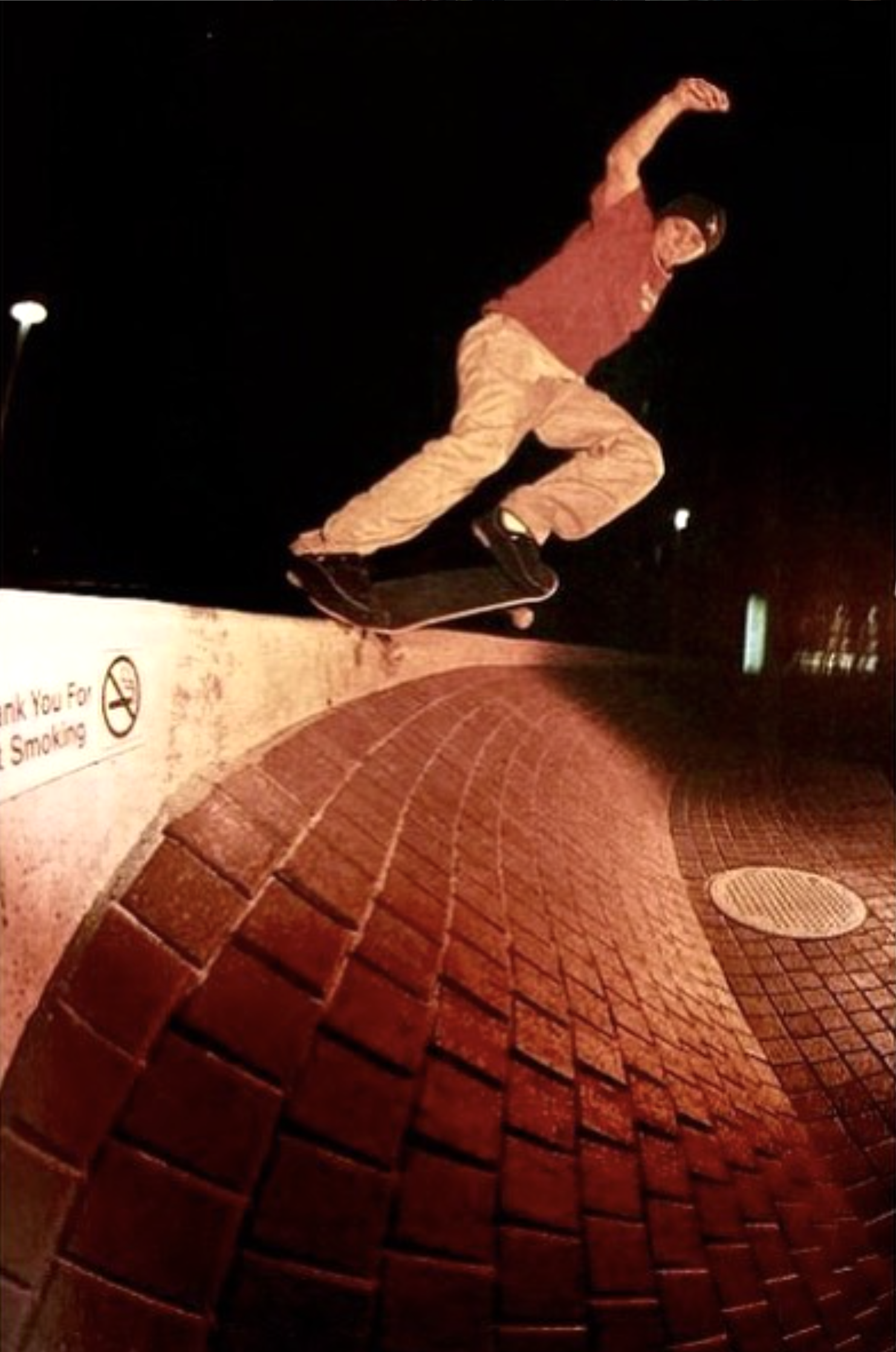
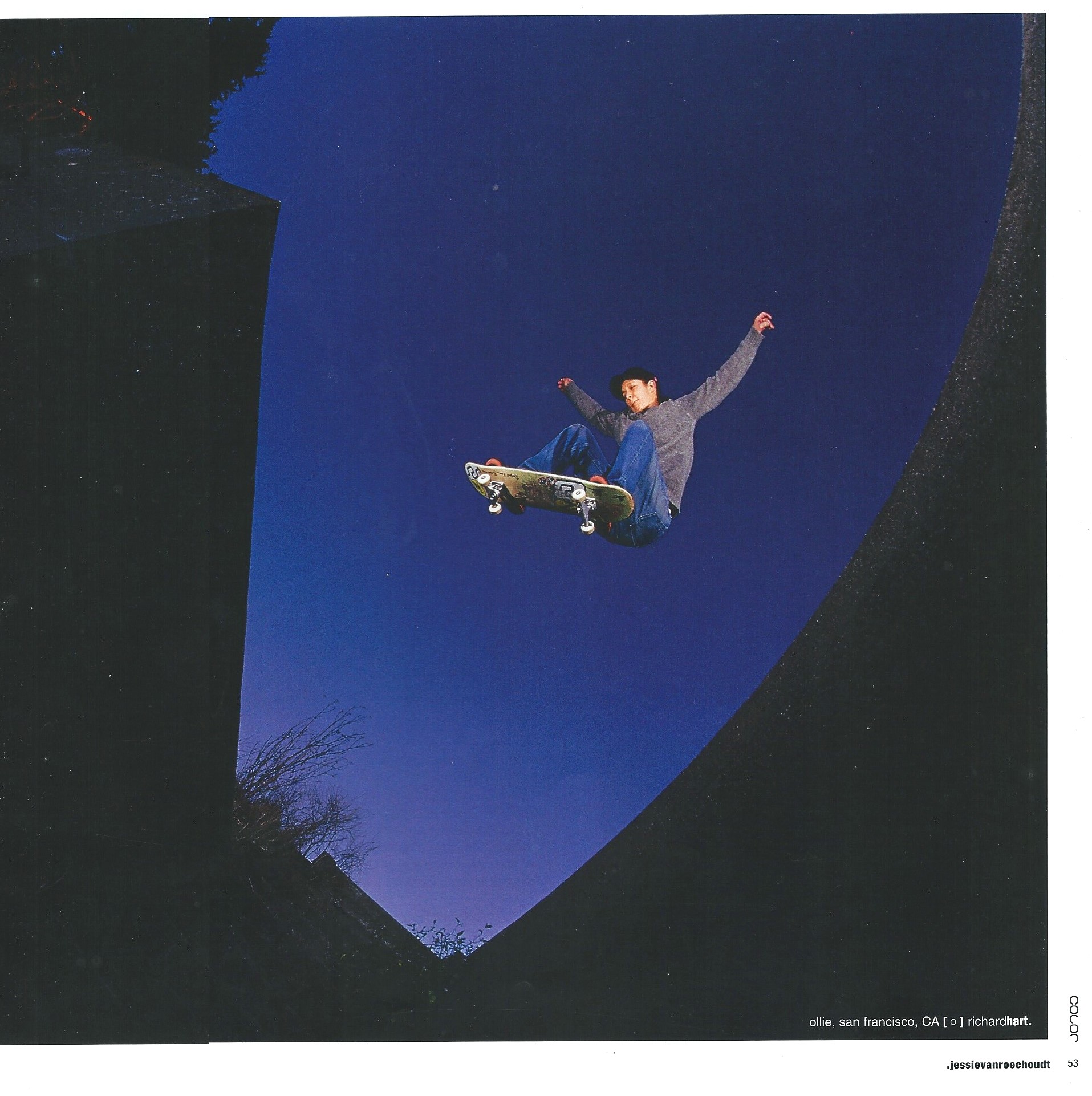
Photos at night by Richard Hart (COLOR mag 2002), Joe Brook (Slap 2001), Eric Guizzetti.
Jessie was also developing her talent as a photographer by picking the brains of her friends on these photo shoots. In the Spring 2003 issue of Push magazine (a Canadian, female-focused skateboard magazine by Denise Williams), Jessie was interviewed and said that, “The reason I got into photography was when I would shoot photos with skate photographers and I’d ask them, ‘how did this work, how did that work?’ So they taught me how to use a camera.” Jessie acknowledged Joe Brook, as someone who was especially encouraging.
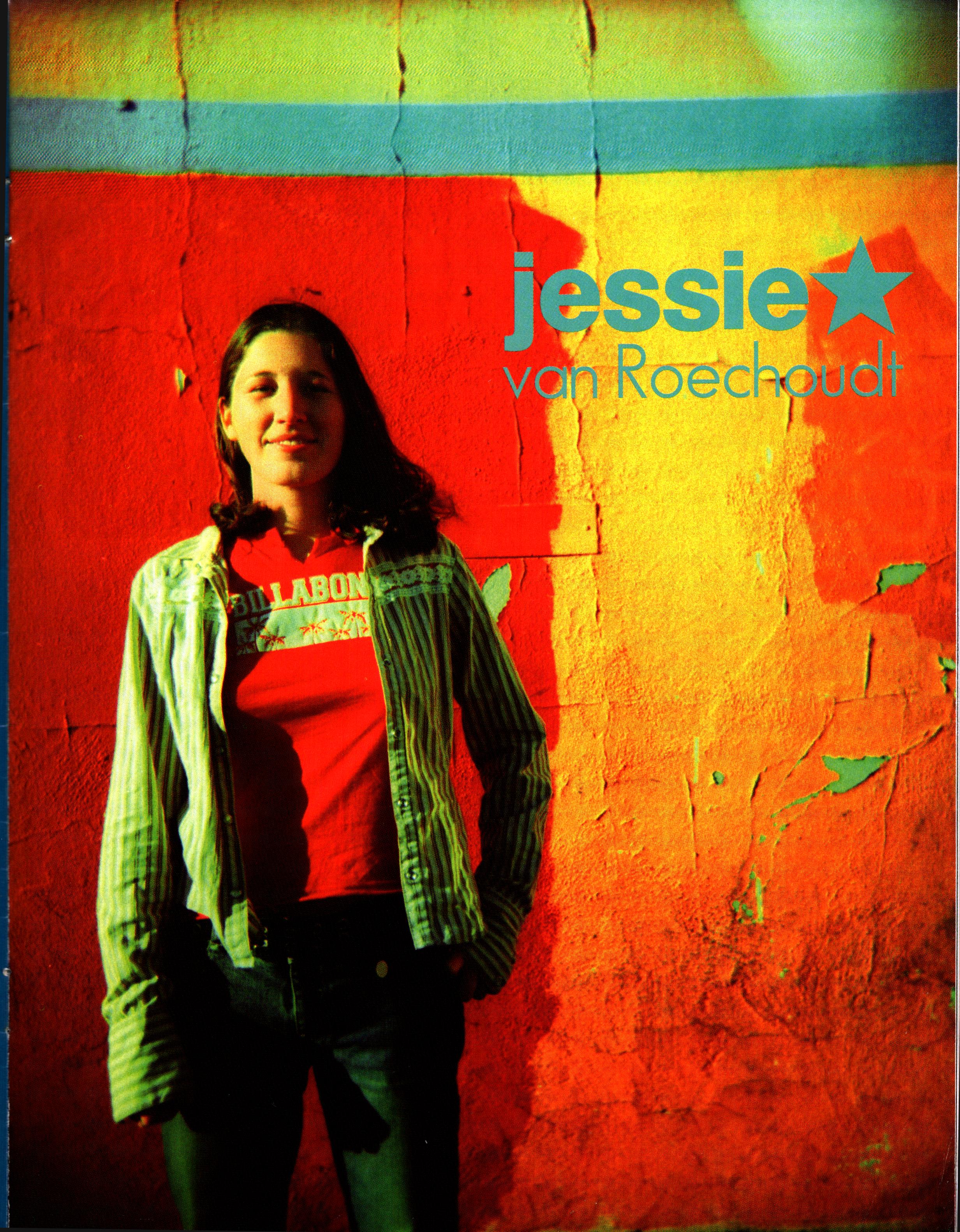
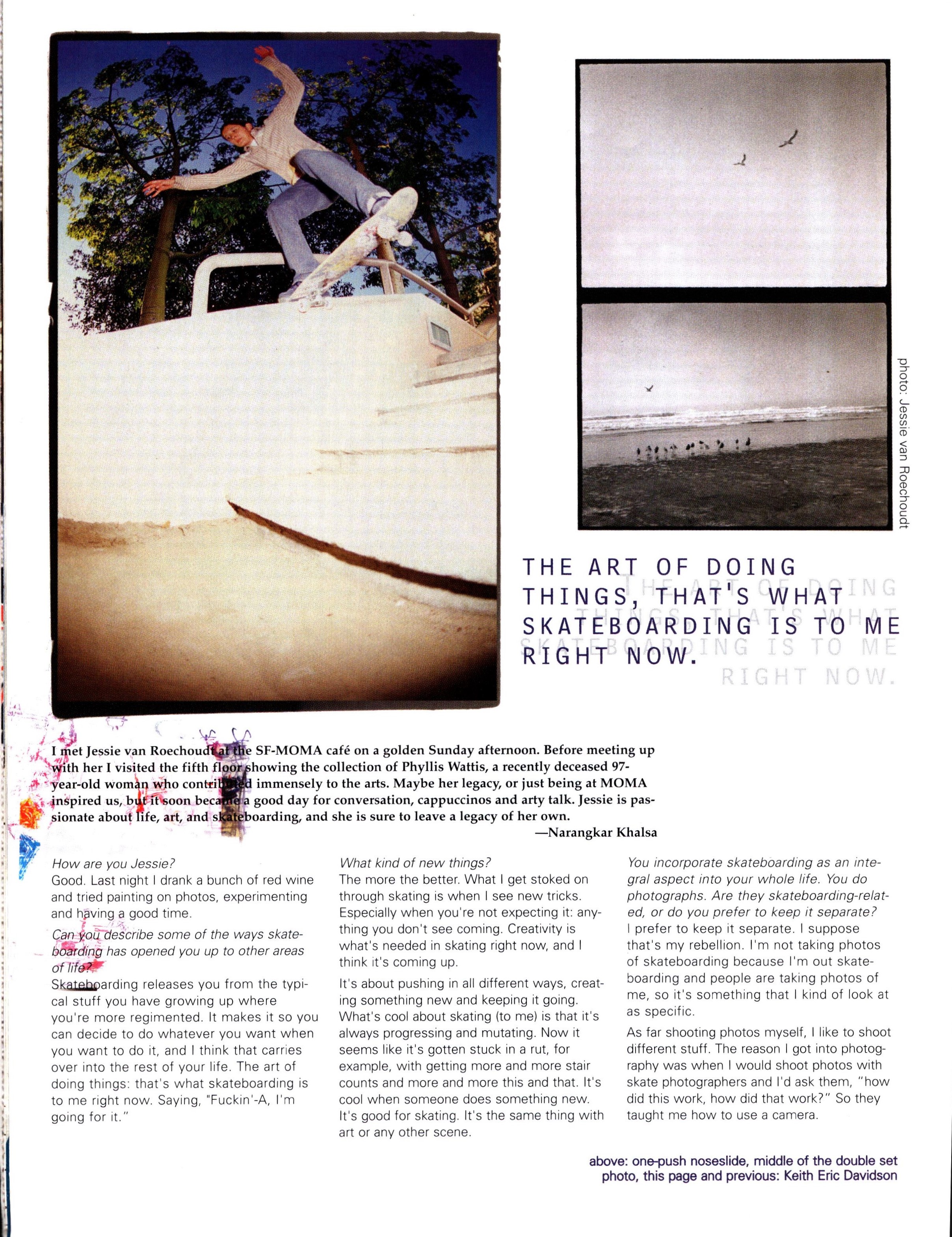
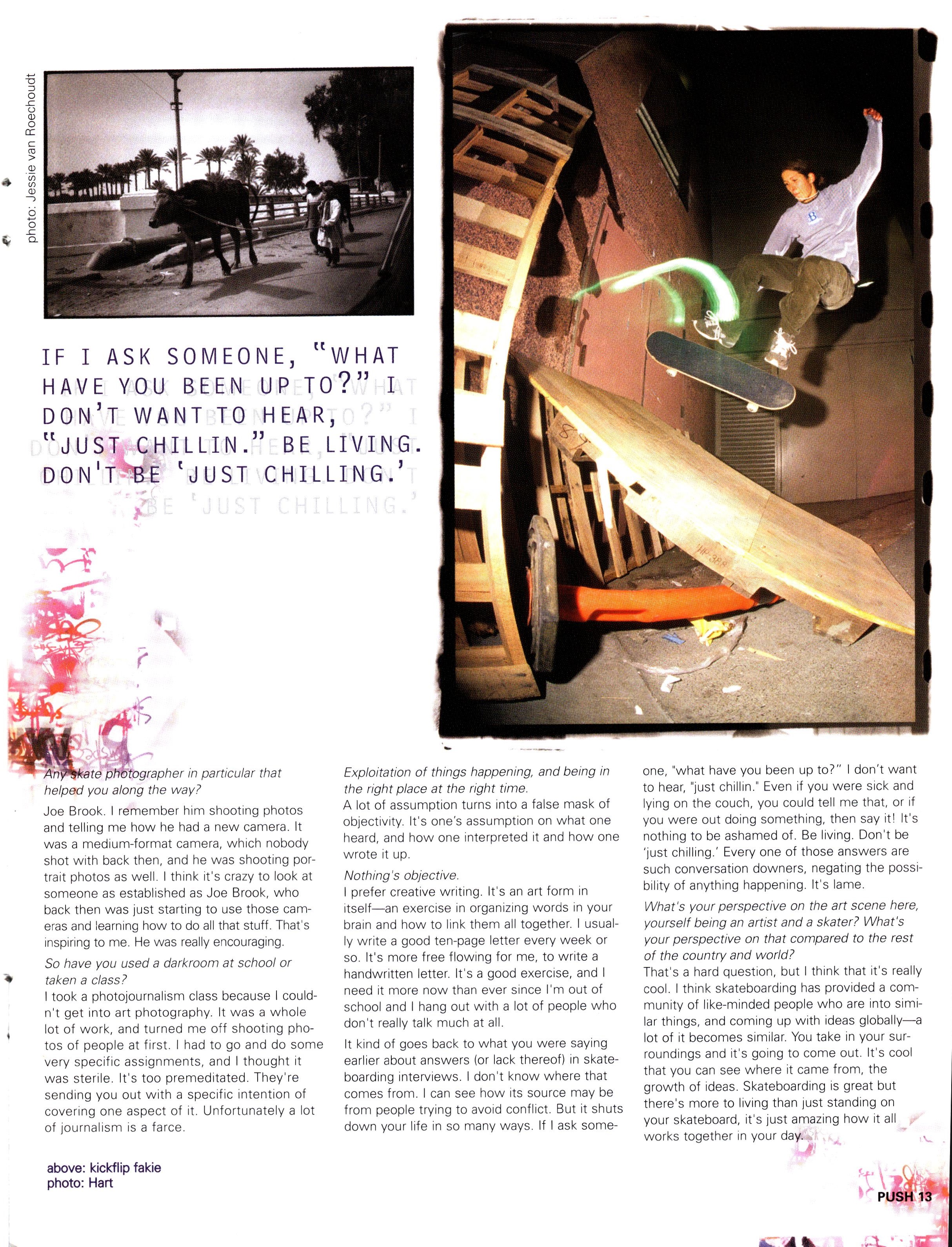
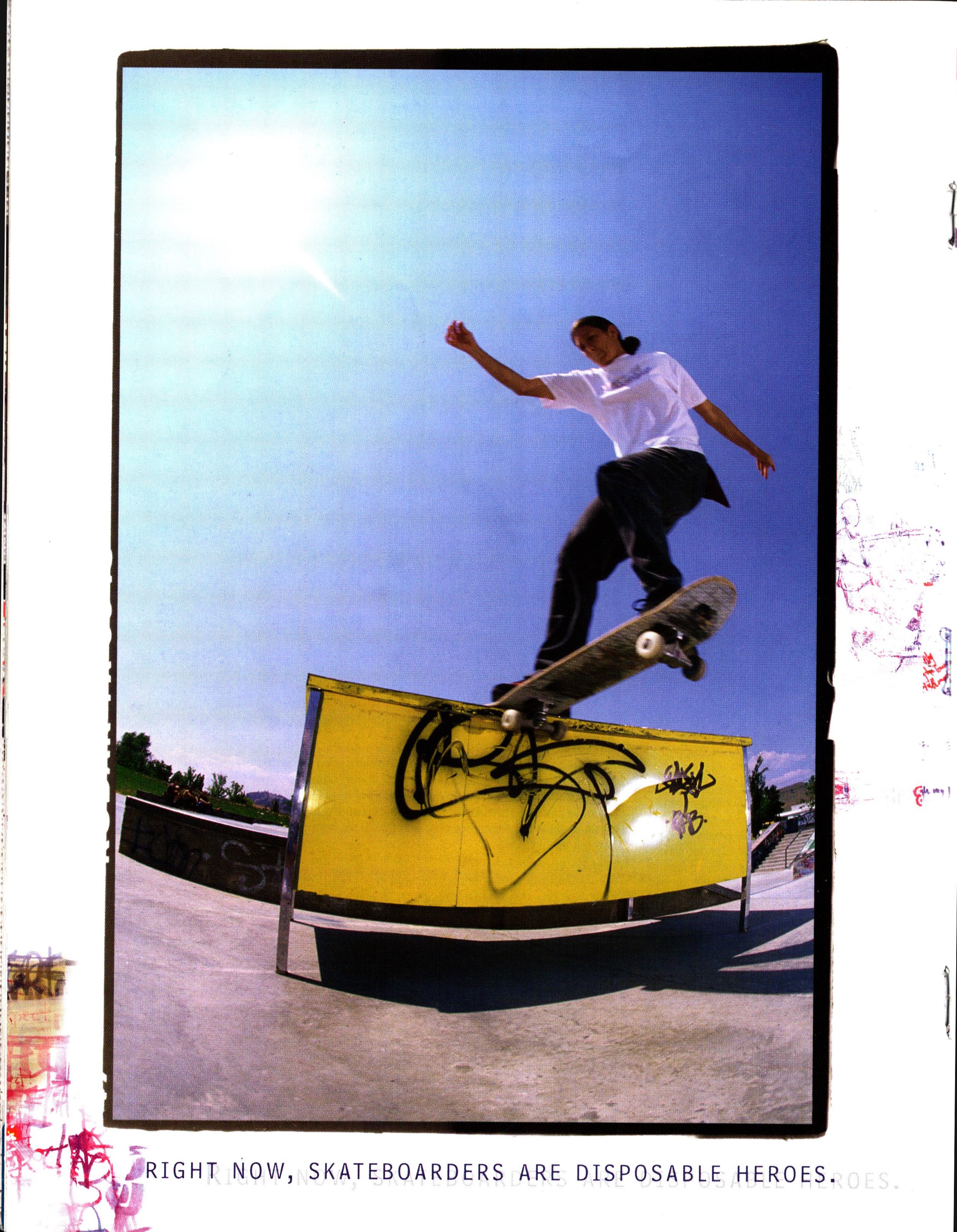
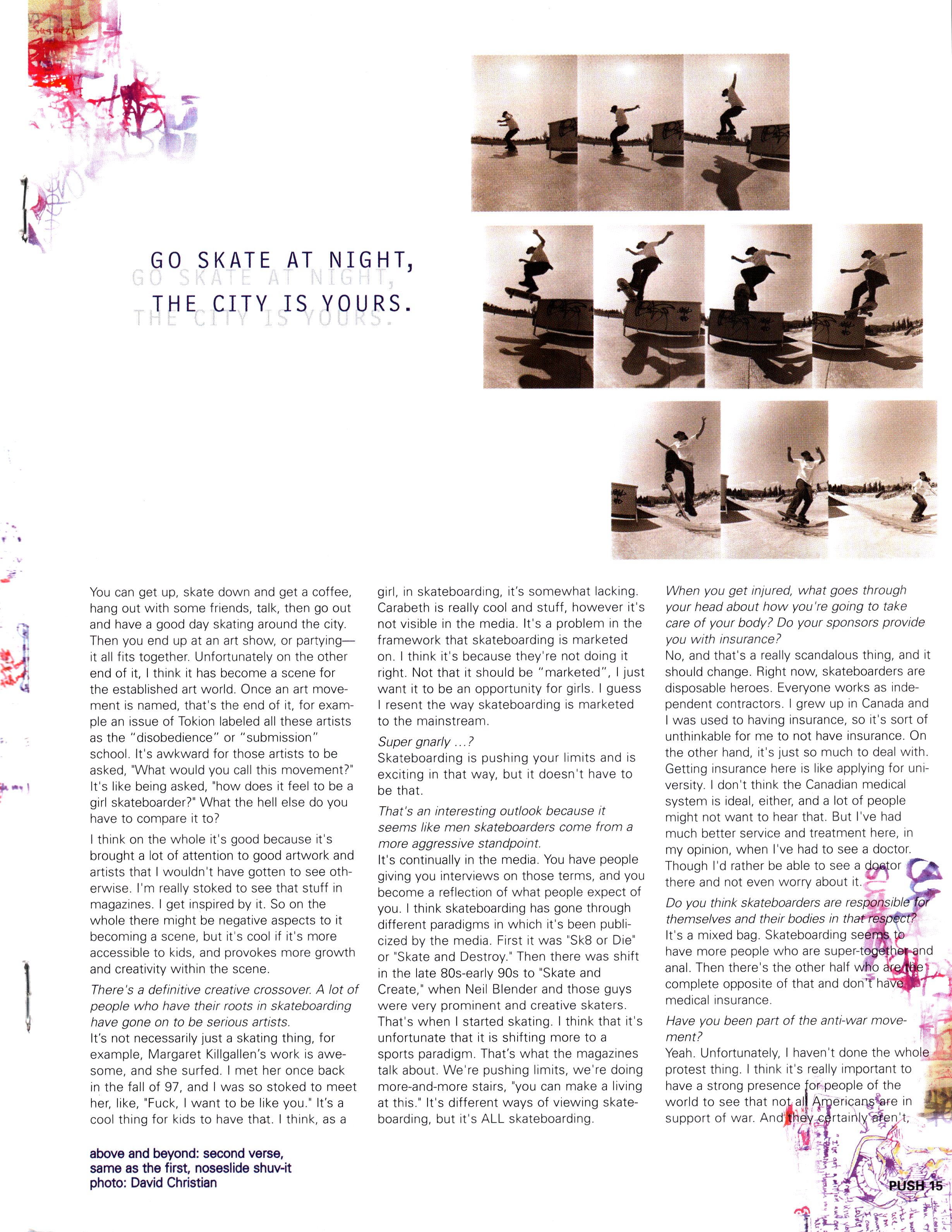
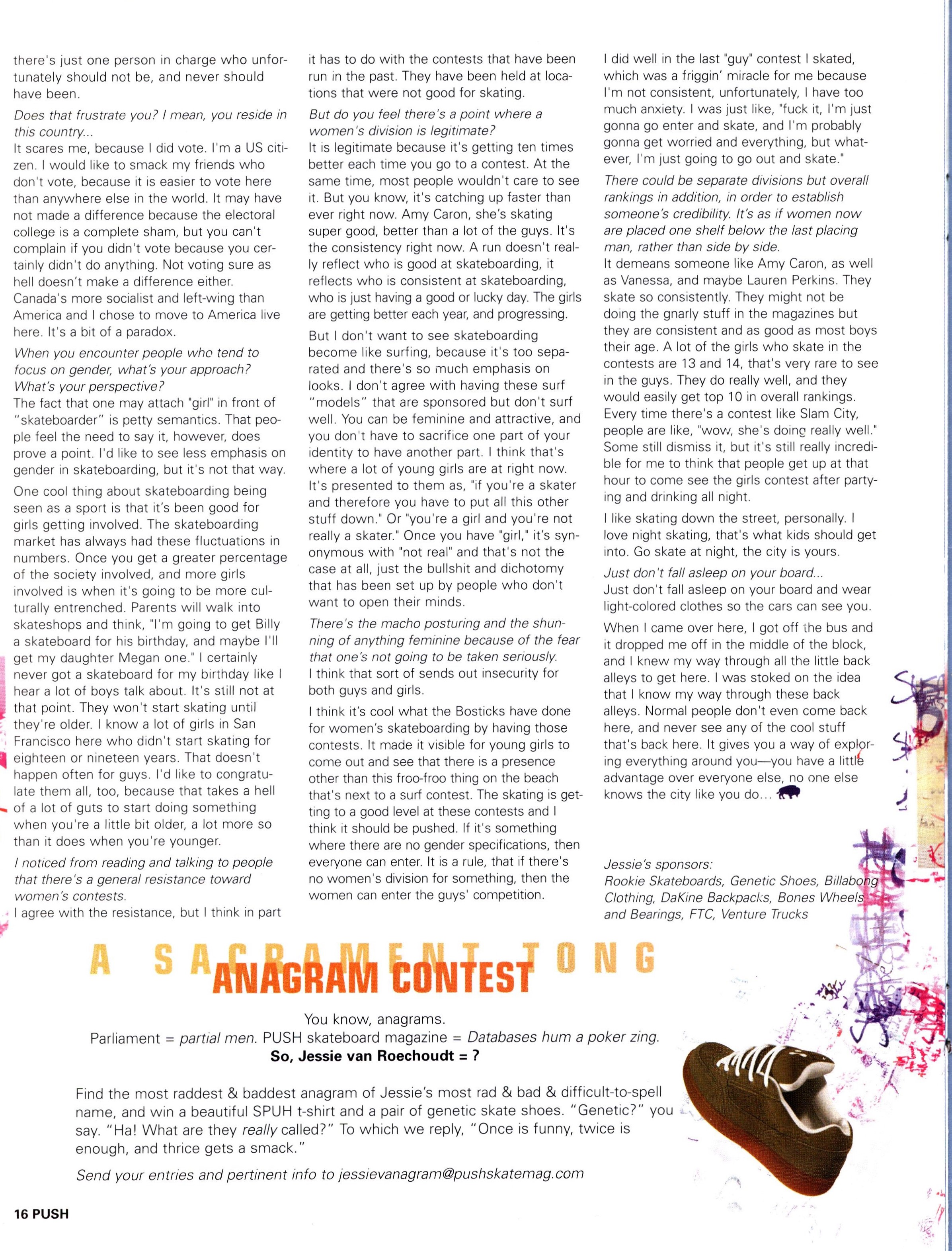
Jessie took the cover for the for the Spring 2003 issue of Push mag with a photo by Bryce Kanights.

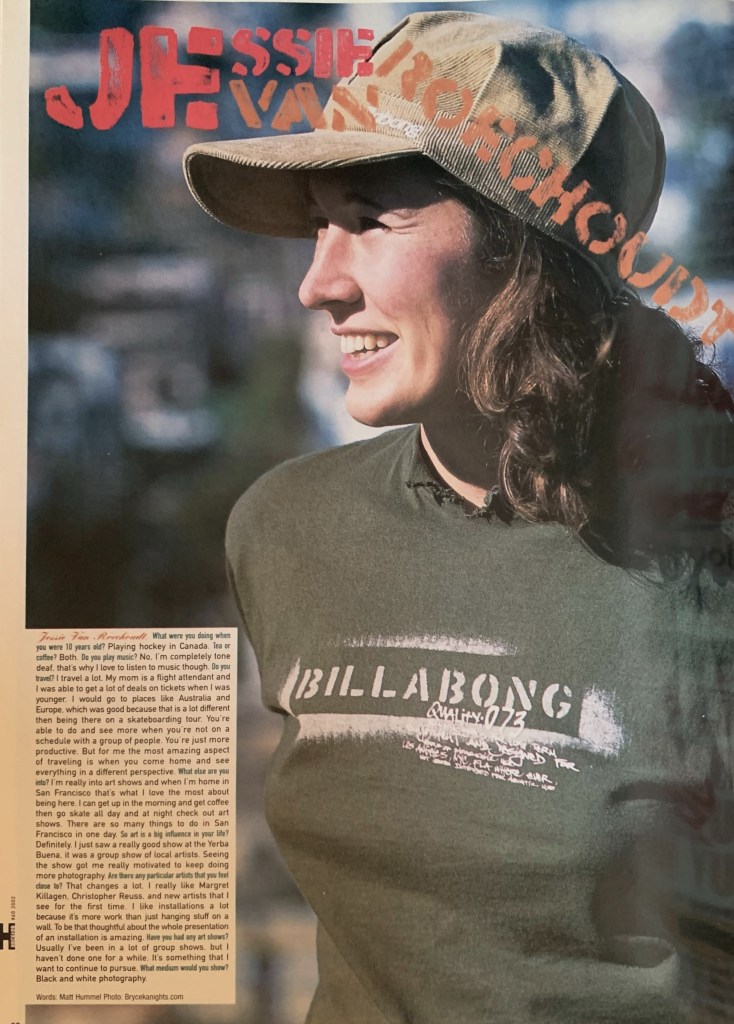
In a blurb for Heckler, Jessie explained how motivated she was to seek out art shows in San Francisco and be exposed to new, innovative work, especially installations. At the time of her Push interview, Jessie was stoked on the artwork and print-making of Margaret Killgallen, who also surfed. “I met her once back in the fall of 97, and I was so stoked to meet her, like, ‘Fuck, I want to be like you.’” Jessie then expanded on the impact of having other women to emulate and inspire, whether in art or skateboarding and the challenge of operating within an industry that prevents equitable visibility.
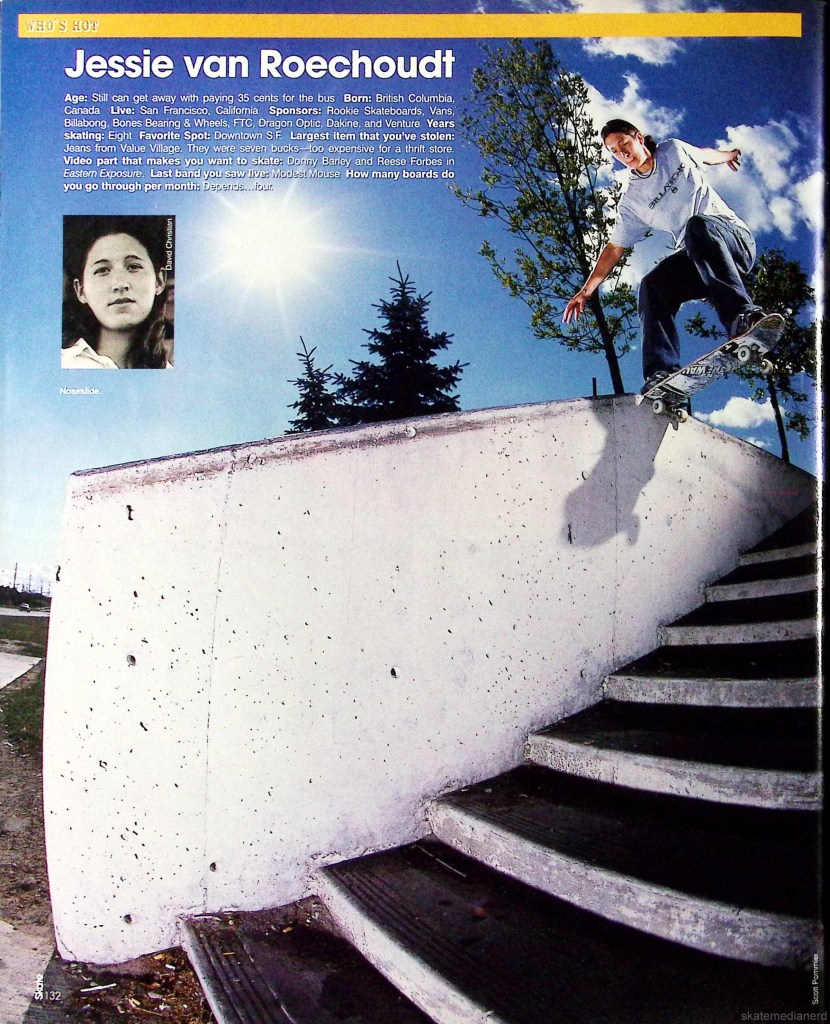
Skateboarder magazine was the most popular media outlet in the 1970s until it deteriorated in the 80s (it became a general sports mag called Action Now until it folded in 1982). Fortunately, there was a re-launch in 1997 and the “Who’s Hot” feature was revived, acknowledging up-and-comers, which often included women during the 1970s.
Jessie had first appeared in the Summer 1998 issue of Skateboarder thanks to a photo by Joe Brook, and then she was acknowledged in a “Who’s Hot” article in October 2002, with a Q&A and photo by Scott Pommier. Unfortunately, according to @skatemedianerd, of the 459 skateboarders who received a “Who’s Hot” shout out in the revitalized publication, there were only two women represented (Jessie and Marissa Dal Santo) – a reflection of the lack of support for female skaters at the time, in contrast to the 70s.
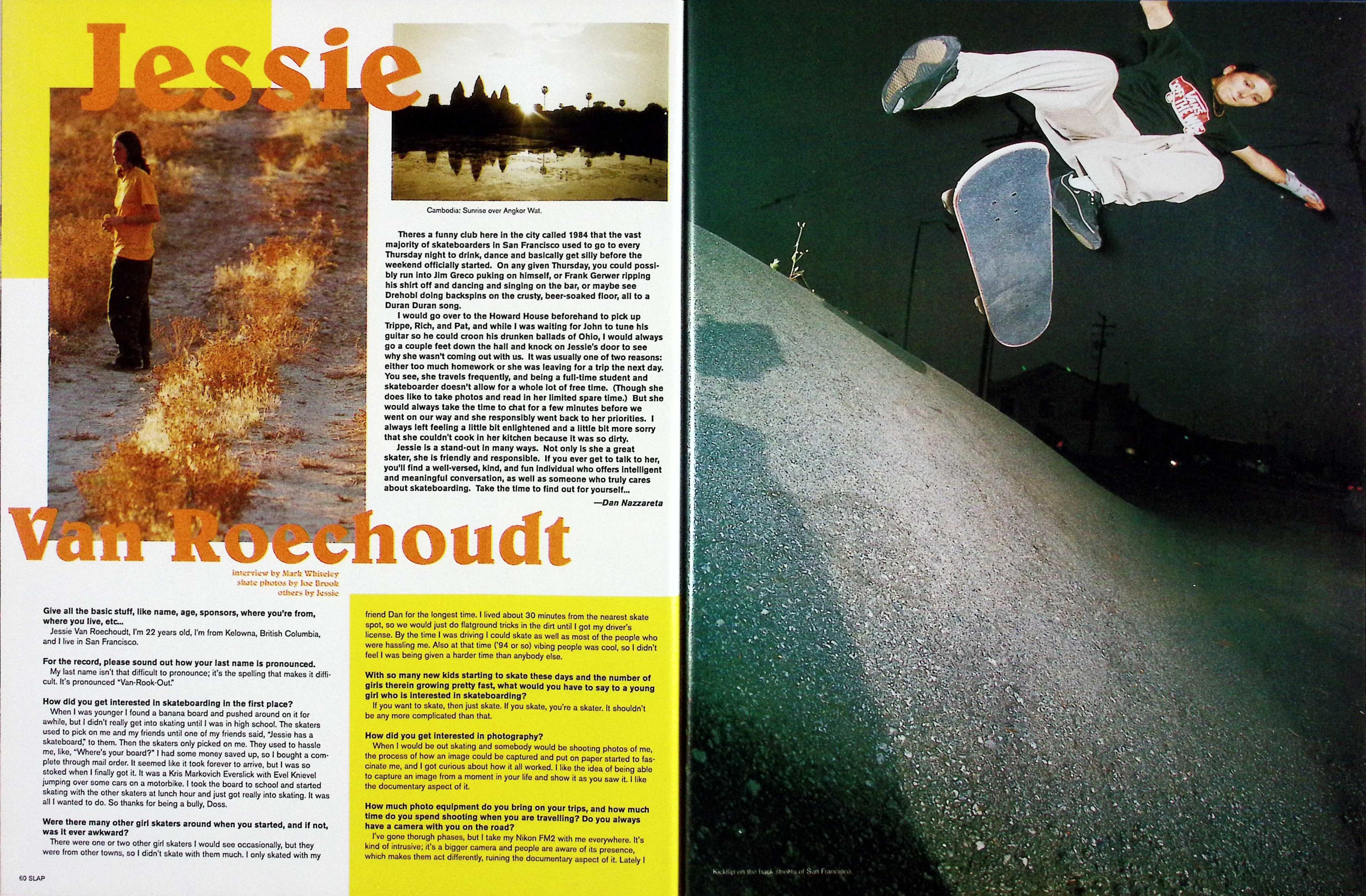
Slap magazine stepped up with a glorious 8-page interview on Jessie in the February 2001 issue by Mark Whiteley full of photos of Jessie skating, and her own black and white images, taken during her travels. Jessie preferred to keep these two realms separate, documenting her overseas observations as a kind of art expression versus capturing tricks on four wheels.
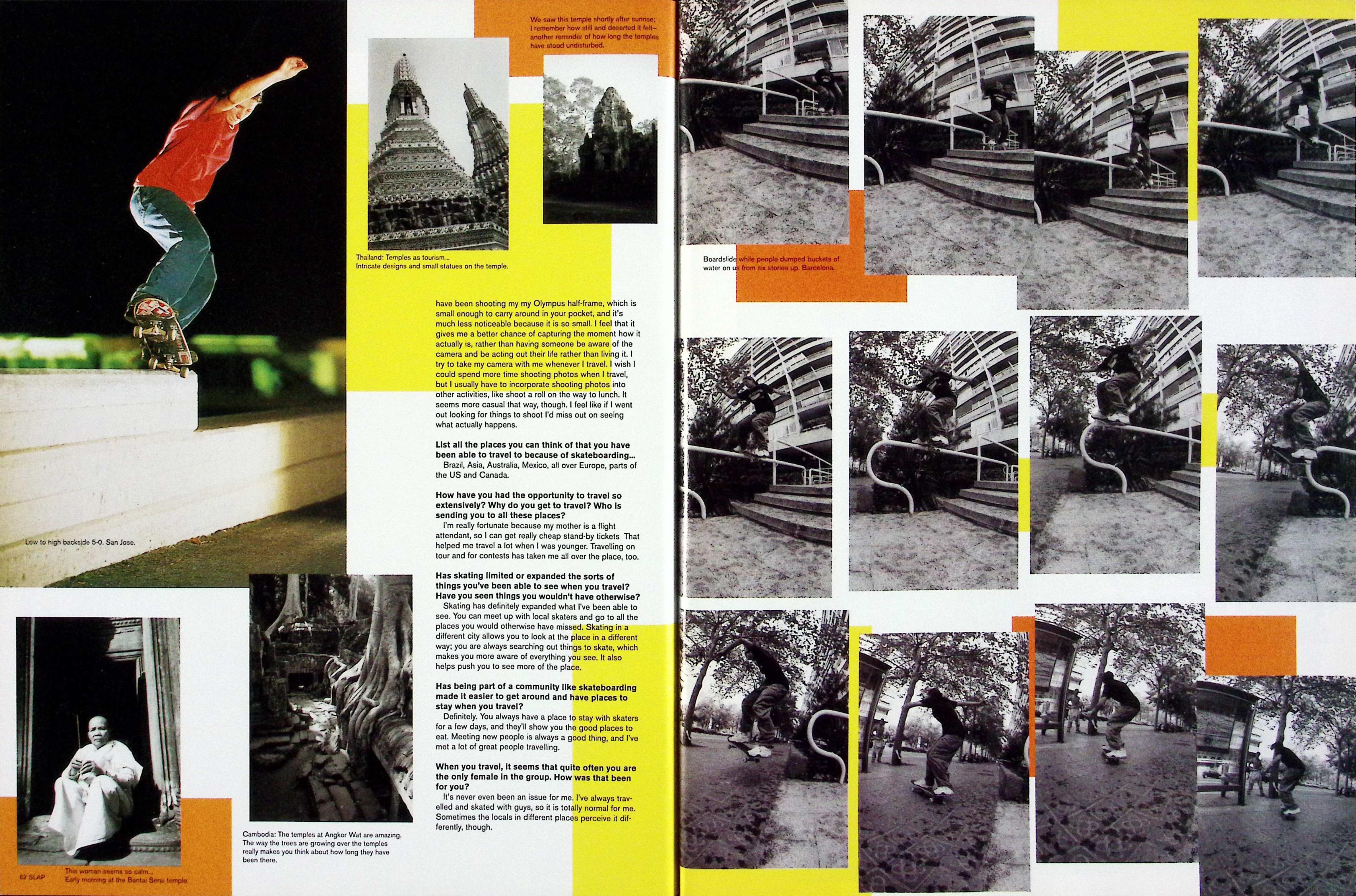
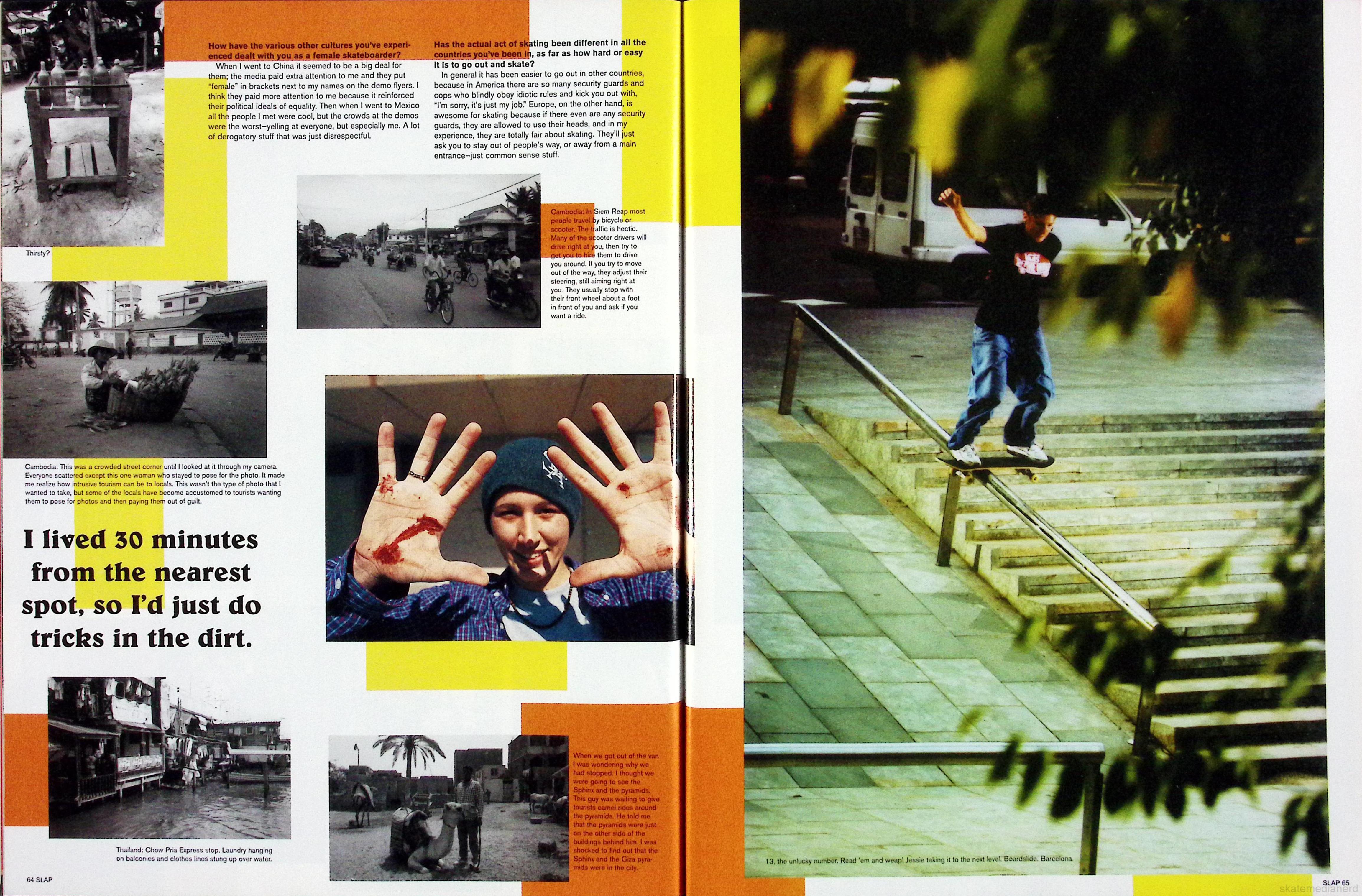
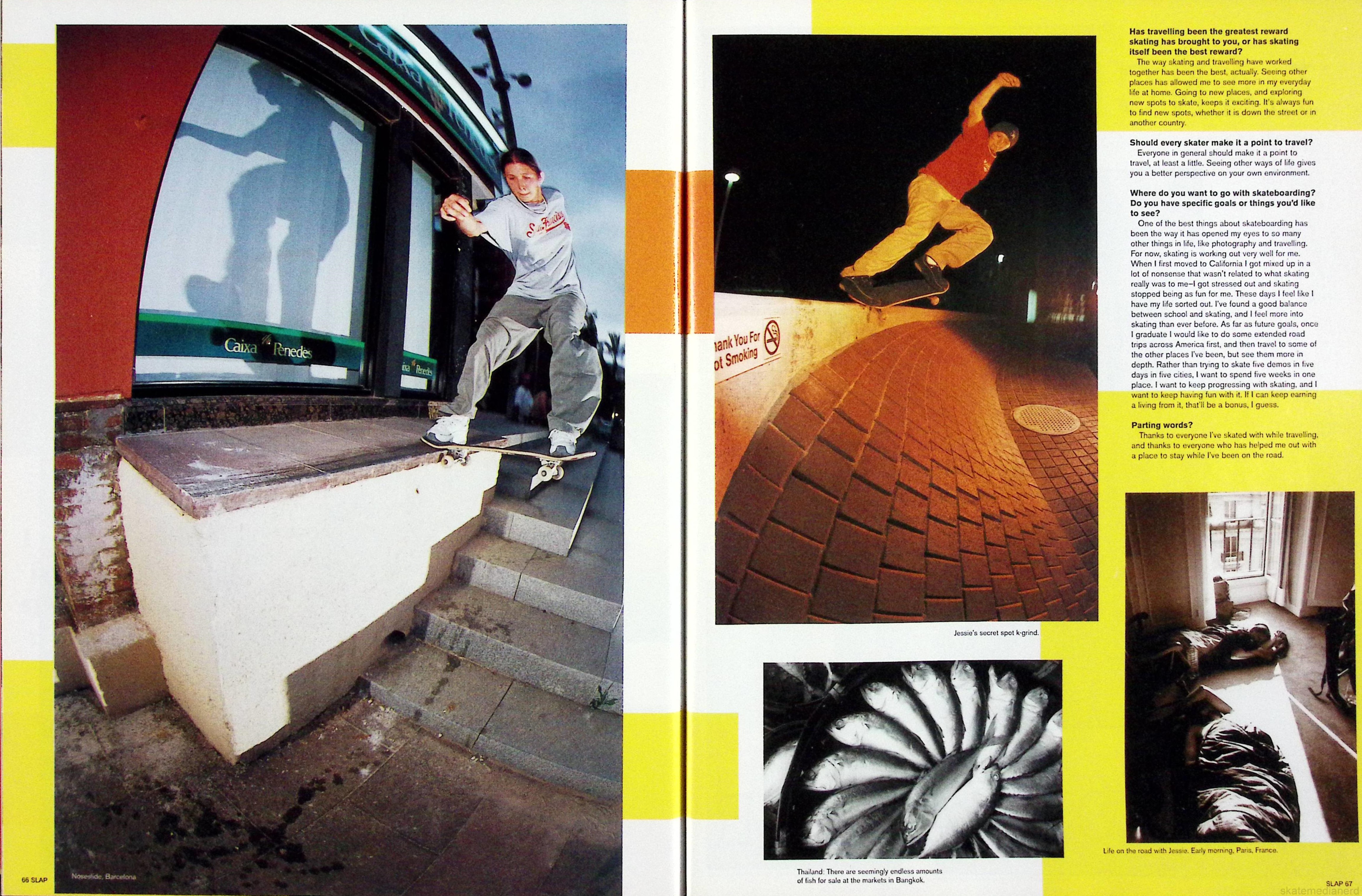
Jessie was fortunate in that her mom was a flight attendant and would line-up cheap stand-by tickets, so she could travel. Jessie had been to Brazil, Cambodia, Thailand, China, Australia, Mexico, all over Europe and North America. These trips gave her a different perspective compared to being on a skateboard tour or going to contests, although Jessie did appreciate meeting up with local skaters to explore their city in a unique way (Whiteley). Jessie was a big advocate for combining skating and travel, to witness other ways of life. As a sponsored skater, Jessie was part of many trips overseas, and was included in the coverage of the Gallaz team in Australia, as they worked on the video AKA: Girl Skater, as seen in this photo by Jaya Bonderov in Big Brother (June 2002).
Jessie represented Rookie and her growing list of sponsors at contests and recalled the vibe at these events that were finally including women in the late 1990s. For example, in September 1997 Jessie competed in the first All Girl Skate Jam at the Graffix Warehouse in Chula Vista, placing 5th in Street Finals. She improved her result in 1998 with a 4th place in the AGSJ Pro Street event, and again, missed the podium in 1999, with another 4th.
“Everybody knew everyone. It was a really small, really tight scene. The prize money wasn’t all that. I won a couple World Cup events. The most I made first in those days was $1200 USD. I won $500 in [São Paulo] Brazil for winning the World Cup there in 1999. Big props to Mimi [Knoop] and Cara-Beth [Burnside] for having the vision and organization to change [with the Women’s Skateboard Alliance]” (Archie). 1999 was a good year for Jessie, as she also came 2nd behind Elissa Steamer at Slam City Jam, ahead of Vancouver local, Michelle Pezel.
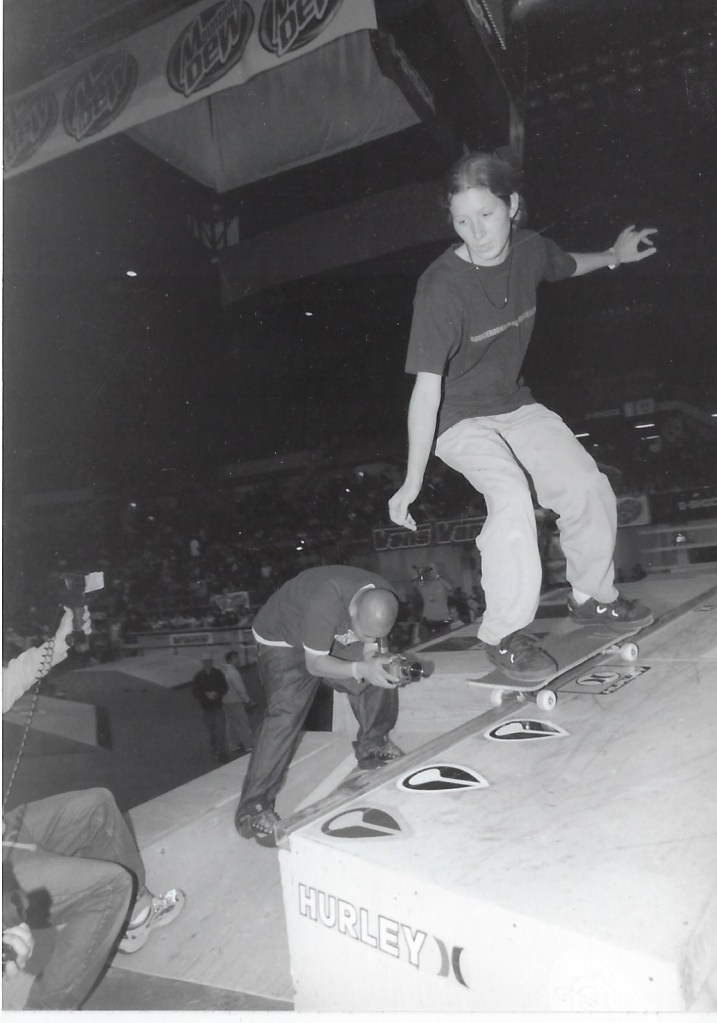
Photo: Jeff Greenwood (Concrete Disciples) took this photo of Jessie competing at Slam City Jam in 1999.
The gradual increase in contest opportunities in the early 2000s was encouraging to Jessie, as she witnessed skaters like Amy Caron, Vanessa Torres, Lauren Perkins, and Stefanie Thomas performing with consistency and pushing the standards (Williams). Their presence would in turn, motivate the rest of the field but Jessie was still holding her own with her top World Cup ranking being 2000 with a 2nd place overall behind C’naan Omer, and ahead of Amy Caron.
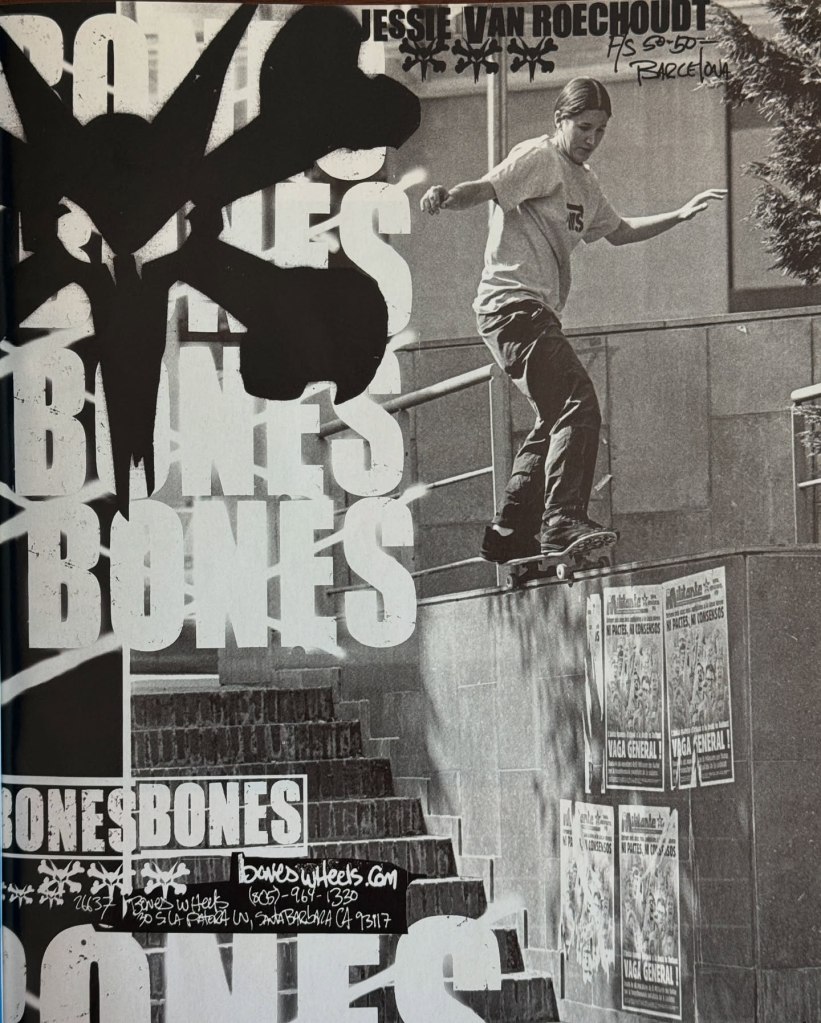
Photo: Bones Wheels advertisement of Jessie with a gap to 50-50 drop in Barcelona, published in the March 2003 issue of Thrasher.
Meanwhile, attending University was still a priority, and to Rose Archie for King Skateboard magazine, Jessie shared that she should have released her pro board with Rookie sooner but she had wanted to finish university and be skateboarding full time before the board came out.

Photo: a selection of Rookie boards with Jessie’s pro deck on the far left.
“I’d talked to Elska [Sandor] and Catherine [Lyons] who ran Rookie—I’d been on the company since it started. Tiffany Bozic drew the graphic of some Canadian Geese and Matt Irving helped with layout. The process of making that board graphic was the point where I realized that I needed to learn Illustrator and other design software, so I start taking design courses pretty much at the same time as that board was coming out. My board came out around the time of September 11th, 2001, and Rookie was so close to the World Trade Center in NYC, that after that happened they were without power or any infrastructure for a couple months and that was basically the end of Rookie” (Archie).
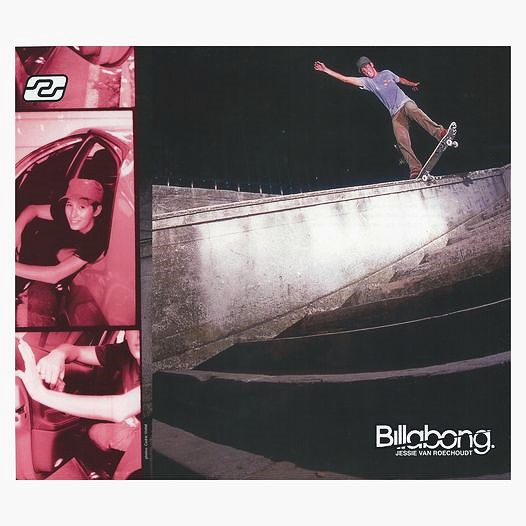
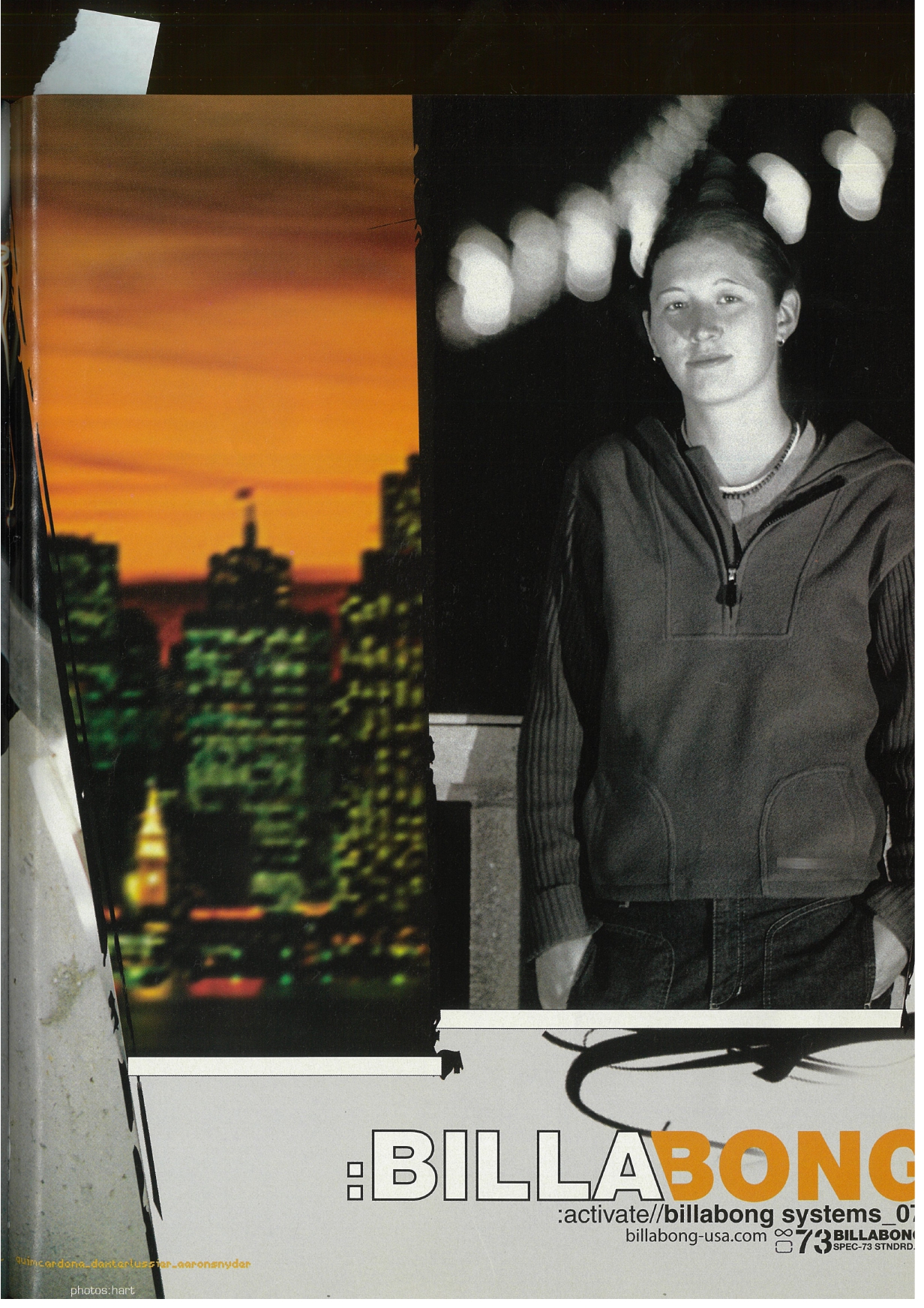
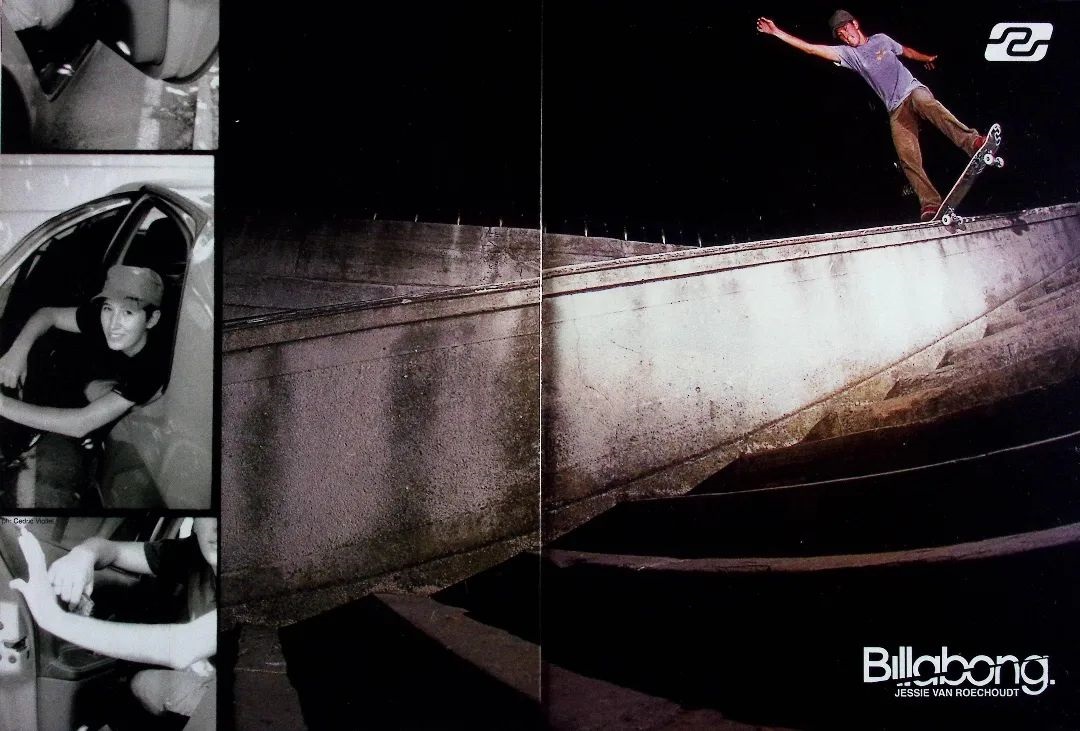
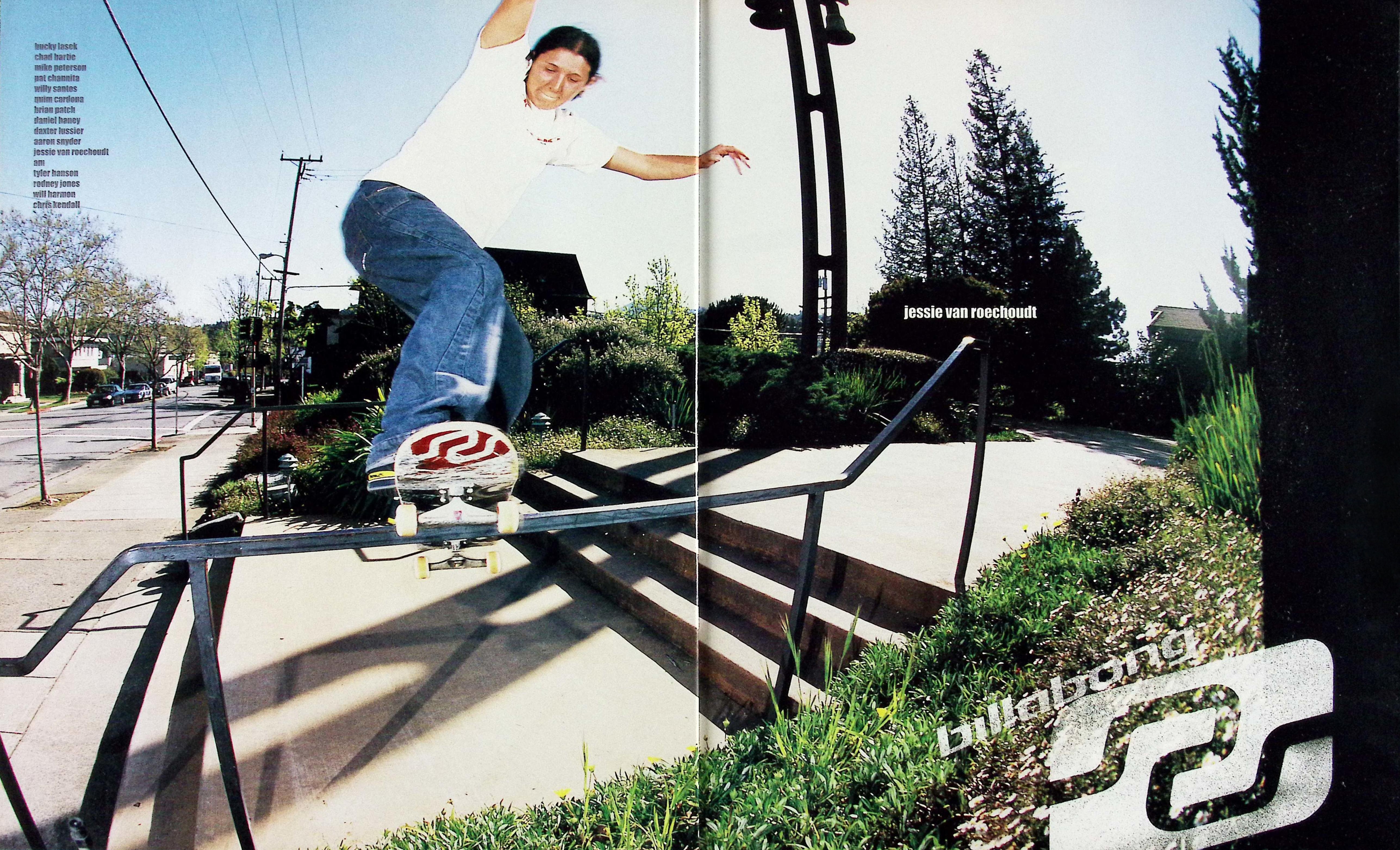
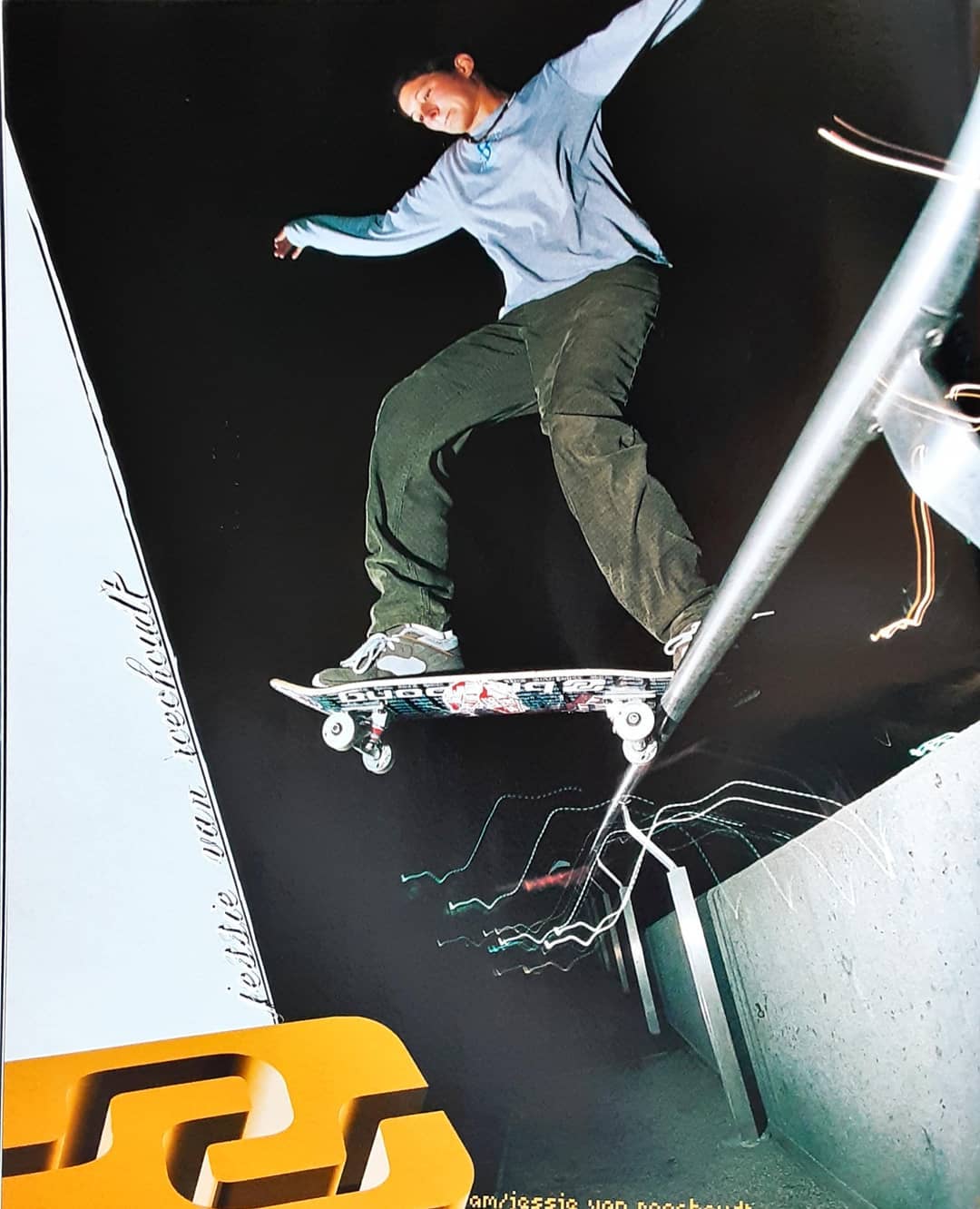
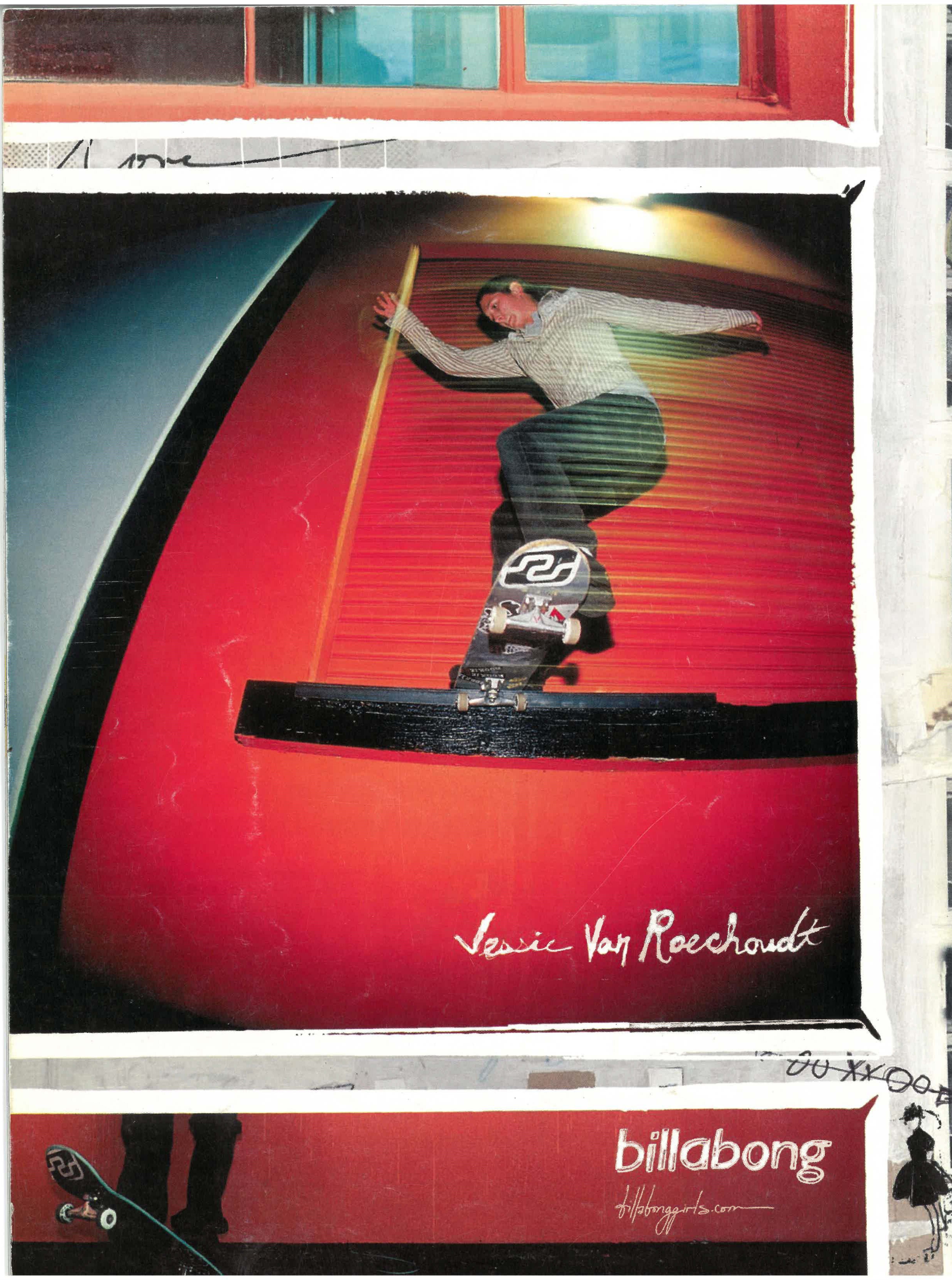
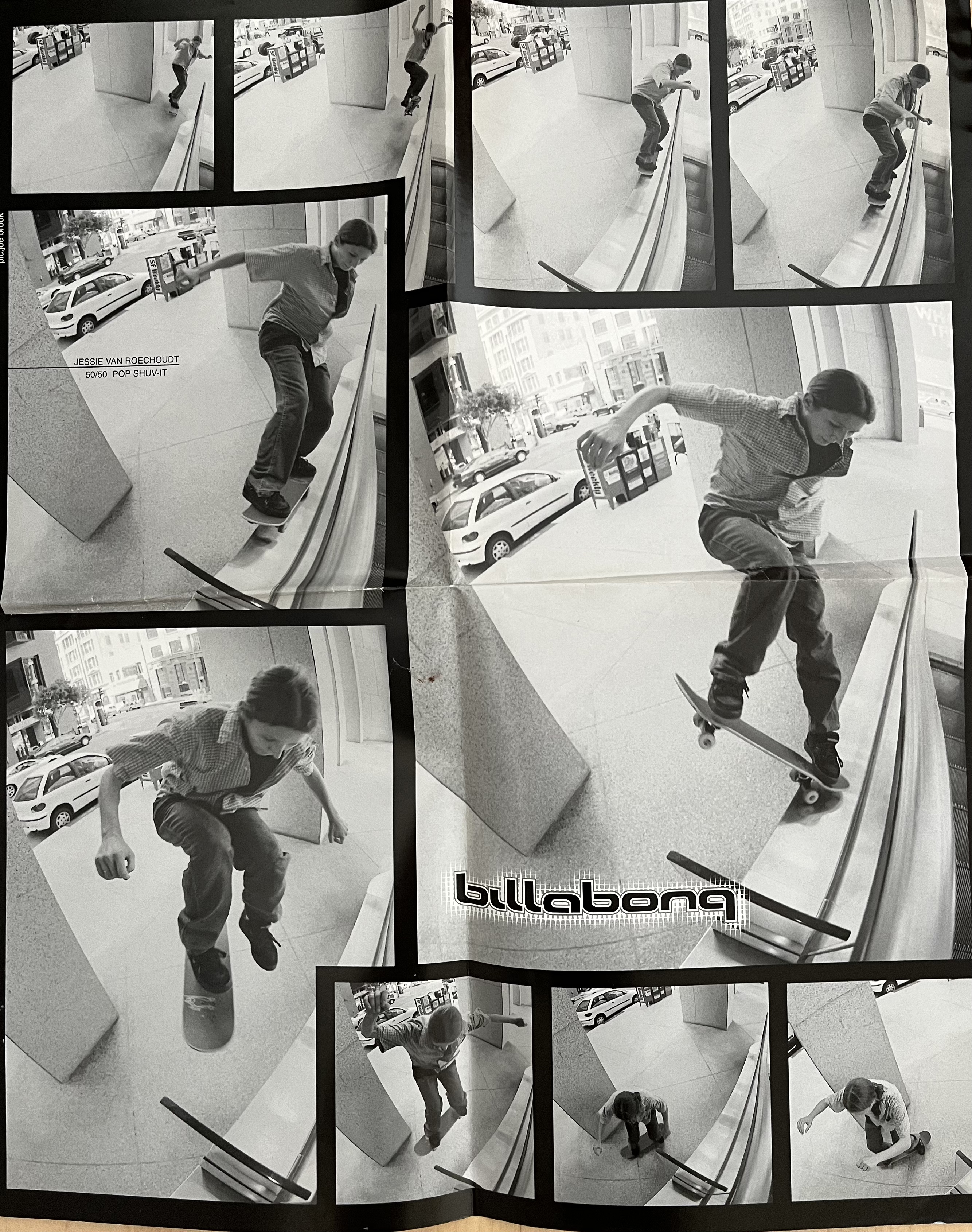
Photos: Billabong advertisements taken by Cedric Viollet, Joe Brook, Lisa Whitaker, Richard Hart.
During her travels overseas, Jessie experienced a range of attitudes towards her existence as a “female skater,” which could be grating. In her Push interview, Jessie explained that “The fact that one may attach ‘girl’ in front of ‘skateboarder’ is petty semantics. That people feel the need to say it, however, does prove a point. I’d like to see less emphasis on gender skateboarding, but it’s not that way” (Williams). In 2002, the industry was still grappling with identity and this attitude that a girl was not a “real” skater, especially if they were feminine. Jessie understood that this dichotomy was bullshit “set up by people who don’t want to open their minds.” Jessie always felt that “If you want to skate, then just skate. If you skate, you’re a skater. It shouldn’t be any more complicated than that” (Whiteley).
In a feature for Skateboarder (Summer 1998), called “Manifesto of Indifference,” Jessie pitched a series of questions to leaders in skateboarding being Cara-Beth Burnside, Elissa Steamer, Jaime Reyes, Jen O’Brien, and Jodi McDonald. In her introduction, she stated, “Skateboarding is skateboarding: no gender specifications needed. To say, ‘girls’ skateboarding’ is to differentiate it from ‘skateboarding’… The urge to categorize things is inherent. But doesn’t categorization defy the freedom that is at the heart of skateboarding itself?” Jessie felt that having her gender distinguished was dismissive, and in the 1990s and early 2000s that certainly was the case.


There was a kind of insinuation that tacking on “girl” was code for saying that you were inferior and less authentic, since “skateboarder” on its own was assumed to be male. Jessie called out this approach, and her words reminded me of Bonnie Blouin, especially when she wrote, “Believe in yourself, in the power of your mind and body to accomplish whatever it is that you want to do.” And she concluded that there was no need to categorize and make yourself small to fit a box. It also wasn’t about conforming to this dominant masculine vision of being a skateboarder because, in an interview with fellow Canadian, Rhianon Bader, Jessie Van said, “I think you should be able to be as feminine as you want to be and also be considered a legitimate, ripping skateboarder.”
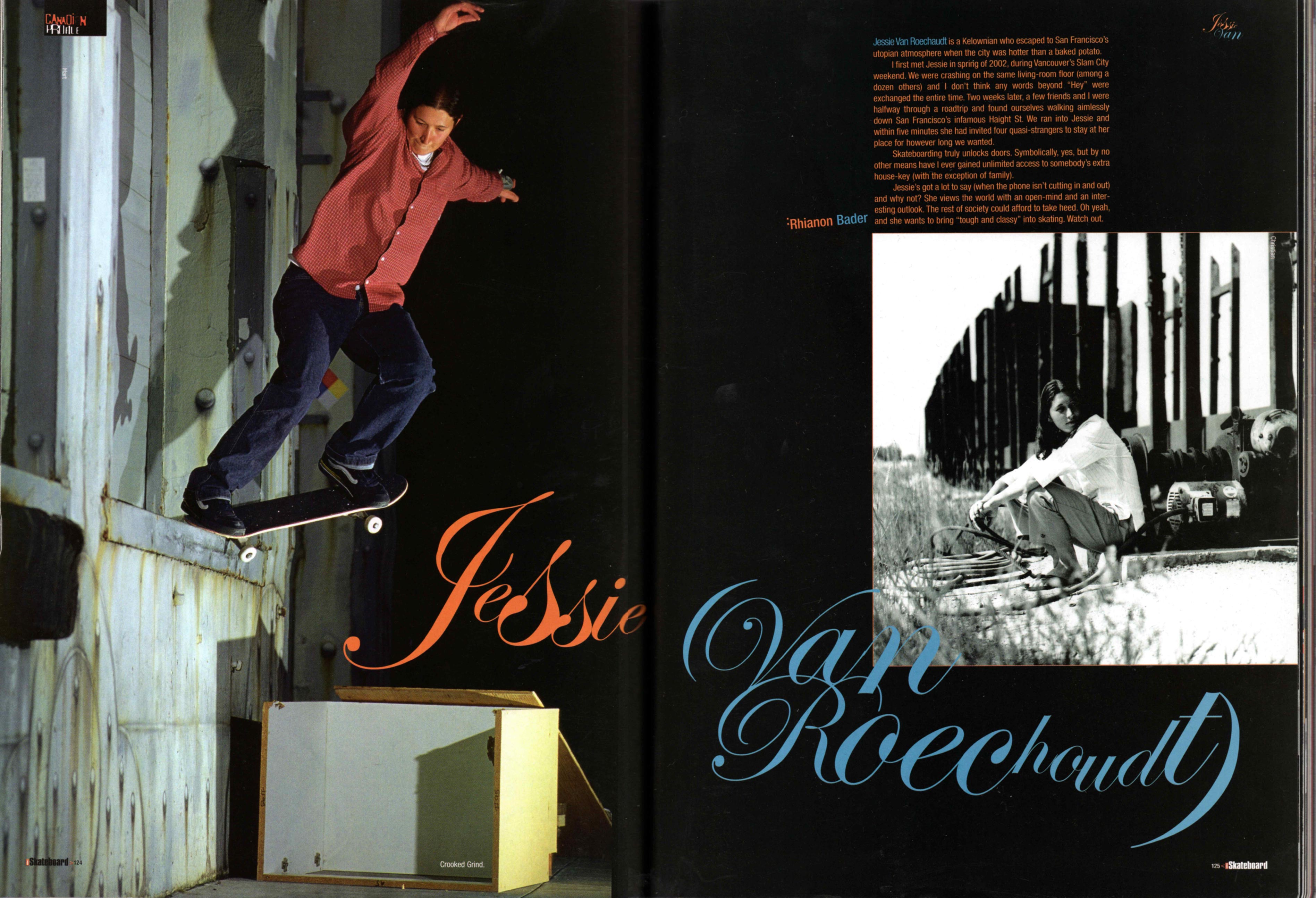
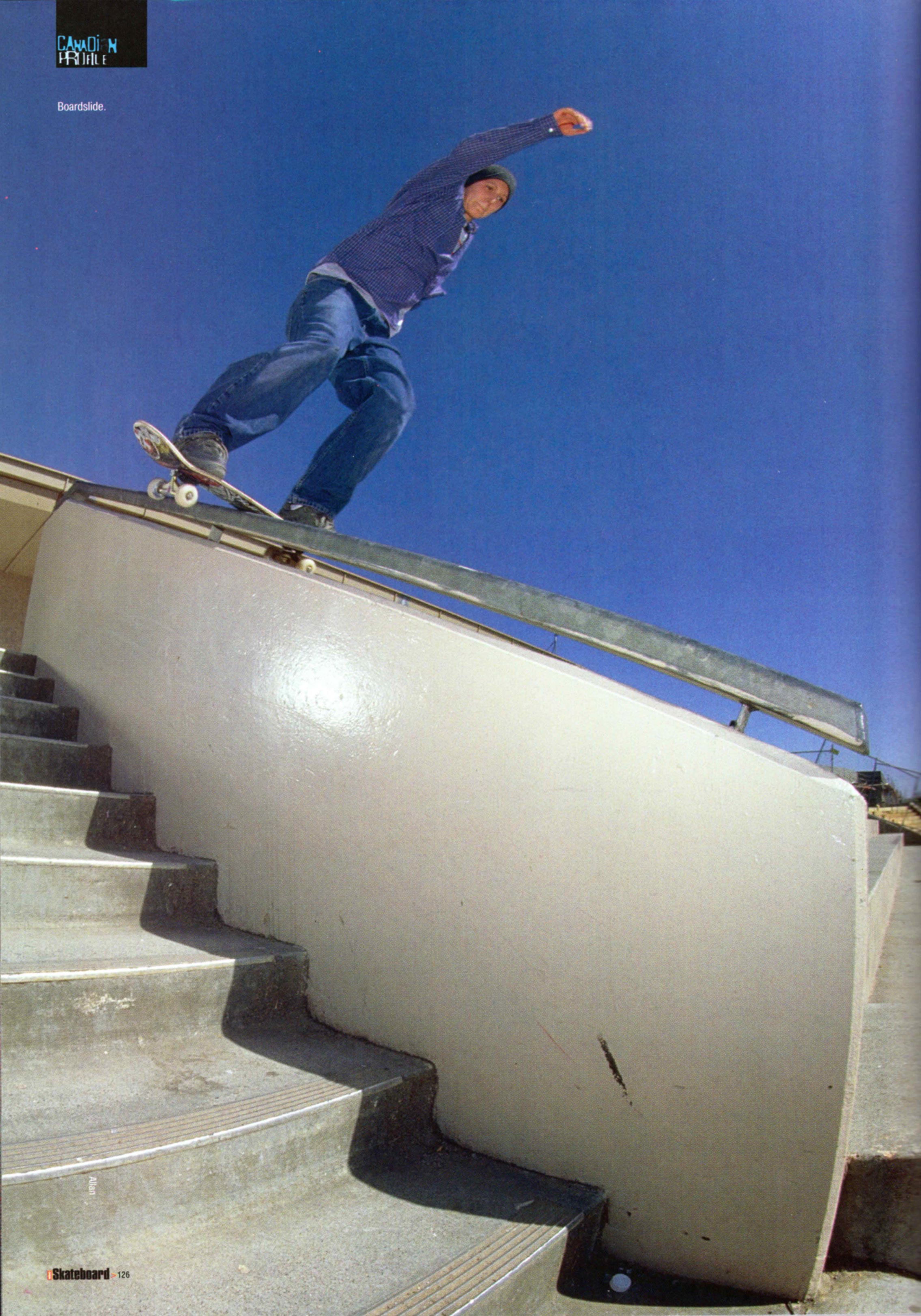
Photos: The intro to Jessie’s interview for SBC magazine (Summer 2003) by Rhianon Bader was a crooked grind taken by Richard Hart, followed by a blue sky boardslide documented by Ryan Allan.
Jessie hoped that someday, there would be a monumental shift in society’s attitude toward girls’ participation in skateboarding. “Once you get a greater percentage of the society involved, and more girls involved is when it’s going to be more culturally entrenched. Parents will walk into skateshops and think, ‘I’m going to get Billy a skateboard for his birthday, and maybe I’ll get my daughter Megan one.’ I certainly never got a skateboard for my birthday like I hear a lot of boys talk about. It’s still not at that point…” (Williams).
Instead, there was still a tendency for women to have to wait until they were 18 or 19 to seek out skateboarding independently. She said, “I’d like to congratulate them all, too, because that takes a hell of a lot of guts to start doing something when you’re a little bit older, a lot more so than it does when you’re younger” (Williams).
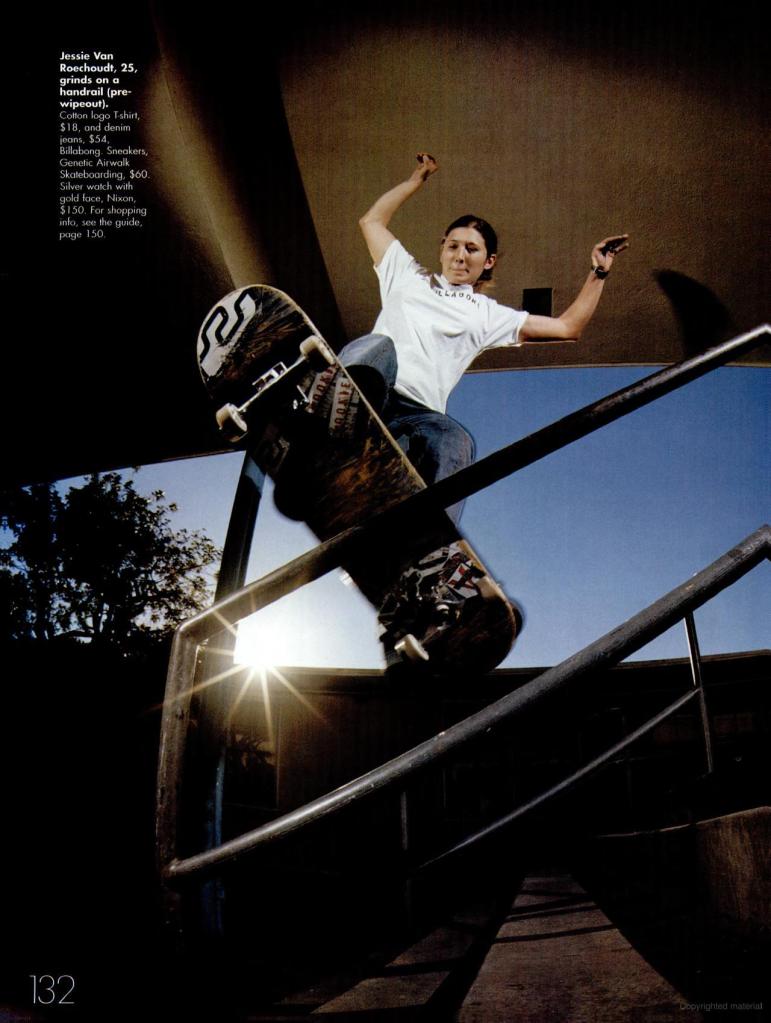
Photo: Tobin Yelland for a feature in Elle Girl magazine (August 2003) called “Skate or Die.”
In 2004, Jessie was featured in a Spotlight on The Side Project website (which became the Girls Skate Network), with long-time skateboard friend, Lisa Whitaker (who also rode for Rookie and whom Jessie describes as the “patron saint” of skateboarding for all her dedication). Jessie shared her appreciation for how skating motivated to her explore and find new things resulting in her having visited every continent expect Antarctica.
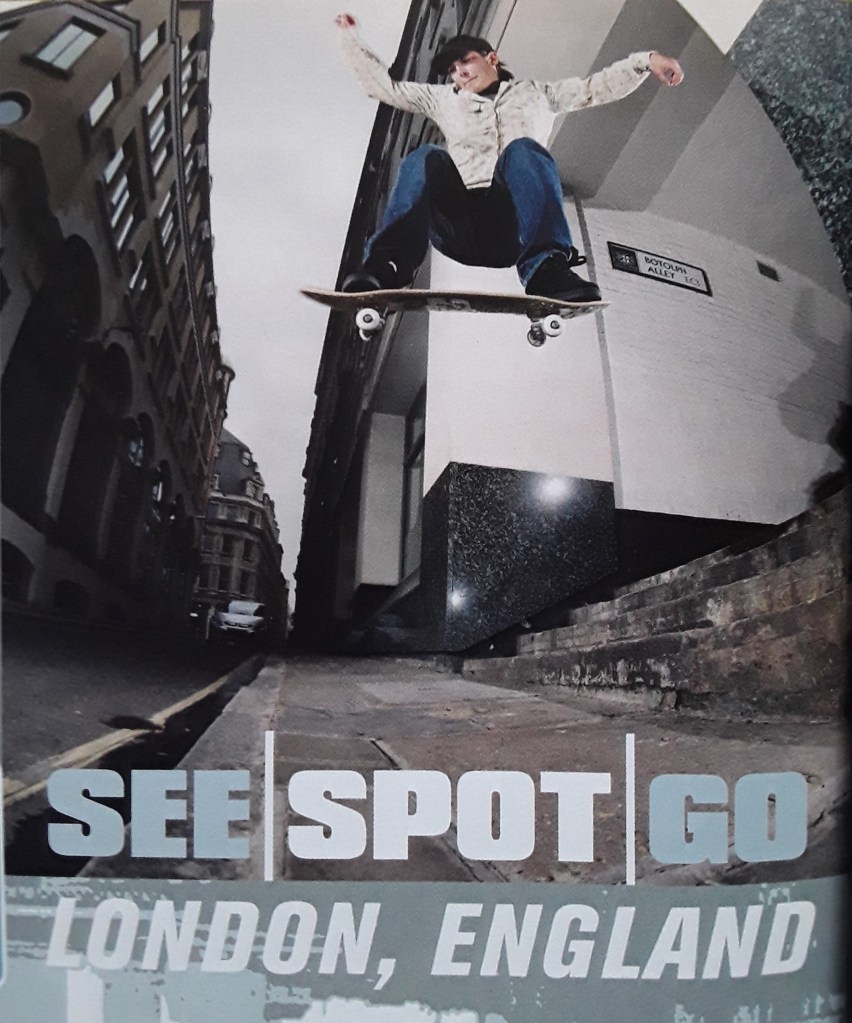
Photo: Jessie was featured several times in SG magazine, which catered to women involved in surfing, skateboarding, snowboarding.
When asked about contests, Jessie admitted that she didn’t thrive in a competitive environment but expanded on her World Cup win in Brazil saying, “I couldn’t understand anything the announcers were saying, which made it way less stressful, just being oblivious and skating in a jam, with no plan, it was fun. And its one of the few contests that I’ve ever won, so I was stoked about that.”
Lisa made sure to include footage of Jessie in the ground-breaking Villa Villa Cola video, Getting Nowhere Faster (2004) and she often appeared in Lisa’ blog cams over the years.
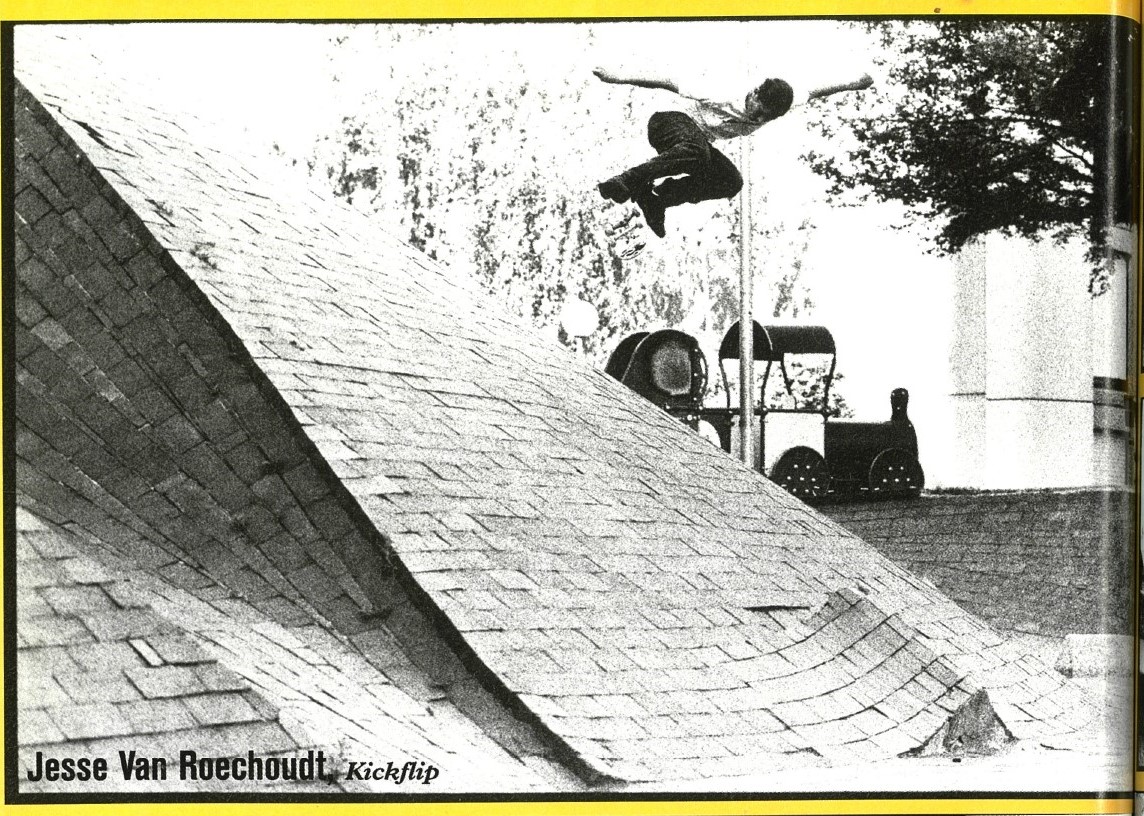

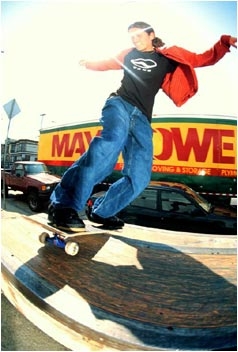
Photos: Richart Hart (appeared in TransWorld April 2003), Brendan Sohar (SBC magazine), Patrick O’Dell (for Skateboard.com feature in 2003).
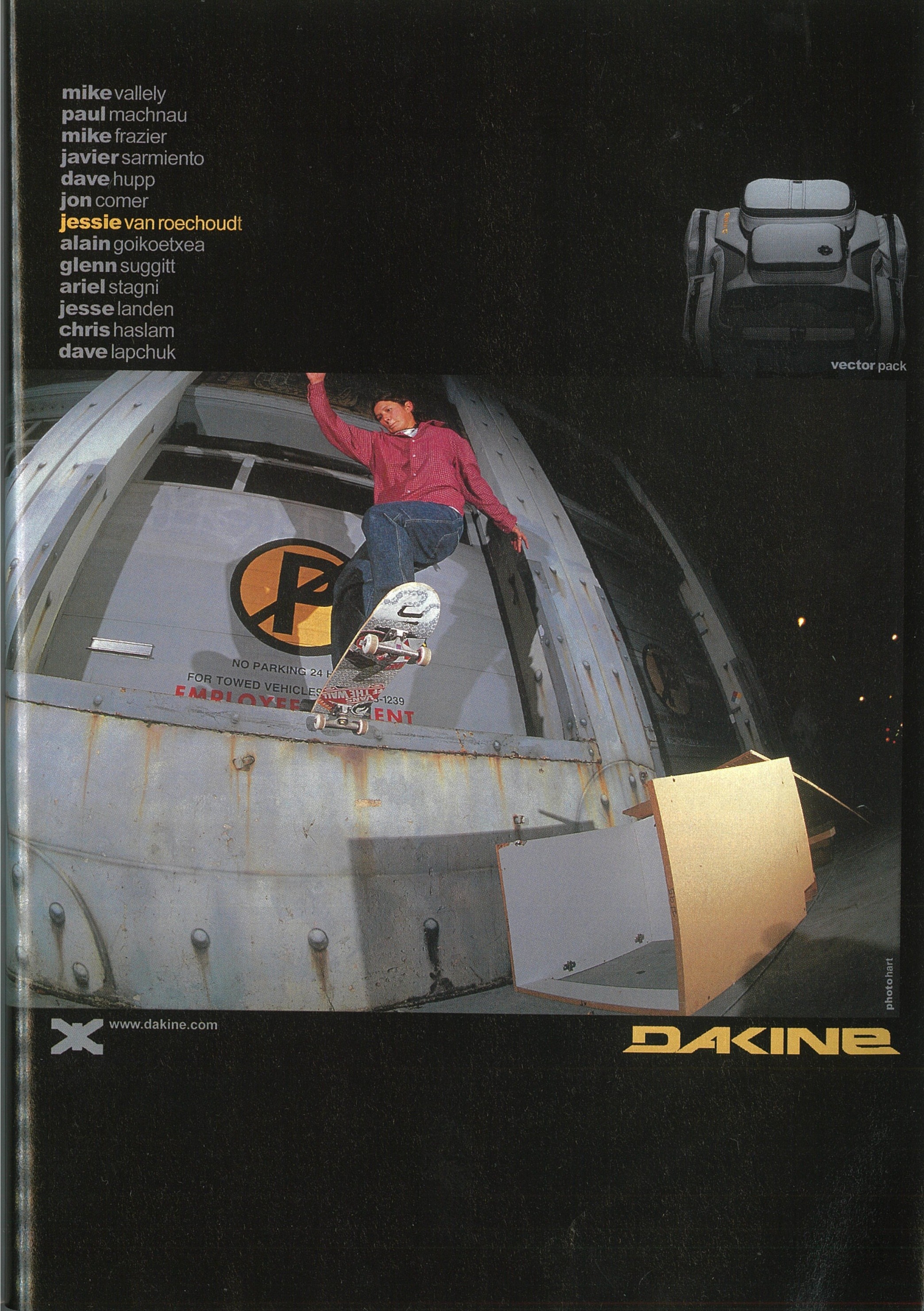
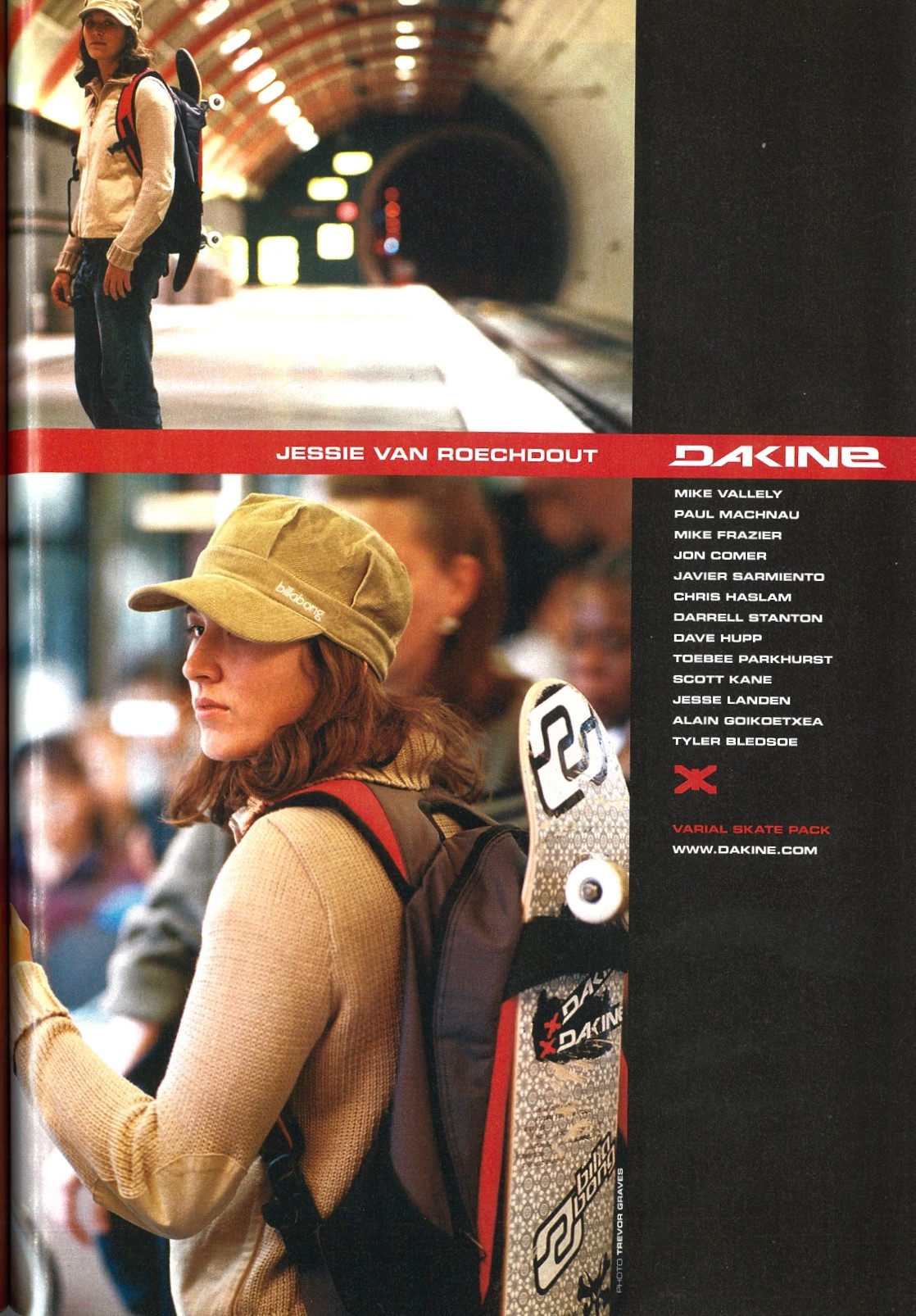
Photos: Dakine action shot appeared in TransWorld (October 2002), and the backpack Dakine ad appeared in Heckler and TransWorld (April 2003)
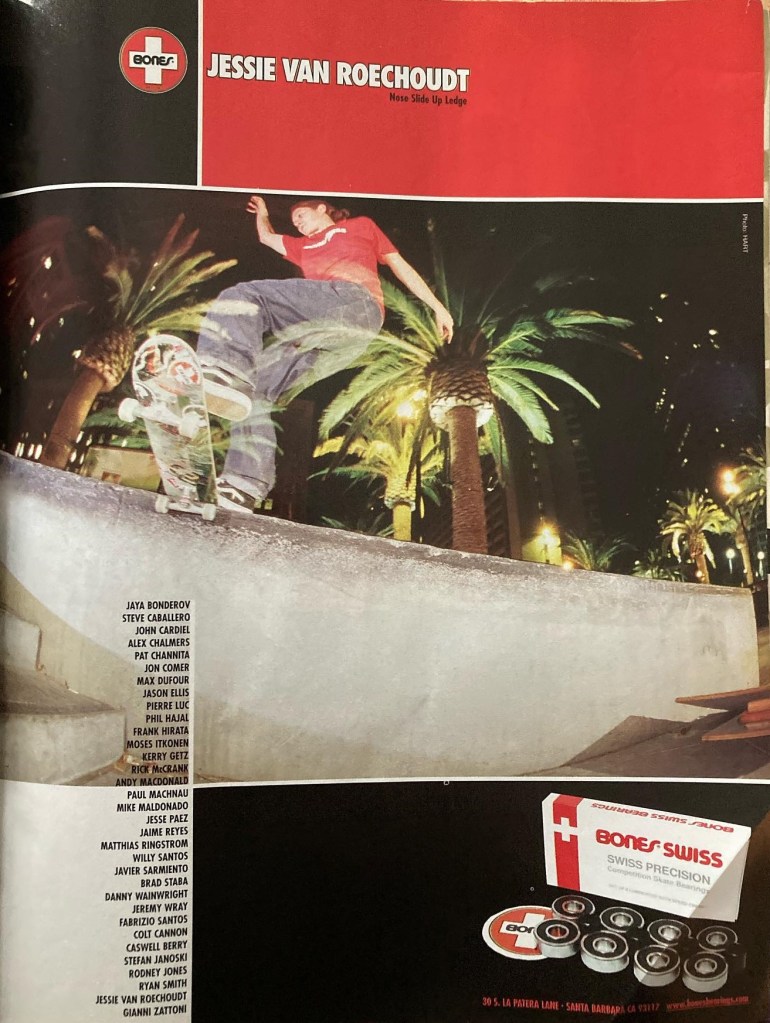
Photo: noseslide up a ledge for Bones was published in Slap (November 2001) by Richard Hart
When Jessie eventually transitioned away from being a sponsored skateboarder on the competitive circuit she said, “it was nice just to have skating be purely about the act of skating” (Archie). Simultaneously, Jessie continued to develop her skillset as a photographer and her work was featured in the Framed exhibit at Antisocial skateshop in June 2006. She also expanded on her interest with design software, but noted that, “After the iPhone came out, I transitioned to mostly doing motion graphics and then that led to interaction design and UX design. I worked at ad agencies, design studios, and then in-house long-term contracts designing interfaces at Samsung R&D and Google” (Archie).
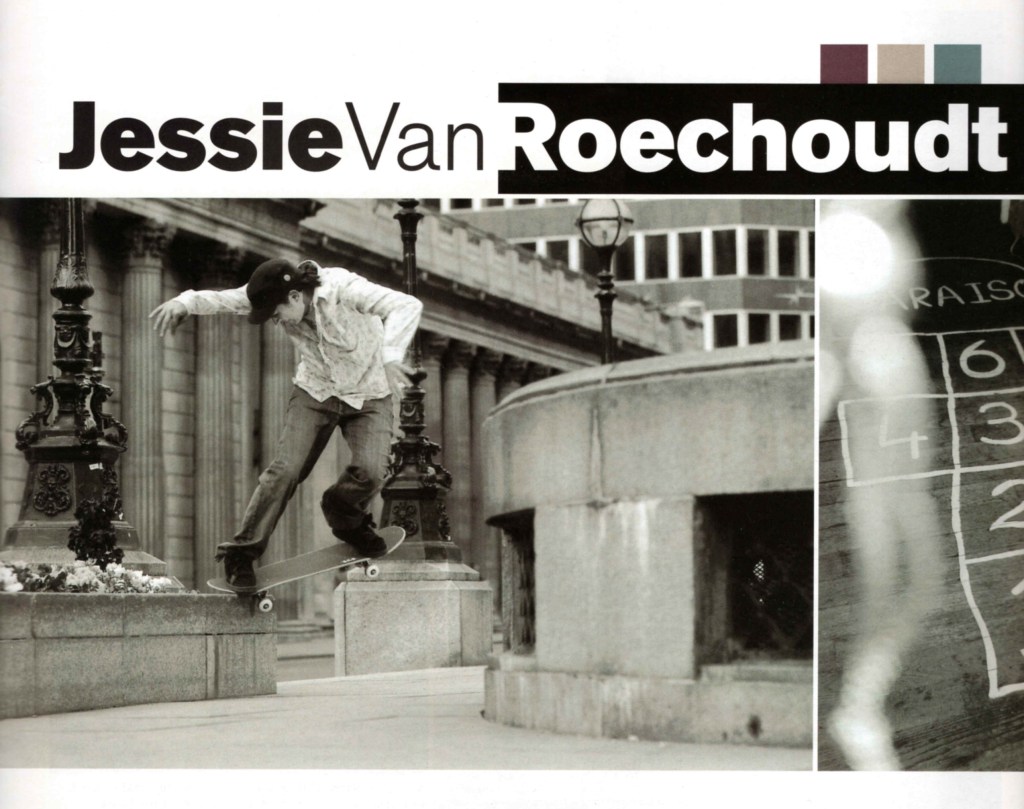
Photo: the UK-based magazine Sidewalk featured Jessie in the March 2005 issue with a backside 180 nosegrind by Wig Worland.
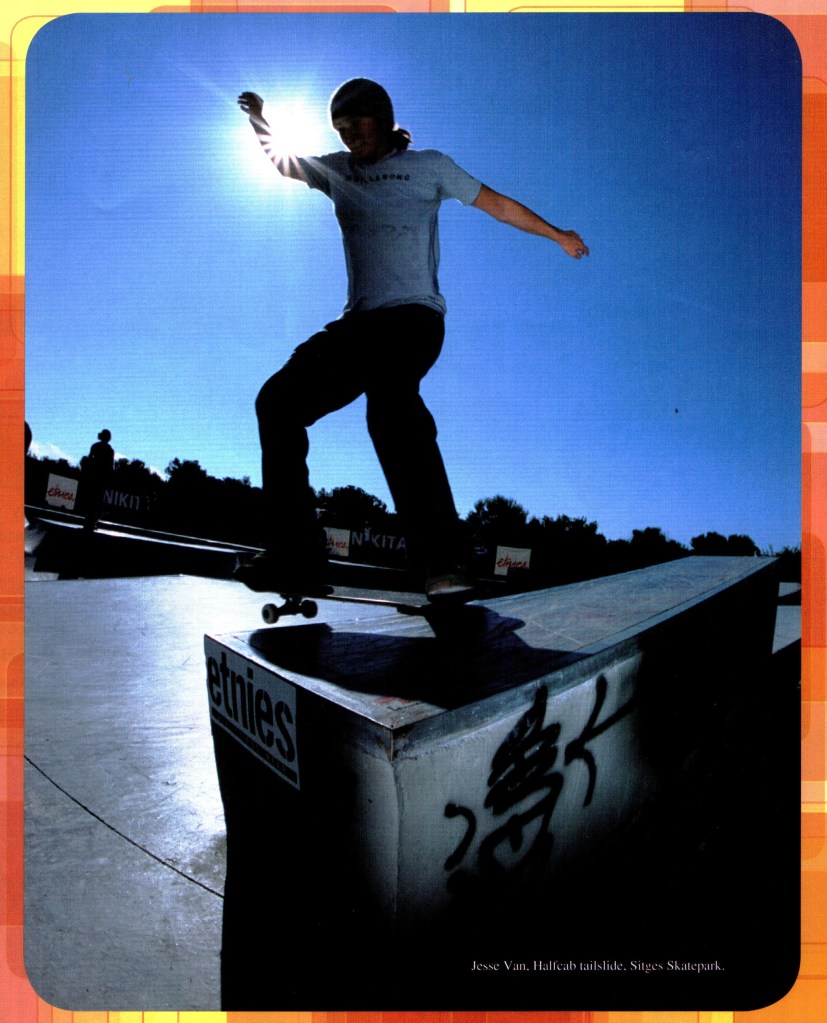
Photo: Jessie was included in an article for Check it Out magazine (issue 17, 2005) about a skate trip in Barcelona, Spain.
Eventually, Jessie’s skateboarding history and work experience merged when an opportunity to work for adidas arrived. Jessie is now the Senior Manager of Global Brand Comms for adidas Skateboarding and gets to travel the world and advocate for and promote skaters like Nora Vasconcellos and Momiji Nishiya.
Jessie is also one of the Editors of Mess Skate Mag along with Shari White and Kristin Ebeling – legends in their own right. The magazine emphasizes bold photography, a dynamic mix of skaters from a wide range of backgrounds, and an artistic aesthetic that reveals Jessie’s eye for design.

It’s interesting to read Jessie’s vision for skateboarding over twenty years ago, as it speaks to how much the industry has evolved. In 2003, in conversation with Denise Williams, Jessie explained that with women in skateboarding her hope wasn’t to have our involvement be a marketing play but rather, “I just want [skateboarding] to be an opportunity for girls.” It was so simple. Skateboarding as a universal opportunity for fun, fulfilment, friendship, competition, whatever it is you want it to be, no matter your background.
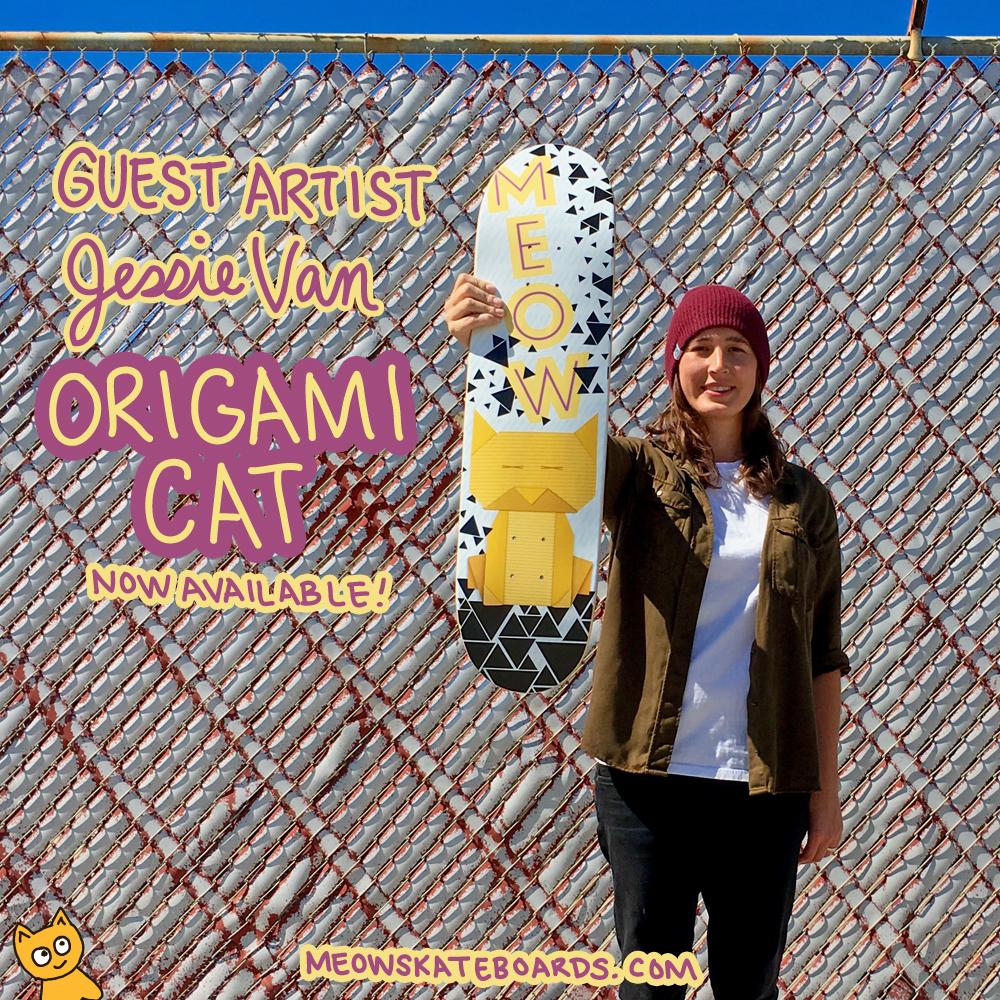
Photo: Jessie contributed a design in 2016 to Lisa Whitaker‘s company Meow
If you’d like to listen to Jessie share more about her story, there was a great feature of her for Quell Party (episode 13 starting at 29:40) from September 11, 2019. Jessie delves into growing up with a gender-neutral name that maybe gave her some stealth access to activities like hockey and what was evidently a boys’ team, sometimes feeling like she wasn’t a “normal” girl, overhearing industry leaders in the 1990s dismiss women’s accomplishments, the importance of equal prize money, and how attitudes have evolved today.
Finally, another great quote, but this time from Narangkar Khalsa, an artist and editor of Swash Buckler zine. Narangkar said that, “Jessie is passionate about life, art, and skateboarding, and she is sure to leave a legacy of her own” (Williams). There is no doubt in my mind that Jessie has made her mark and continues to shape skateboarding in a positive way. Jessie still makes time to go skateboarding and sometimes even appears in the 30+ (40+ ?) division of contests like Wheels of Fortune!
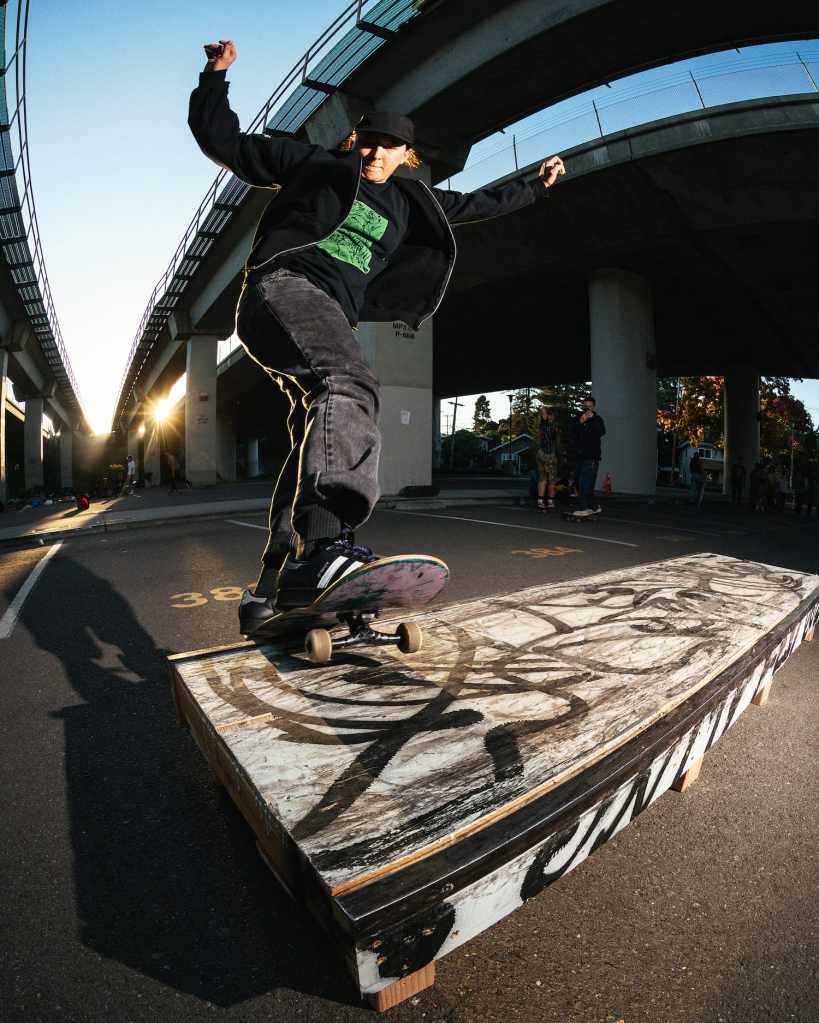
Photo: Unity Fest 2024 by Norma Ibarra, as seen in Thrasher
References:
- Archie, Rose. “Checking in with Jessie Van Roechoudt,” King Skateboard 11.3 (October 2019), p. 26.
- Bader, Rhianon. “Jessie Van Roechoudt,” SBC Skateboard 5, no. 2 (Summer 2003).
- Christian, David. “Jessie Van Roechoudt,” COLOR magazine 2, no. 1 (March 2002) 48-55.
- Koenigsberg, Adrian. “Episode 13: Jessie Van,” Quell Party (September 11, 2019).
- O’Dell, Patrick. “Skatelife: Jessie Van Roechoudt,” Skateboard.com (2003).
- Swan, Rachel. “Jessie Van Roechoudt: Pro Skater,” San Francisco Bay Guardian, November 2006.
- Van Roechoudt, Jessie. “How Rookie skateboards shaped women’s skateboarding.” Jenkem Magazine & Quell Skateboarding (July 2, 2021).
- Whitaker, Lisa. “Spotlight: Jessie Van Roechoudt,” The Side Project.com (August 11, 2004).
- Whiteley, Mark. “Jessie Van Roechoudt,” Slap February 2001, 60-67.
- Williams, Denise. “Jessie Van Roechoudt,” Push December 2002, 11-16.
 Womxn Skateboard History