
In a recent visit to New York, I was encouraged by skateboarder C’naan Omer (Hamburger), who won Vancouver’s Slam City Jam women’s street in 2000, to reach out to Irene Ching. Irene is a vert roller-skater with a long legacy going back to the 1970s, and I trusted C’naan’s recommendation. In this archival project, I hadn’t planned on deviating away from skateboarding, but Irene’s story and photos caused me to pause and reconsider especially after our conversation on August 18, 2024.
While some hardcore skateboarders are hesitant to accept this, skateboarding and roller-skating are bound together. In the 1960s, we repeatedly hear that youth dismantled their roller skates and applied them to a piece of 2×4 to create their own DIY skateboards, which means we are indebted to rollerskating. There’s even an early skateboard company called The Roller Derby, paying tribute to competitive roller-skating.
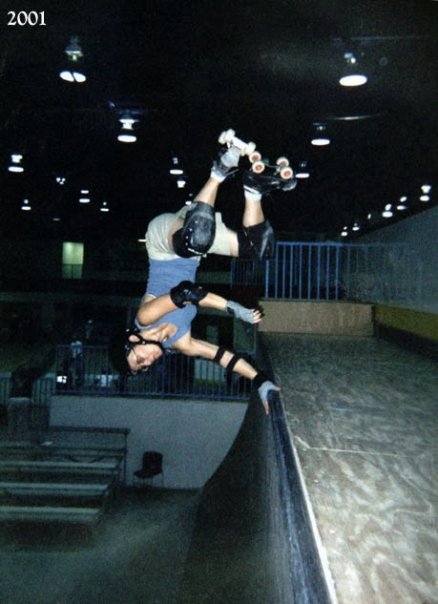
Photo: RexPlex NJ, Ray Mendez
And then, in the 1970s at skateboard parks it was common to have both skateboarders and roller-skaters enjoy the space together without tension. On occasion, leading roller-skaters like Fred Blood, Duke Rennie, and Kenny Means had photos and interviews included in skateboarding magazines [See: “Blood & the Boyz” by Denise Barter in Action Now, November 1980]. There seemed to be mutual respect in these communities regardless of what was under their feet because it was the vertical terrain that unified them.
And yet, in these reports of vert roller-skaters there was no mention of women’s accomplishments, women like Irene Ching. Perhaps it was assumed that female roller-skaters stuck to Venice Beach, cruising around in bikinis listening and dancing to Disco music, but there’s always going to be exceptions, and Irene was one of them.
Over on the east coast, Irene grew up on South Street next to the East River in NYC and had taken up ice skating around age 9 and then begged her dad to get her rollerskates from the 5 & 10 store. “These were steel clamp-ons with loose ball bearings and a skate key to adjust them to fit your shoes.” And, just like skateboarders in the 1970s have reported, everything changed for roller sports with the evolution of wheel technology because of urethane. In an interview from Dogdays it’s written that, “It wouldn’t take long for Irene to discover her love for vert. While her friends would rather skateboard, Irene stuck with her quads and just emulated her tricks first from skateboarders and later form side surfing roller skaters from the west coast.”
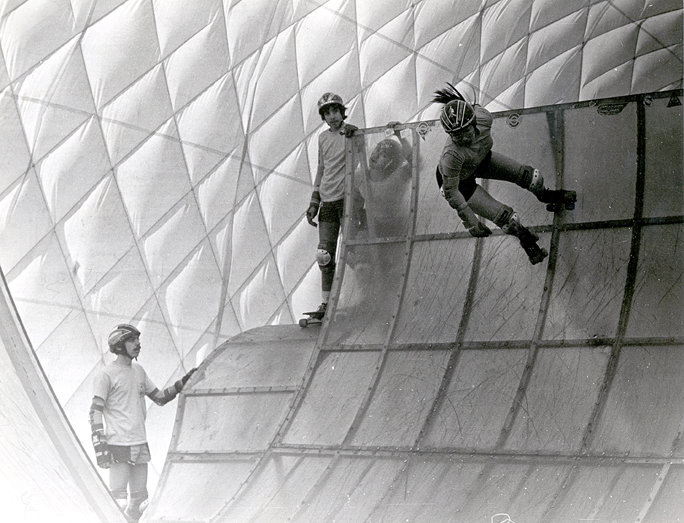
Photo: Irene Ching on the plexi-glass ramp at Skateboard City, Staten Island, NY in 1978. Irene said that it was a bit of an ordeal to get there with multiple trains and a hike, but worth it.
Irene was the only woman pursuing vert in her community, whether it was on skateboards or roller skaters, and she wasn’t remotely phased by it. “First, we all started with street skating, the usual jumping over things, going through traffic and just finding whatever obstacles you can find in a city. And we did a lot of downhill. We did a lot of dancing; many of my skateboarding friends did roller skate. We skated in Central Park…” Irene explained to Dogdays that in New York it was rare for anyone to own a car, so it really was all about transportation and having fun, like hanging on to cars going uphill and catching a free ride (aka “skitching”). “It was funny, mostly the taxi drivers were OK with it. It was fun for them too I think.”
Irene eventually purchased a skateboard around the age of 17 or 18. “I happened to get a job at a sporting goods store and they at the time just decided to open up a skateboarding department. It was probably in 1978 or 1979 when those big red Krypto wheels came out. They were super soft so you could skate over everything. And that’s what blew it up really for city people.” Irene briefly attempted to skateboard at the first skate park she went to, but without any instruction, she opted for roller skating along with a friend. “That’s really how it happened, because it would have never dawned on me, on my own, to try to roller skates. It being my first skate park, without knowing anything about what to do and not to do. Then I started seeing pictures of roller skaters from the West Coast in skate magazines once in a while. And I was like, OK, it’s a thing.”
To skate vert on roller skates, the preferred method was “side surf” with your heels facing inwards, so the wheels are aligned in a row. Irene explained that she remembered learning this move as an ice skater, which was called a spread eagle.

At the local skatepark called “Skateboard City” on Staten Island, the scene was all guys, but Irene said her presence was mostly accepted. “I think it was more the young boys that I would get crap from in the early days… just silly boy stuff. It was nice when I started seeing more women coming into the parks, it definitely felt good to have that different type of energy instead of all the testosterone the entire time.” In the 1970s, since Irene was working at the sporting goods store, she was used to being surrounded by guys, and while a younger girl might occasionally appear at the park, there was no consistency.
Over in Europe, in the 1980s, the connection between skateboarding and roller-skating continued, as seen at events in Germany like the Münster Monster Mastership. The footage of the contest inspired Irene to keep going. “Europe seemed to be like a bigger scene for roller skaters. I think they were more accepting of it, like they didn’t try to hide it because a lot of those guys skateboarded too.”
In the 1980s, Irene was also still in the mix with her skateboarding / roller-skating community. In fact, her photo of David Hackett, skateboarding at the Brooklyn Banks was published in the June 1988 issue of TransWorld magazine.

Photo: Irene at Jersey shore ramp by Mark Sullivan in 1990
In her interview with Dogdays, there was significant discussion about the naming of tricks, and the adaption of surf, skiing, snowboarding, and skateboarding terms, the different roller-skating styles, and the whole history that goes back ultimately to ice-skating. But the fact remained that Irene was a novelty as a female vert roller-skater and held her own whether the X-Games included it as a competitive sport or not.
In a zine called Mimi’s Revenge from 1995/96 there’s an interview with an artist named Maura Sheehan who gives Irene a shout out! Maura created a vert ramp in 1995 as a kind of temporary art installation inside the Brooklyn Bridge Anchorage called “Culture Bridge: a social sculpture” as described in Thrasher, November 1995.

This ramp is important for women’s skateboarding history because it’s where the female co-owners of Rookie Skateboards, Catharine Lyons and Elska von Hatzfeldt (Sandor) first met at the launch party. In Mimi’s Revenge, Sheehan acknowledged that Irene was skating alongside leading locals like the Lopez brothers (Rich and Sanford), Dan Zimmer, Steve Rodriguez and Sean Greene, and that she “is as good as any of the guys.” Maura also said there was a girl’s night (9pm-1am) on Thursdays, to try to make the ramp more inclusive.
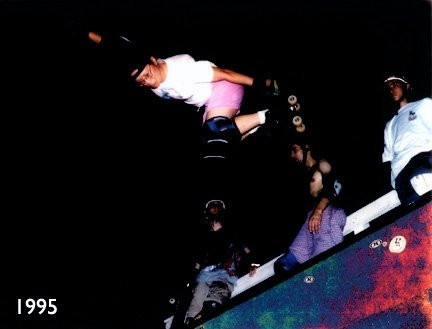

Photo: Irene at the Brooklyn Bridge ramp 1995 (photo: Jay Kuznetz) and she is mentioned in The New York Times, July 14, 1995, review of the Brooklyn Bridge Anchorage.
Irene recalled that the Brooklyn Bridge ramp was only available for a few months during the summer “but it was such a great spot ‘cause in there it was nice and cool and damp indoors. Outdoors it was hot and sweaty. Yeah, it was such a great refuge and it was our crew, like a family.” Irene would access the ramp at least twice a week and said it was “phenomenal!” Since there weren’t many options, the skate sessions were aggressive and intense, but Irene was up for it.
And, speaking of Steve Rodriguez of 5boro, Irene said that he had always been really kind to her. “He’s like the skateboarding mayor of New York City… he got [Brooklyn] Banks re-opened.” She also offered tribute to Andy Kessler (RIP) who passed away 15 years ago, as the godfather of NYC skateboarding, since he helped establish the first skateparks in NY.
Irene did share that there were times when she felt excluded, even with friends, since she would be the last person to get a seat in the car going to a skate session, but that all changed when she got her own ride. “I was actually all about taking the younger kids that couldn’t drive or go anywhere, the were like 13, 15, 16.” Irene knew they needed the opportunity to do something positive like skate and stay out of trouble, so she loaded them in, “the more, the merrier.”
In the 1990s, the attitude by the general public towards wheeled sports, both skateboarding and rollerblading became hostile with gear getting confiscated, fines issued by cops, and tensions with security guards. There was also a growing rift between skateboarders and rollerbladers, perhaps because space was so territorial and because of the immaturity of young men who went so far as to condemn rollerblading as queer, which was sadly, the ultimate insult during an era where AIDS impacted gay men and a stigma towards them was cultivated out of fear and ignorance. The skateboarding industry in the 1990s was fragile, and some skateboarders would lash out at any perceived threat to their identity as heterosexual and masculine, and that included rejecting roller-skaters.


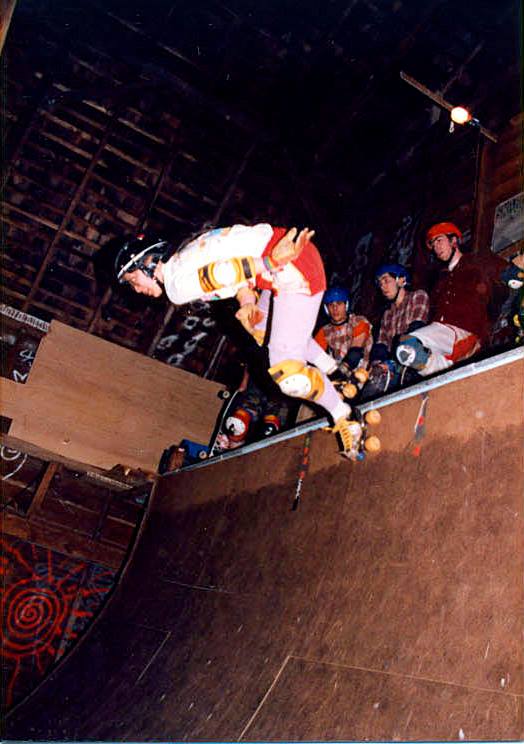
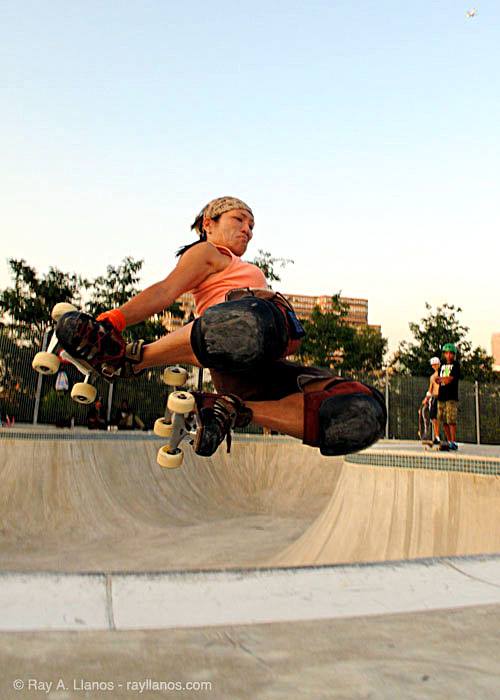
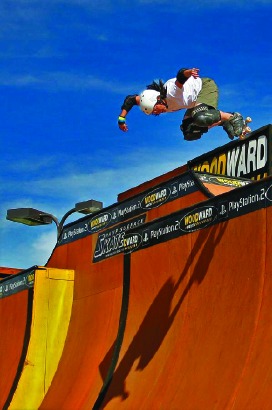
But through it all, Irene forged on, and mostly stayed clear of the various controversies and trends, preferring to develop her vert-skating skill as seen in the late 1990s and early 2000s on ramps like Rexplex in New Jersey, the Casino skatepark in Asbury, Woodward West, and Red Dragons ramp in Vancouver, Canada. Irene acknowledged fellow side-surfer, Brian Waingwright of North Carolina whom she witnessed skating at Woodward East and the Vans Warped Tour, still killing it in his 50s, just like Irene.
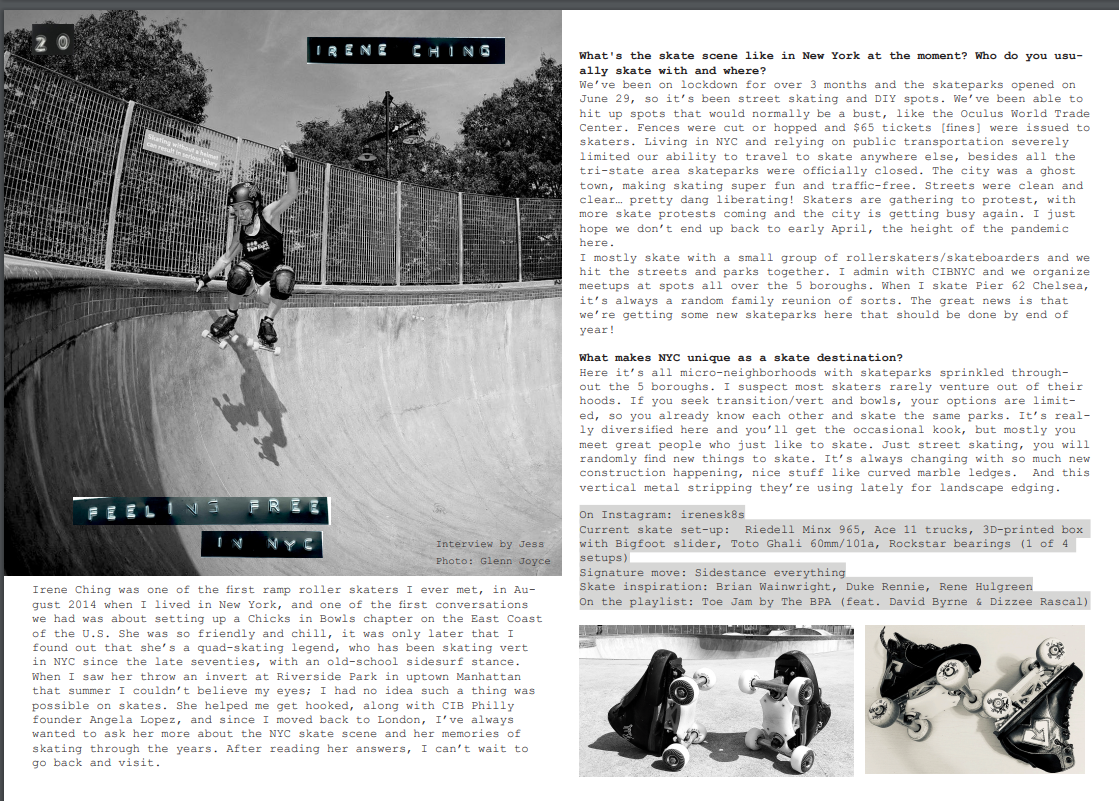

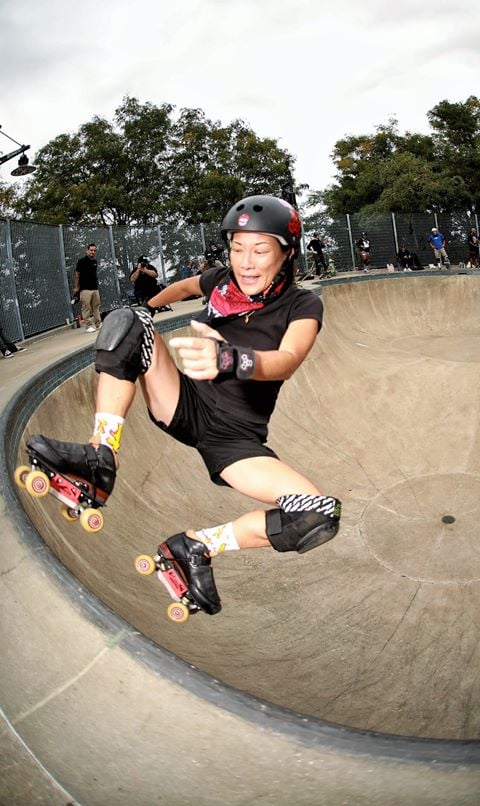
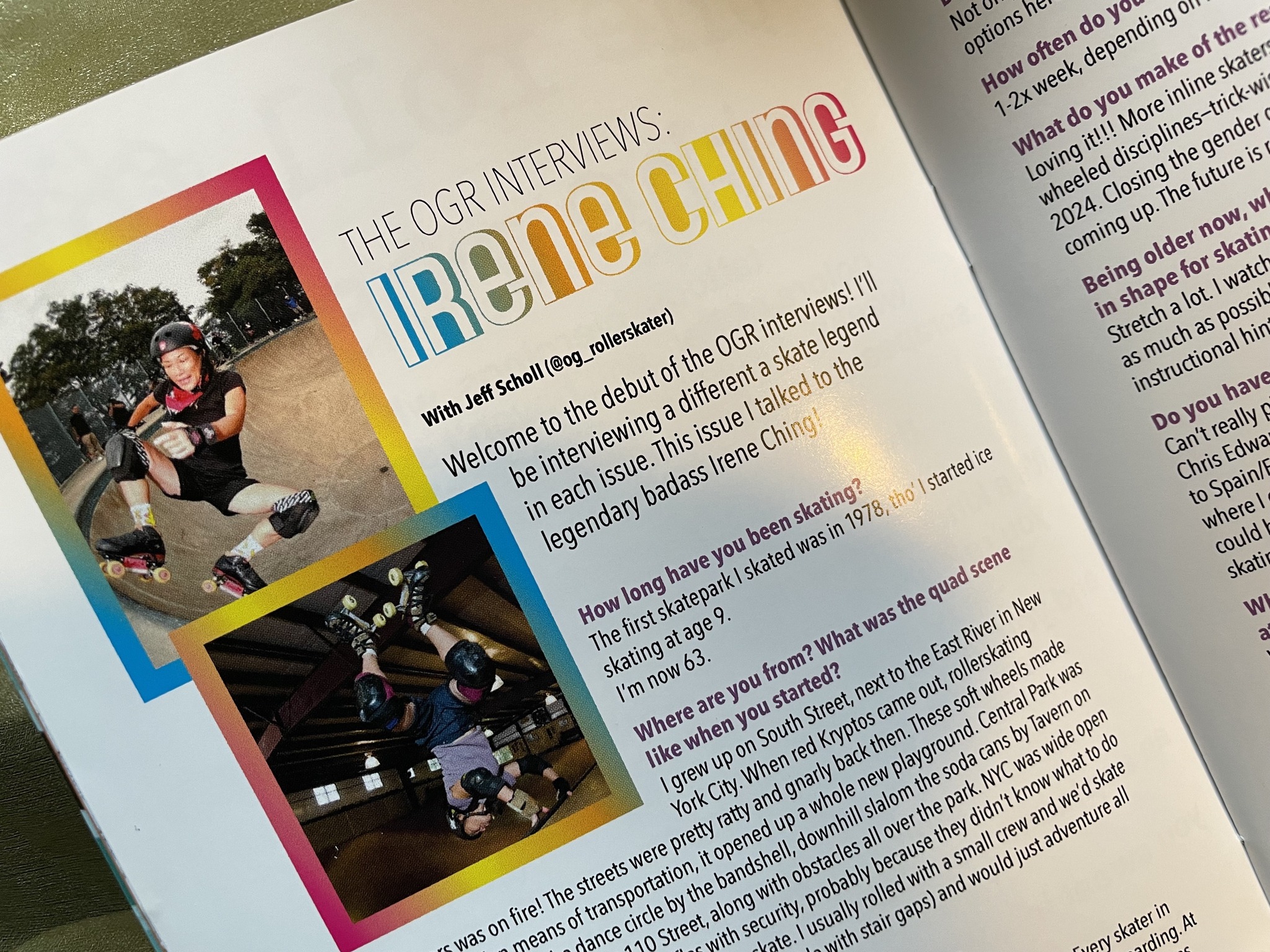
Irene is now in her 60s and is increasingly being recognized for her legacy. She had two photos from the Brooklyn Banks published in the book Full Bleed: New York City Skateboard Photography (originally published in 2010), and more recently interviews in zines like Staple Gun (August 2020) and Roller Rag Mag (Spring 2024). There’s been a real boom in roller-skating at parks likely connected to the impact of COVID. Irene explained that, since contact sports like Roller Derby were no longer permitted, individuals like Derby girls sought to claim some space in skateparks and, as a result, there’s been a massive return to roller-skating in pools, bowls, and vert.
Footage from 2007: Santa Monica skatepark
It’s awesome to see Irene being recognized and a slow return to a more respectful appreciation between skateboarders and roller-skaters considering our shared connections. It’s also been great to see a more diverse presence at skateparks, and even a mash-up of skaters switching back and forth between boards and roller-skates, just having a blast and challenging themselves.
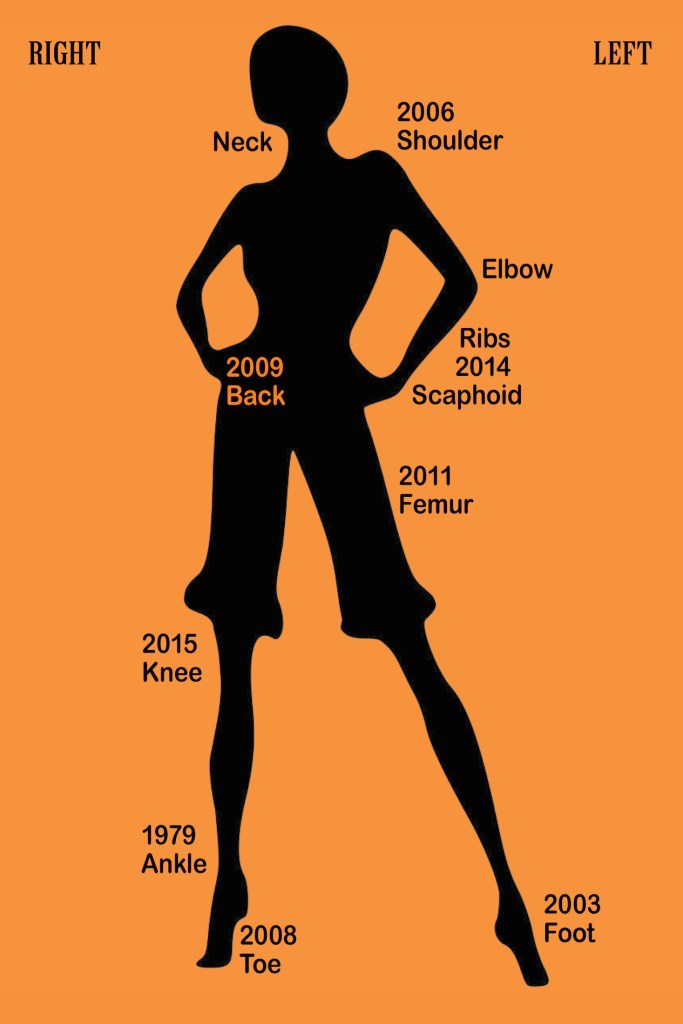
Irene had her fair share of injuries over the years and even has a “body map” to chart them, so these days she’s slowing down since vert skating requires consistent practise. And yet, Irene still enjoys the occasional street session accompanied by her little Chihuahua.
Thanks again, Irene for the conversation and history lesson!
Photos: Allen Gibsons, Glenn Joyce, Jay Kuznetz, Mark Sullivan, Ray Llanos, Ray Mendez, Ryna Tep.
References:
- Adinfinitum. “Irene Ching: skate bio,” Adinfinitum Vertical Rollerskating, February 2002.
- Dogdays. “Irene Ching: ‘We could get on the subway without being harassed,” Dogdays – Roller Skate Magazine, November 27, 2023 *Interview conducted November 2020.
- Mimi and Sushi Girl. “Interview with Maura Sheehan,” Mimi’s Revenge Zine No. 1 (1995-1996), p4.
- Porter, Natalie. “Personal interview with Irene Ching,” August 18, 2024.
 Womxn Skateboard History