
In Canada, we do things and call things a little differently than our American counterparts. Thanks to a friend and former Skirtboarder, Frédérique Luyet I was directed towards archival footage and an article from the CBC about “skurfing.” The definition of “skurfing” according to the Canadian newspaper, The Globe and Mail was “a craze which began about a year ago and involves coasting downhill on an 18-inch board fitted with roller skate wheels.” In the 1960s, the term “skateboarding” was in use, along with sidewalk surfing, but perhaps up north we wanted to make reference to skiing and how one weaves down a slope, or found the word “skateboarding” too cumbersome?
Regardless of the term, Canadian skaters in the 1960s had the same battles with police and city officials as kids south of the border as described in this feature from 1965 for the Weekend Magazine called “Rolling home on a push and a prayer. Skateboards: a fad for fun and fractures” by Melinda McCracken.


This video from June 1965 shows that skaters, regardless of gender wanted permission to skate. It was shared by the announcer that “the Police are directing a campaign to stamp out these menaces, but skurfers are organized too.” And then we’re introduced to Gai Cochrane, the “teenage president of the Ontario branch of the National Sidewalk Surfers of Canada,” explaining why the organization exists.
Gai was attending Etobicoke Collegiate in Toronto and cruised into her interview for CBC. When asked what her parents thought, she said, “They don’t mind just as long as I’m careful and don’t go on the road too much.”
They formed the Association because, “We were told by the Toronto Police that if we were in an organization, a whole bunch of kids together then we wouldn’t be not allowed to surf, they wouldn’t tell us to leave and take our boards away, instead of if we were by ourselves.”
The interviewer, Lloyd Robertsons replied, “They only bother you if you’re in twos or threes… Is this really dangerous?”
“No, it’s about as dangerous as bicycle-riding, if you can control your board then it’s alright for you, but if you can’t then you can injure yourself bad… you can take a bad fall if you’re going fast enough.”
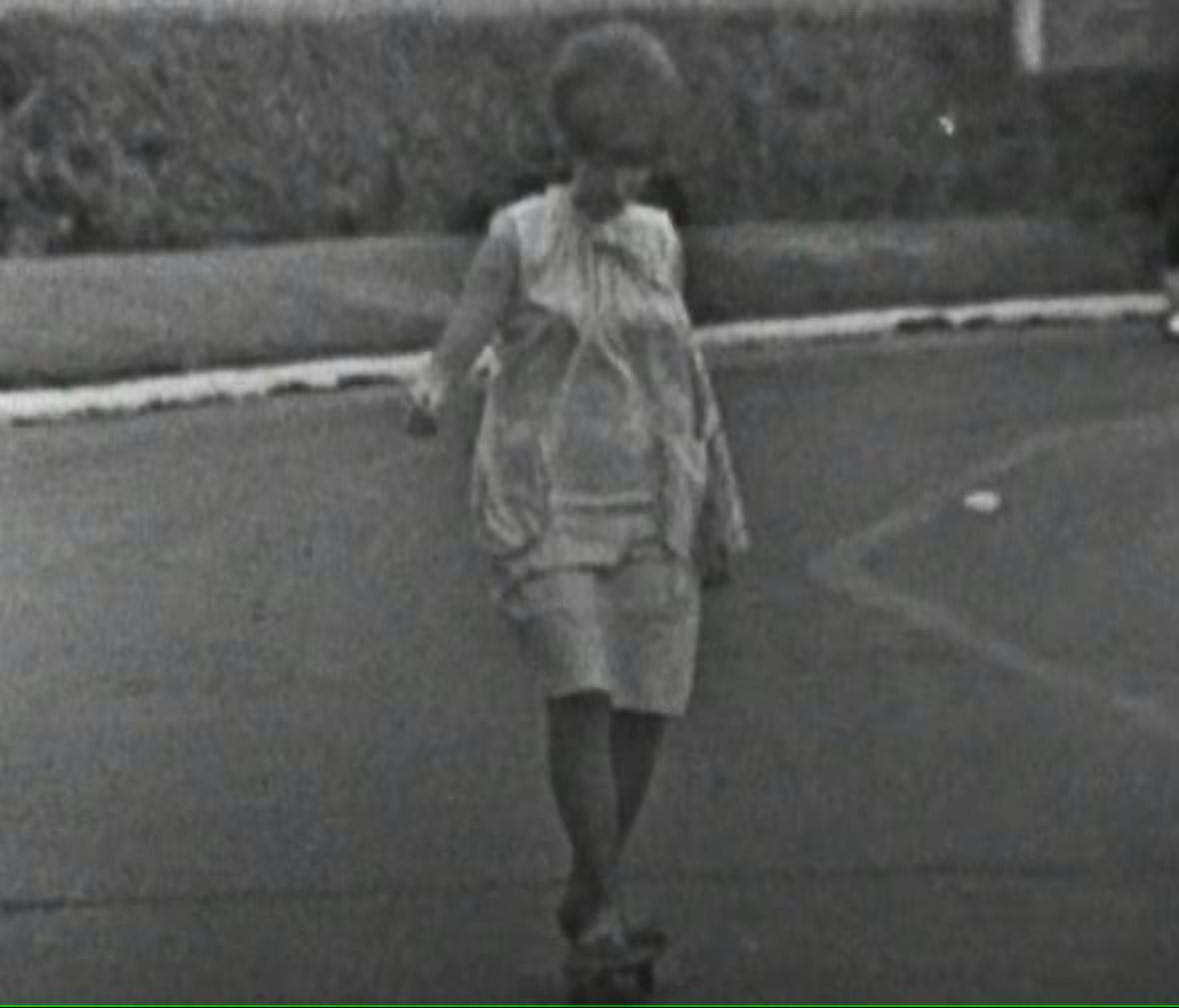

Gai was also asked her opinion on whether or not skateboarding would be obsolete in time, like the hula-hoop trend, which she promptly replied, “No, I think it’ll keep going. Well, in California it’s really catching on, going for two years now… I figure it’ll be longer than the hula-hoop.” She noted that another fad was putting a motor on the back of your board, which surprised the announcer who randomly replied that “well, you may be the first girl on the moon.” Poor Gai then had to give the bloke his first lesson.
Apparently, there had been some “forty fractures” in Ottawa, Canada’s capital city, a few weekends prior to this film feature thanks to skateboarding, and the Ottawa Citizen newspaper was following the debate closely. You can see the developments from curiosity about sidewalk surfing in the spring of 1965 and then the battle between police, city officials and skateboarding youth below…
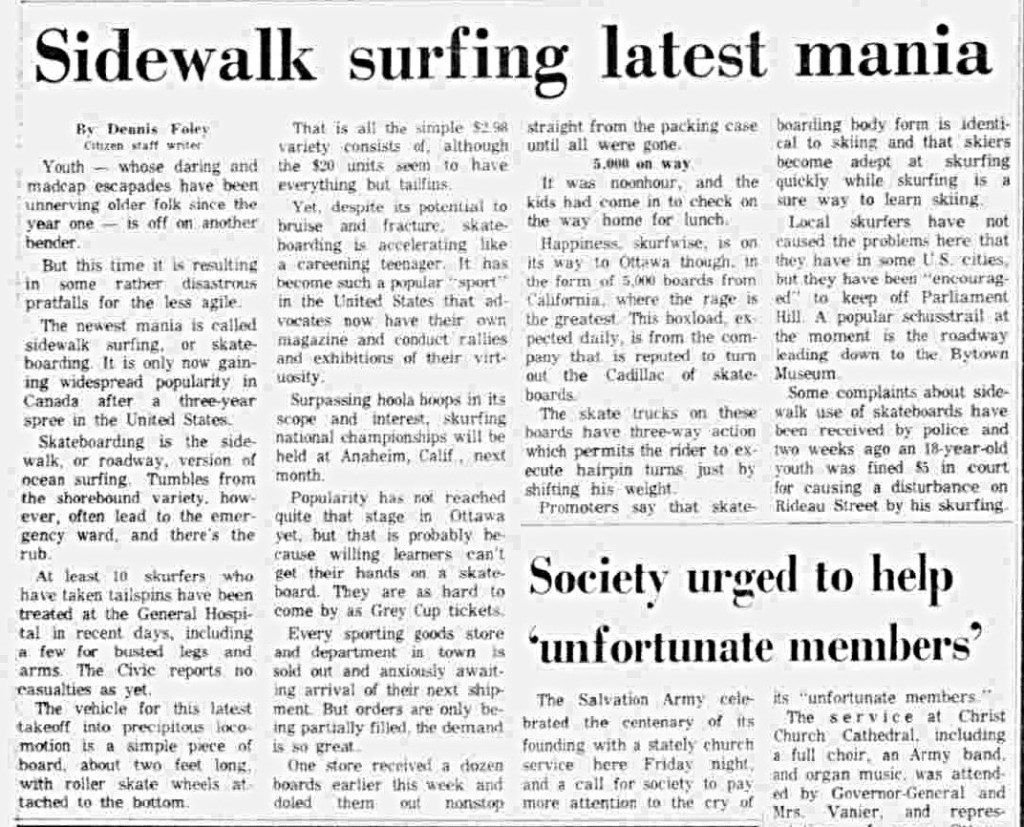
April 10th: “Sidewalk surfing latest mania” by Dennis Foley, who explains that skateboarding emerged three years prior in the U.S. and how 10 “skurfers” were taken to hospital in recent days, meanwhile all the sporting goods stores were sold out of skateboards and orders were only being partially filled because the demand is so great. There was a warning for skurfers to keep off of Parliament Hill and an announcement of the national championships in Anaheim the following month, May 1965.
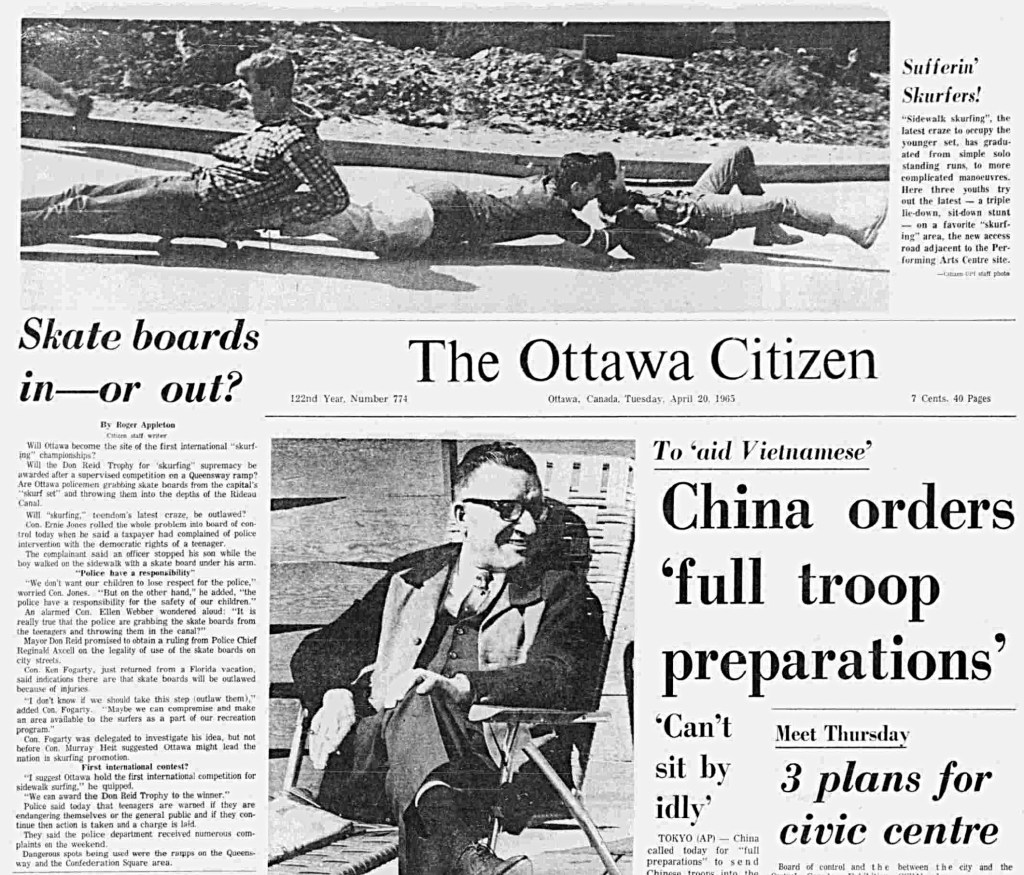
April 20th: “Skateboard in—or out?” by Roger Appleton, who reports on rumours of police throwing boards in the Rideau Canal and Mayor Don Reid’s promise to obtain a ruling from Police Chief Reginald Axcell on the legality of skateboard use. Constable Fogarty wondered, “Maybe we can compromise and make an area available to the surfers as part of our recreation program?” Constable Murray Heit even wondered if Ottawa could hold the first international competition for sidewalk surfing.
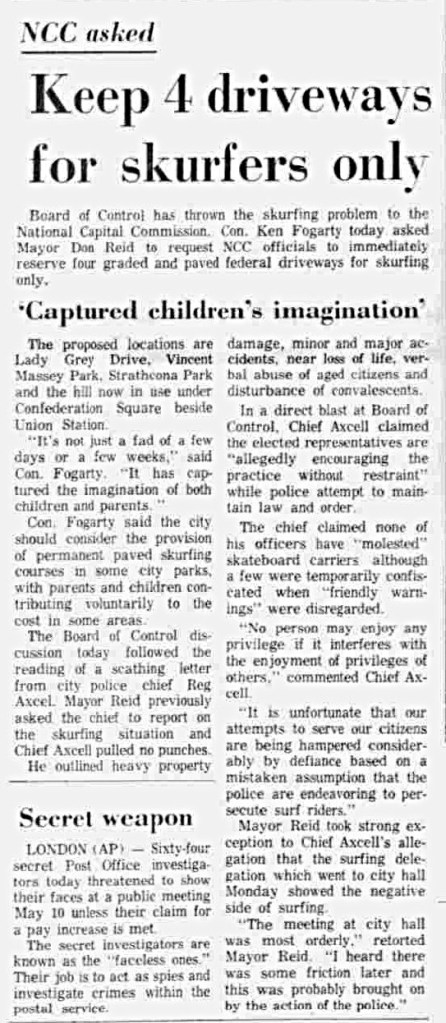
April 22nd: “Keep 4 driveways for skurfers only” on the cover page begins with a proposition that certain driveways be delegated for skurfing, with Constable Fogarty proposing “the provision of permanent paved skurfing courses in some city parks with parents and children contributing voluntarily to the cost in some areas.” Fogarty believed that “It’s not just a fad of a few days or a few weeks… It has captured the imagination of both children and parents.” But obviously there was some tension on the force. Police Chief Axcell had apparently written a scathing letter and felt he needed to clarify that “none of his officers have ‘molested’ skateboard carriers,” although why he would need to say this suggests otherwise. “It is unfortunate that our attempts to serve our citizens are being hampered considerably by defiance based on a mistaken assumption that the police are endeavoring to persecute surf riders.”
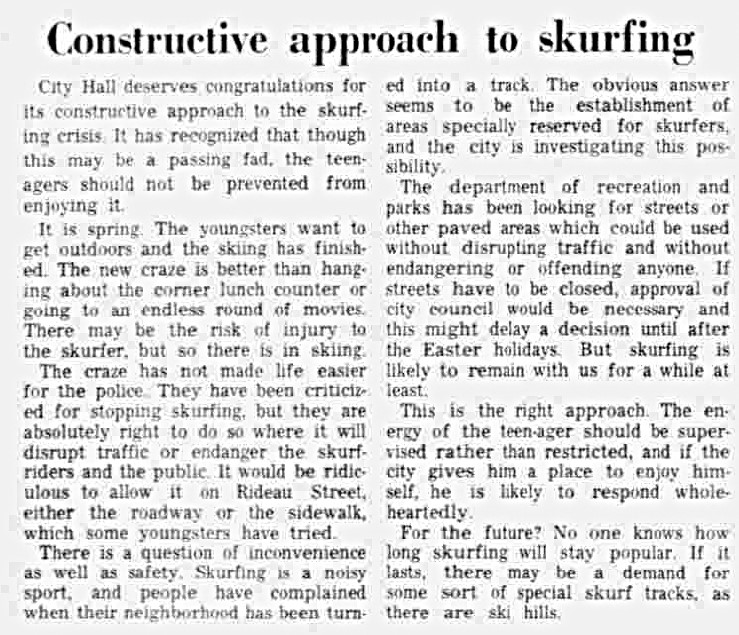
April 22nd: “Constructive approach to skurfing” was an editorial on page six summarizing the debate about the new craze. “The energy of the teen-ager should be supervised rather than restricted, and if the city gives him a place to enjoy himself, he is likely to respond wholeheartedly,” was the conclusion. There was a vision of “special skurf tracks” like ski hills for the youth to practise on.
April 24th: “Skurfing” is the title of a letter to the editor by Barbara Edwards, Grade 9 of Rideau High School in Ottawa. Barbara said, “I disagree with the statement you printed that the Ottawa police don’t have anything against us teen-agers skurfing. If this is so then why do they take away our skurf boards, or even worse, our skurfing haven? All we want to do is have a little bit of fun… the police stop us and give us a lecture… If they are not against us then why do they do this?”

May 3rd: “Boat line operator: ‘Skurfers keeping tourists away.’” There are claims that skateboarding is an epidemic and that skateboarders are blocking the entrance to the docks below the Chateau Laurier, and ruining tourism by preventing tourists from gaining access to cruise boats.
May 7th: “Skateboards: more a way of life” by the Canadian Press interviews police across the nation with the emphasis mostly on the negative aspects of skateboarding like injuries and traffic jams. Apparently, some neighbourhood streets in Dartmouth were practically blocked off because there were so many kids skateboarding. The article even noted a rumour, which the Ottawa police tried to deny, that they were throwing kids skateboards into the Rideau Canal.

Only a single policeman in Vancouver wisely observed that skurfing was “more a teenage way of life,” than a fad. Sadly, even when a sporting goods store in Edmonton tried to make a compromise, by negotiating with the owners of parkades to be enjoyed by “skurfers” on Sundays, his efforts were rejected. The concluding statement from the Quebec Safety League was that skateboards should be banned outright. Not a single skateboarder was interviewed.
**Meanwhile, Mayor Angus Campbell of Pembroke, Ontario blocked off a street from traffic for “skurfing” as announced in the May 8, 1965, issue of The Gazette in. They even had a barrier of hay at the bottom, enhanced with strong netting to ensure that the kids have fun and stay safe.
May 21st: “Ban on street skurfing urged: injuries alarming” by Doug MacRae showed how vehement the local police were in their big to get rid of skateboarding in Ottawa. Constable Murray Helt no longer wanted a contest (as proposed on April 20) but used injury statistics and heated language, like called skurfing a “guided missile.” He claimed he had no personal feelings, but then stated that his preference was an outright ban. And then his colleague, Chief Axcell tried to defend his department’s actions even though there were reports of the police being “spoil-sports,” which he felt were exaggerated and out of proportion. So, calling skateboards missiles is okay, but police can’t handle being called spoil sports. Classic.

May 22nd: “Skateboard set put out by ban plan” by Doug MacRae turned to the skaters to hear their opinion of the proposed ban because about 100 teens stormed the newspaper “protesting a traffic committee resolution to ban the boards from public property for safety reasons.” They suggested that skurfers were actually a tourist attraction and gives people a laugh. Sheldon Zack said, “We have to do something, and right now skurfing is it.”

August 6th: “Skurfing ‘out’ for teen-agers: Doctors, police happy.” It was a sad predicament for skateboarders and shopkeepers when the official ban was laid down. A photo showed kids, back in April joyously trying out their skateboarders versus the end of summer with a photo of a pile of skateboards reduced from $5.99 to $2.19. The police closed their favourite ramp, which resulted in outraged “skurfers” demanding an alternate site from city hall, but apparently things began to fade and the nemesis, Police Chief Axcell was smug said, “we foresaw the danger in this fad long before anyone else seemed to… we have no problem now.”

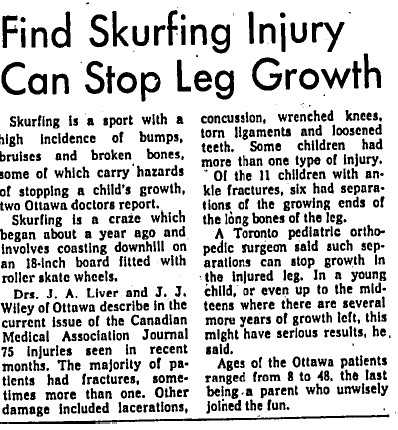
A month later, in the Globe & Mail from September 22, 1965, an article called, “Find Skurfing Injury Can Stop Leg Growth,” made a dramatic claim. Two Ottawa doctors believed that “skurfing” could stop a child’s growth because of the potential for injuries. “Drs. J.A. Liver and J.J. Wiley of Ottawa describe in the current issue of the Canadian Medical Association Journal 75 injuries seen in recent months… Of the 11 children with ankle fractures, six had separations of the growing ends of the long bones of the leg… such separations can stop growth in the injured leg.” But then they admitted that the patients ranged “from 8 to 48, the last being a parent who unwisely joined the fun.”
It looked like skurfing was dead in the water in Canada, but not for long… this scene would soon return.

 Womxn Skateboard History