
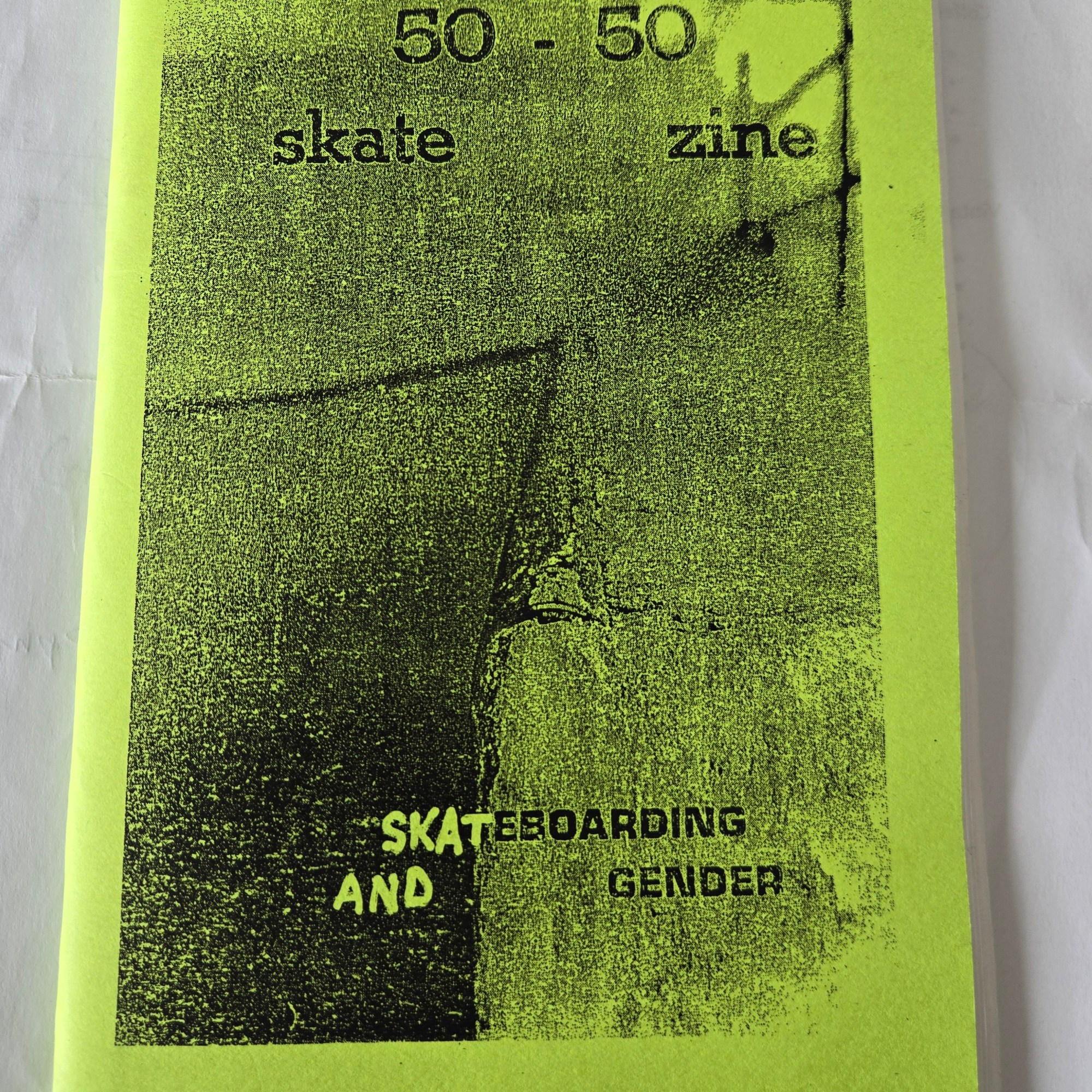
50-50 Skate Zine: Skateboarding and Gender by Zanna of Portland, Oregon came out in September 1999 and was 54 pages in length full of wisdom, rage, activism, insight and skateboarding!
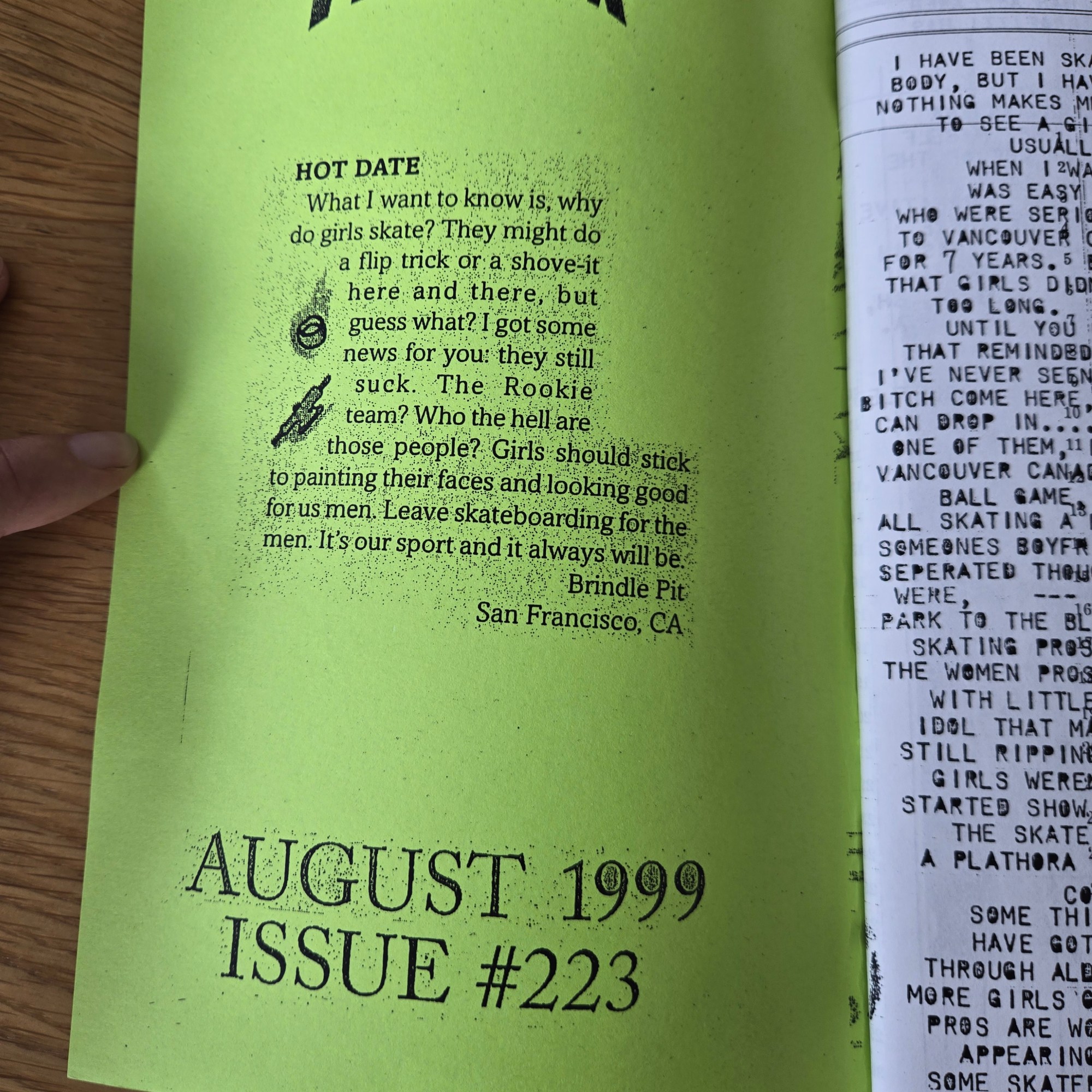
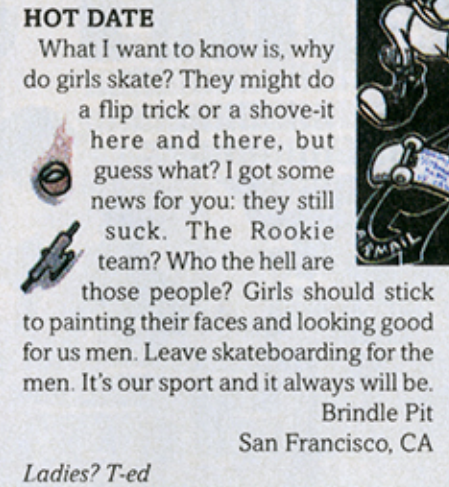
On the very first page, Zanna highlighted a scathing letter from the Mailbox page of Thrasher from August 1999 (issue #223) that condemned women skaters, in particular the Rookie team.
The letter captured the attitude that many young, entitled cis male skaters had in the 1990s and reveals what young women were up against. “Brindle Pit” of San Francisco wrote “What I want to know is, why do girls skate? They might do a flip trick or a shove-it here and there, but guess what? I got some news for you: they still suck. The Rookie team? Who the hell are those people? Girls should stick to painting their faces and looking good for us men. Leave skateboarding for the men. It’s our sport and it always will be.”
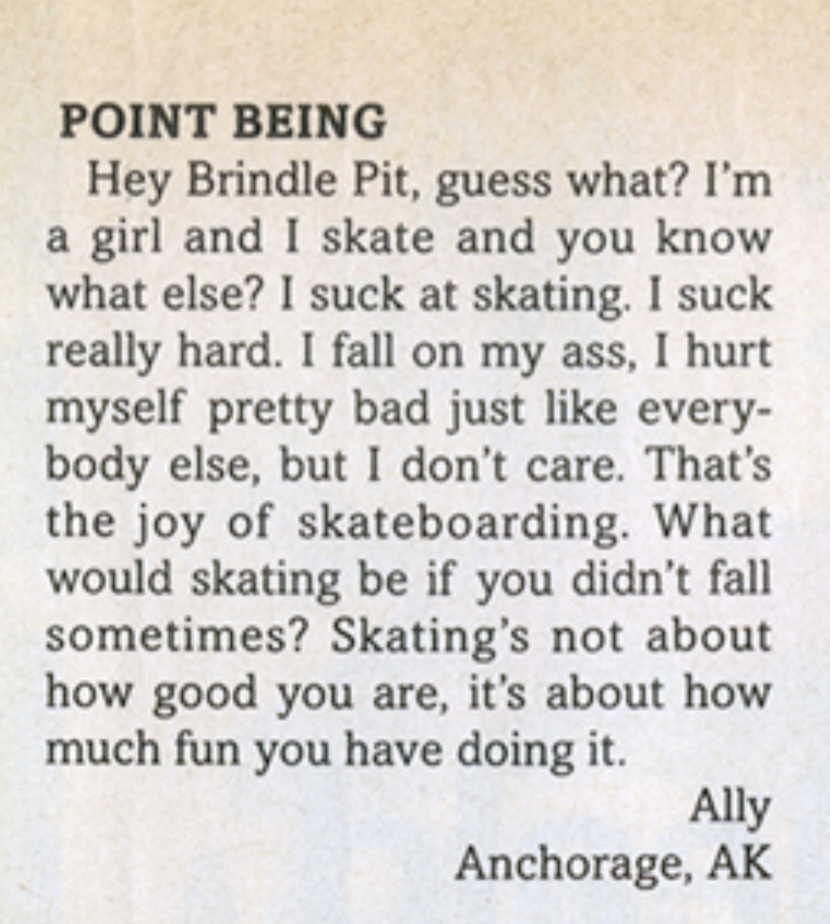
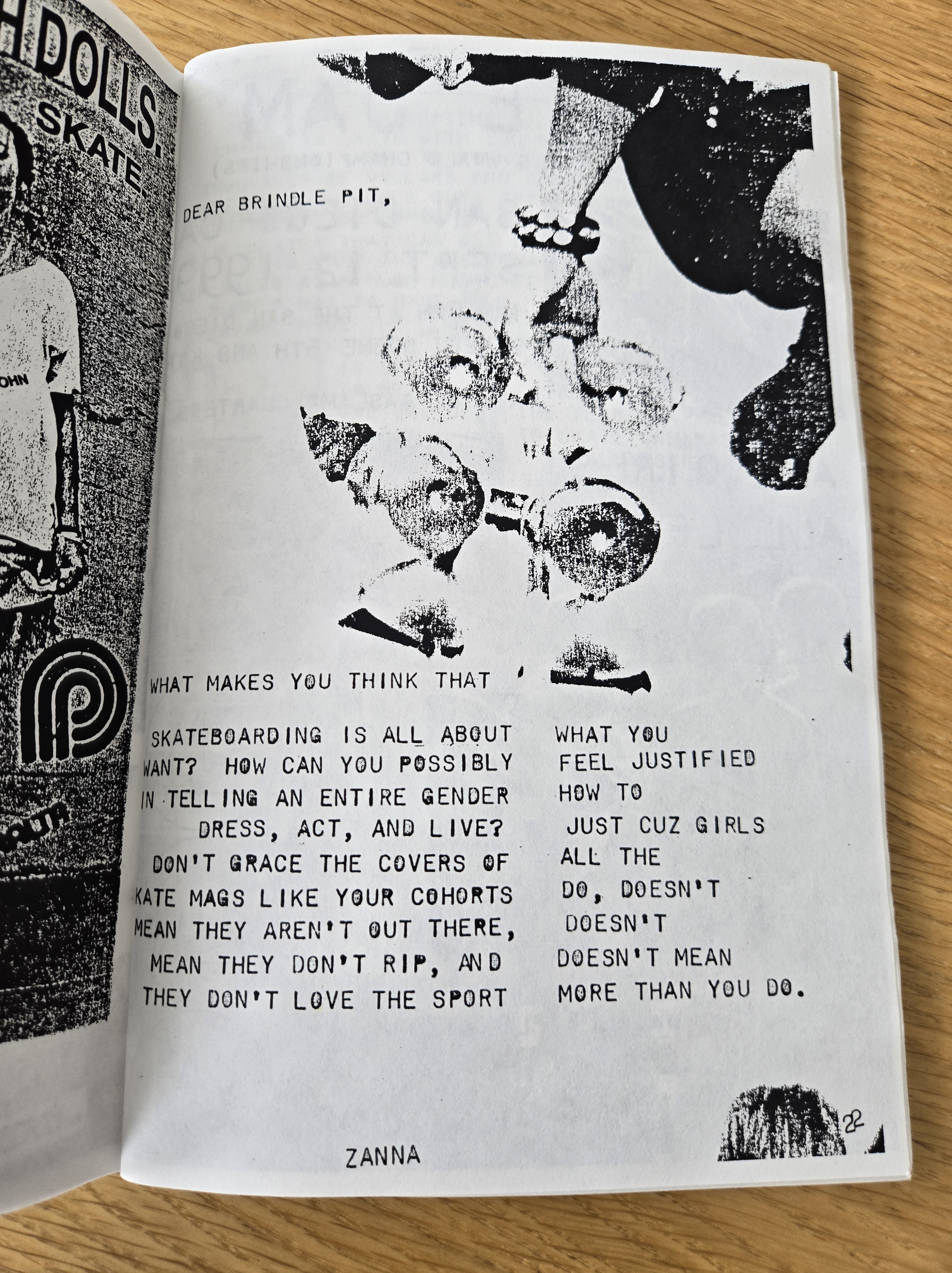
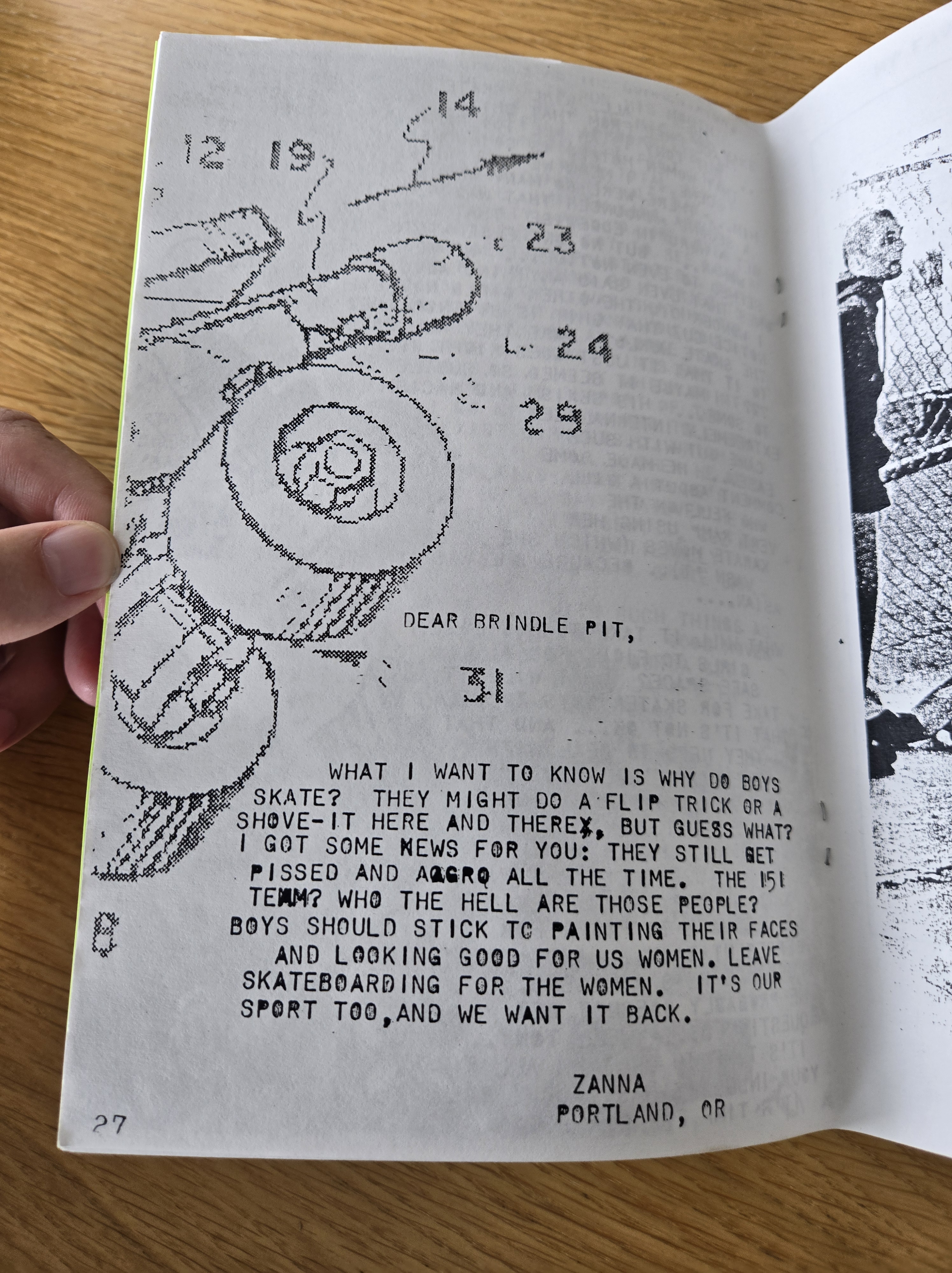
Fortunately, two issues later in the October 1999 issue, Ally from Anchorage, Alaska had some words of wisdom for Brindle Pit, but it was obviously triggering for Zanna who composed their own reply on page 22 and on page 27.
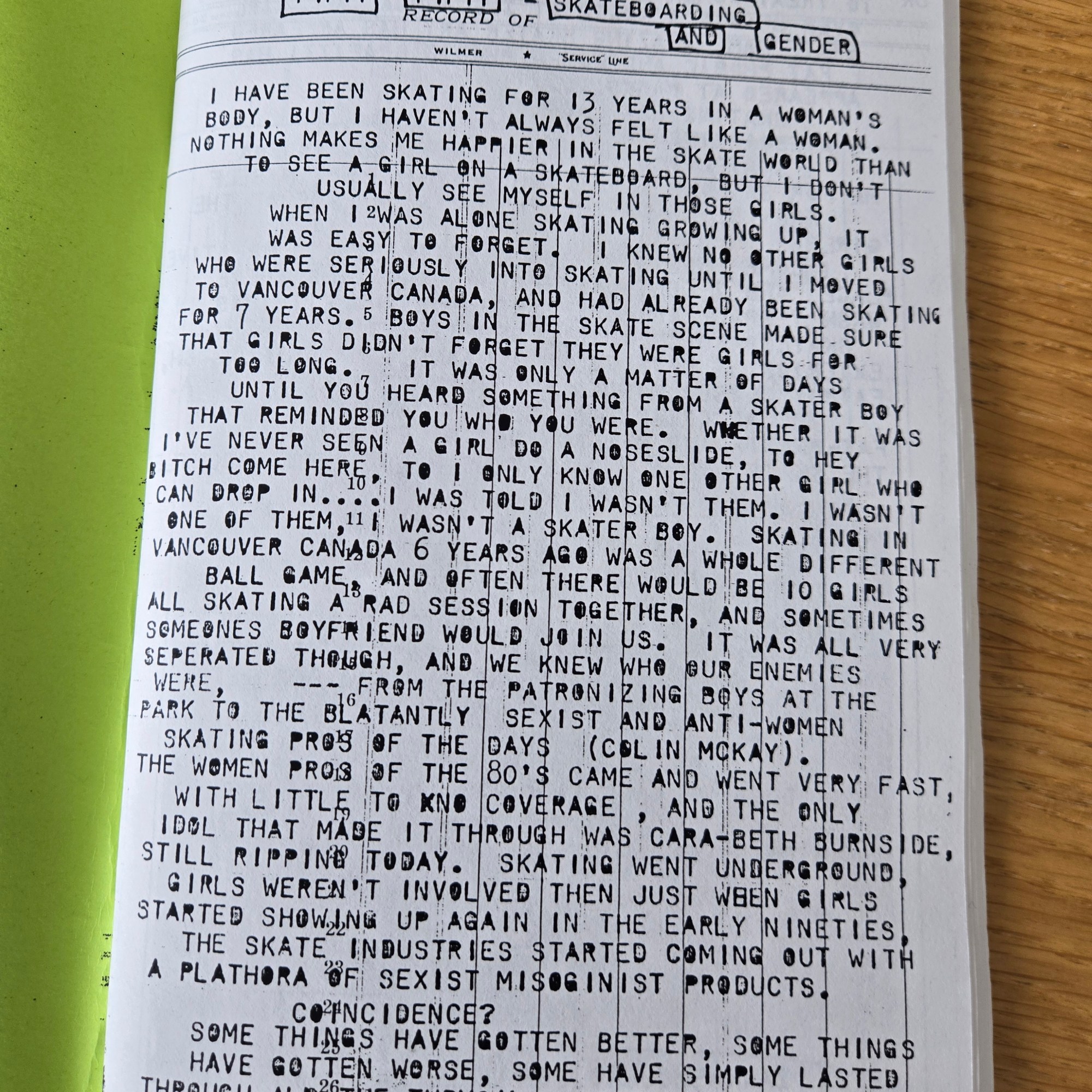
On page 3, Zanna reported that “I have been skating for 13 years in a woman’s body, but I haven’t always felt like a woman. Nothing makes me happier in the skate world than to see a girl on a skateboard, but I don’t usually see myself in those girls” (2). Zanna expanded on how frustrating it was to be constantly reminded by male skaters of their gender and place in the hierarchy. While Zanna appreciated skating with a crew of ten girls at a rad session in Vancouver, “We knew who our enemies were,—From the patronizing boys at the park to the blatantly sexist and anti-women skating pros of the days (Colin McKay)” (2).
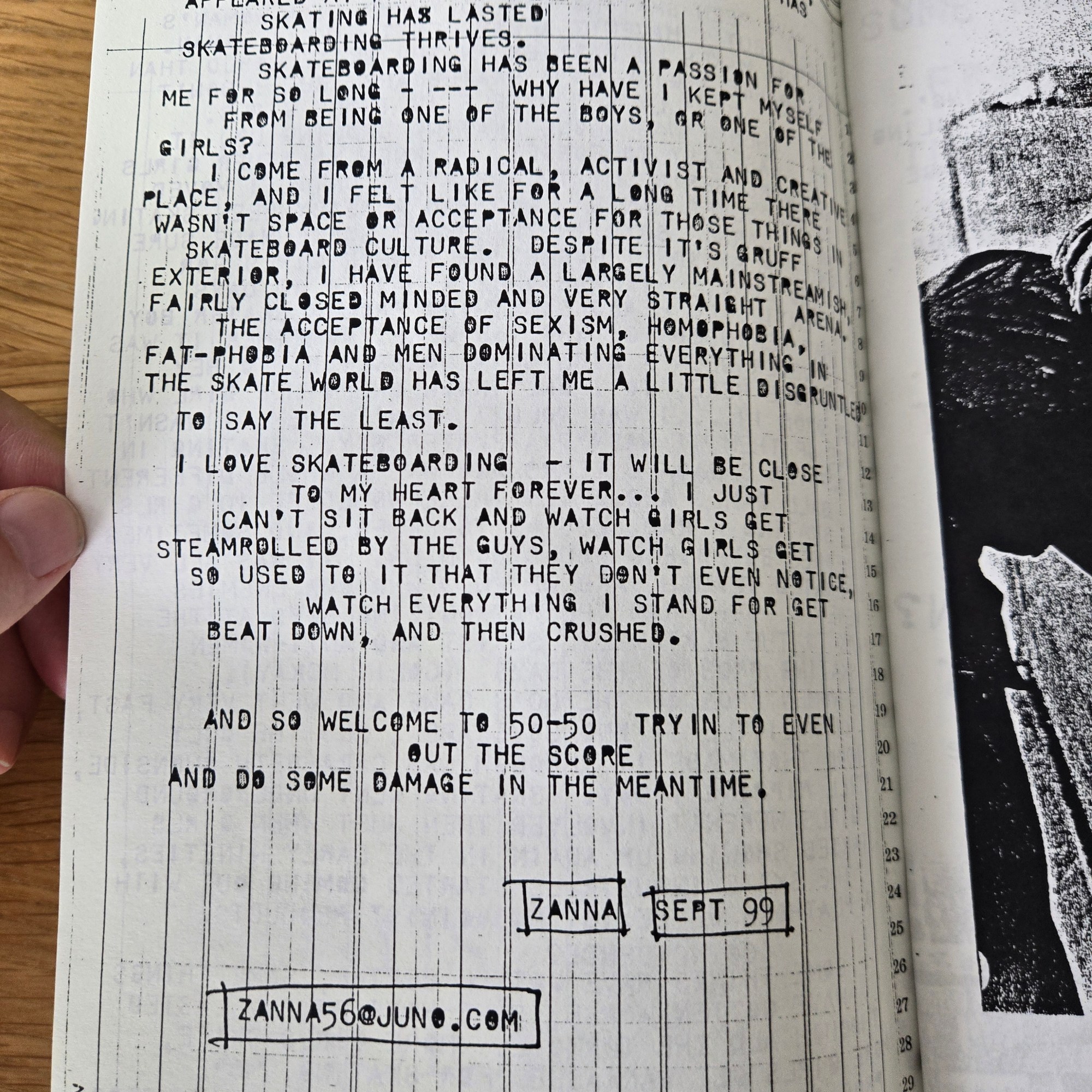
Zanna was hopeful thanks to the recent All Girl Skate Jam which drew over 85 girls, but they were still combatting graffiti at the skatepark that was sexist and fat phobic. “I love skateboarding – it will be close to my heart forever… I just can’t sit back and watch girls get steamrolled by the guys, watch girls get so used to it that they don’t even notice” (3).
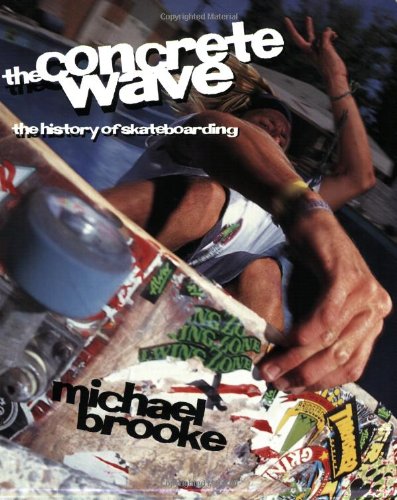
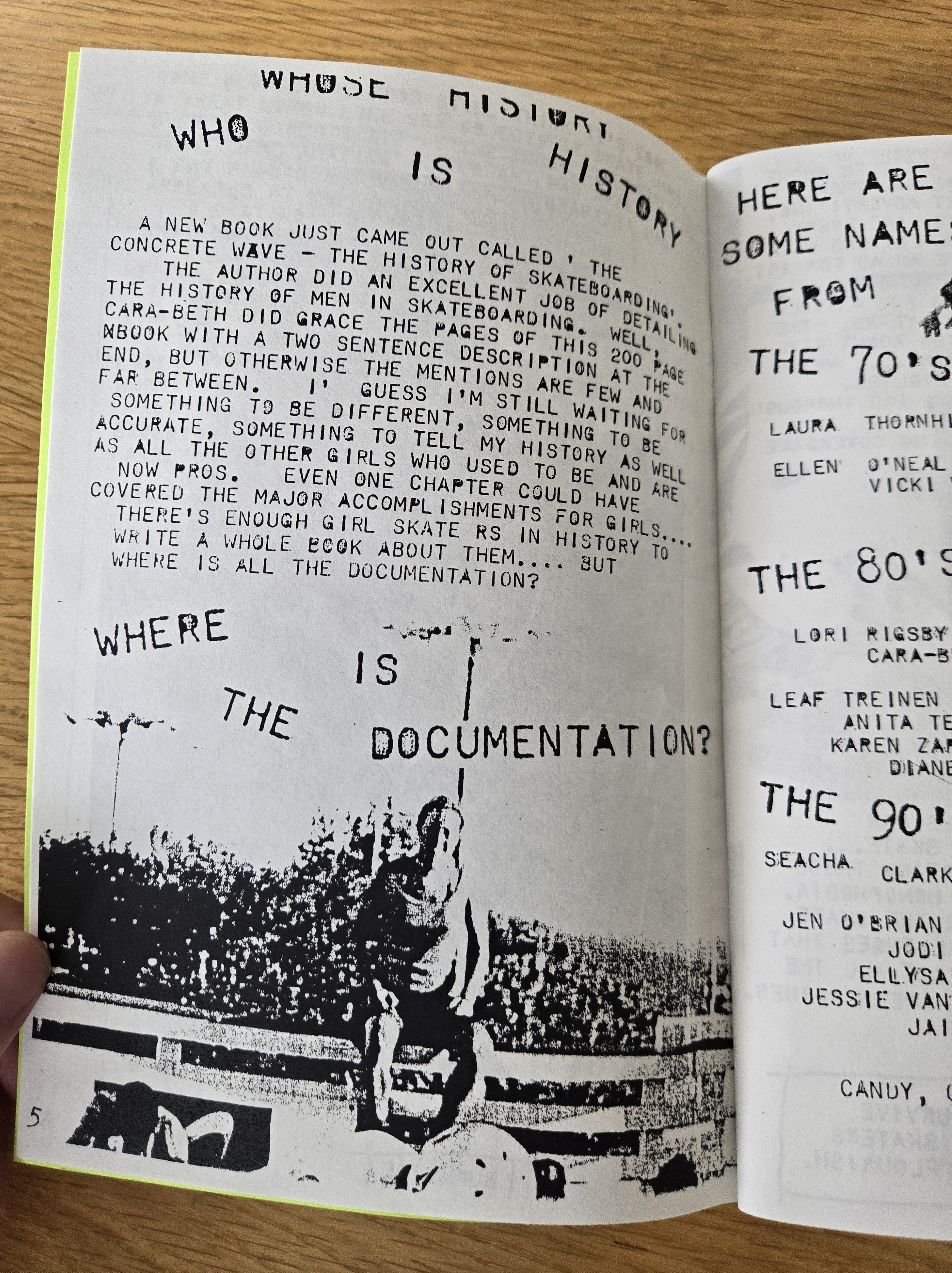
The zine included a critique of the book The Concrete Wave – the history of skateboarding from 1999 by Michael Brooke. And when Zanna wrote, “There’s enough girl skaters in history to write a whole book about them… but where is all the documentation?” (5) I got shivers! I’ve always felt the same way, and this kind of cry in the dark from 1999 really motivates me to keep going with this archive. Zanna then listed some names that now have bios on the site!
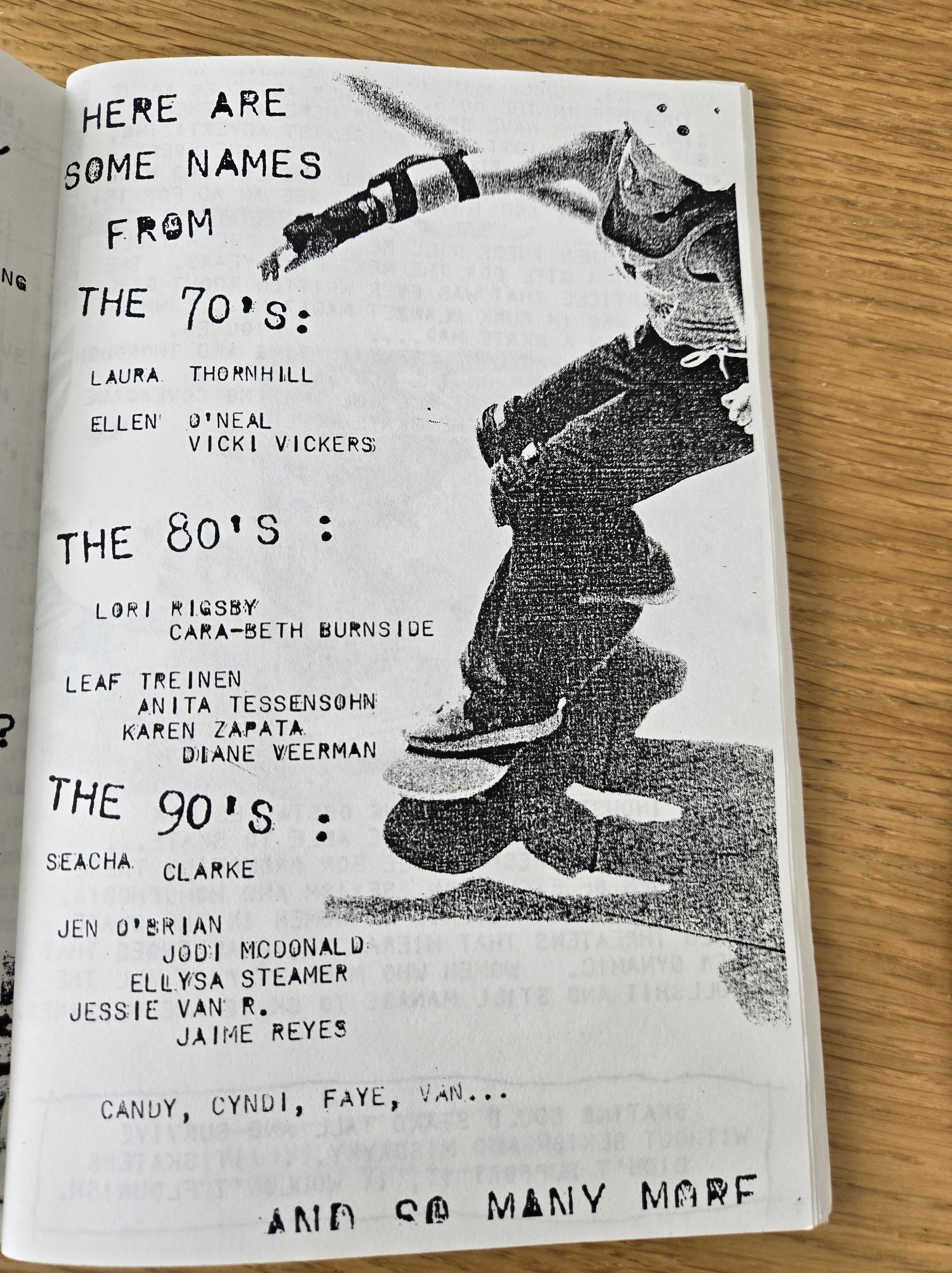
1970s: Laura Thornhill, Ellen Oneal, Vicki Vickers
1980s: Lori Rigsbee, Cara-beth Burnside, Leaf Treinen, Anita Tessensohn, KZ Zapata, Diane Veerman (Desiderio)
1990s: Saecha Clarke, Jen O’Brien, Jodi McDonald, Elissa Steamer, Jessie Van Roechoudt, Jaime Reyes, Candy Kramer, Cindy Gorset, Faye Jaime, Van Nguyen
From page 31 to 50, the zine reproduced the entire article from Punk Planet issue 25 (May/June 1998) called “Not just boys’ fun anymore: the growing girls’ revolution in skateboarding” by Dan Sinker with photos by Patty Segovia. You can actually read the article online, scanned clearly for the internet archive.
Zanna wondered why such fantastic coverage always seemed to occur in publications outside of the skateboarding industry, which is a great question! The 1990s skateboarding industry was creating obstacles for women and promoting “attitudes of exclusion, sexism and homophobia” (7). Zanna explained that, “I’m not against women empowering themselves through pornography or nudity, I’m against the skating industry using naked women as a tool of oppression against all women, especially women who skate. It is used as a tool to keep women out of the sport, and the men involved sexist enough to think that women shouldn’t be involved anyway. Whatever. It all just works as a continuous cycle that perpetuates the fact that skating is all about the boys. I mean I still get the excuse from boys that girls just don’t look good with scraped up knees and bruises” (10).

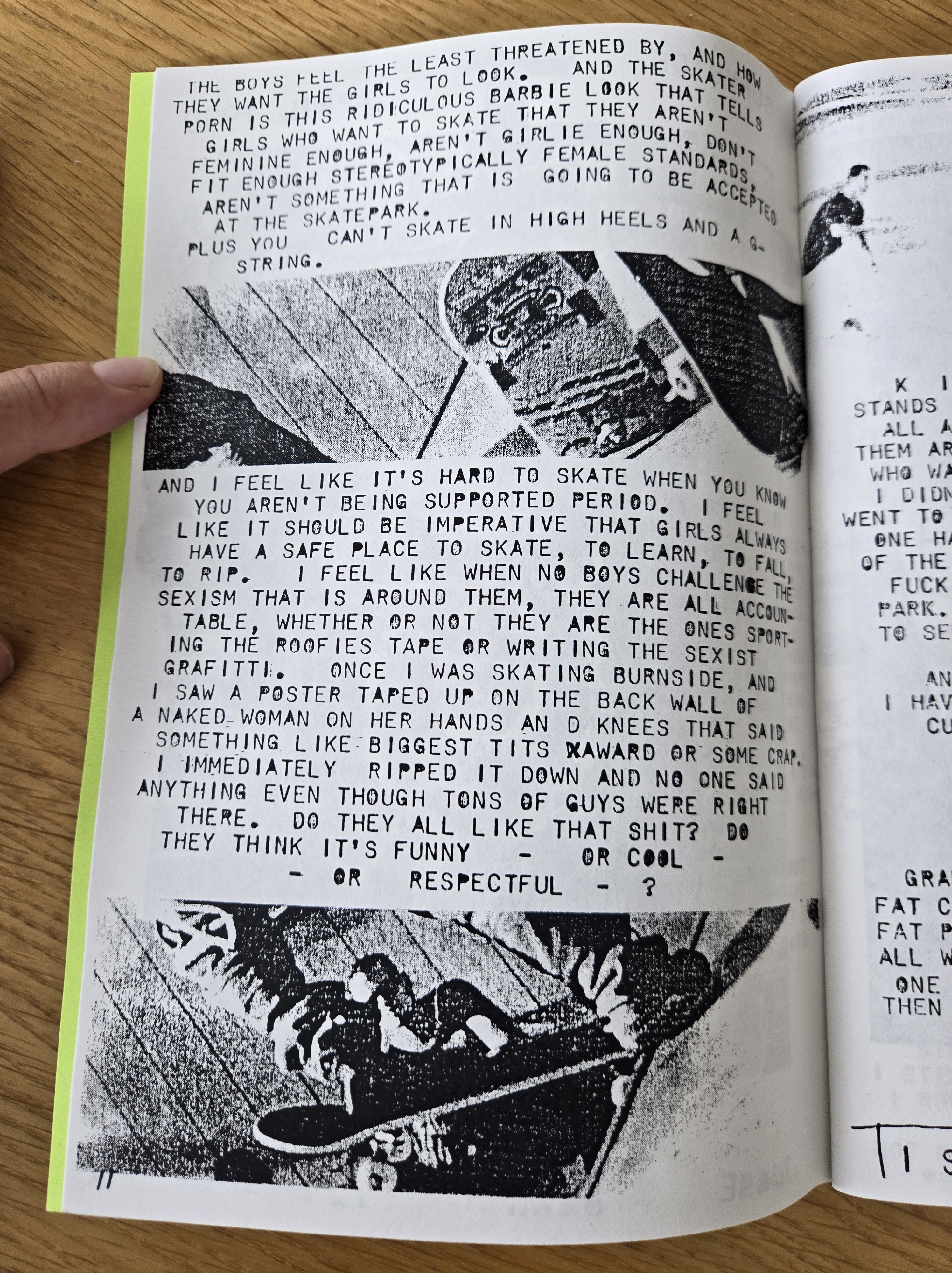
“I feel that it should be imperative that girls always have a safe place to skate, to learn, to fall, to rip. I feel like when no boys challenge the sexism that is around them, they are all accountable whether or not they are the ones sporting the Roofies [grip] tape or writing the sexist graffiti. Once I was skating Burnside, and I saw a poster taped up on the back wall of a naked woman on her hands and knees that said something like biggest tits award or some crap. I immediately ripped it down and no one said anything even though tons of guys were right there. Do they all like that shit? Do they think it’s funny – or cool – or respectful?” (11).
A few days later, Zanna was back at the park and this time there was graffiti that said, “No Fat Chicks,” which prompted Zanna to change it to “Fat Chicks Rule.” Another skater blew up in Zanna’s face, saying that the statement had to be painted over, which resulted in violent threats. He then rounded up 10 to 15 guys to chant, “No fat chicks” over and over with not a single guy coming to Zanna’s defense. The whole experience made Zanna feel like they had zero allies. “I still heard them all the way up the hill as I rode away in fear, anger and disgust. I didn’t go back for many days… not cuz I wanted him to win, but because I felt really violated” (14). Zanna was tired of fighting the good fight and feeling alone.
“I’m tired of defending my own existence at the skatepark so I can simply exist” (15). To add injury to insult, the skatepark graffiti was complimented with “a huge drawing of a naked woman with her legs over her shoulders, an enormous cunt and tits, and a fucking pumpkin for a head. A pumpkin” (17). Zanna explained that “Burnside has this history of belonging to the boys because the boys built it. There is this energy there like it’s their skatepark” (18). Zanna ended up creating an art piece about the graffiti war for the local skate shop and finally in late May 1999, Zanna and their friend painted over it.
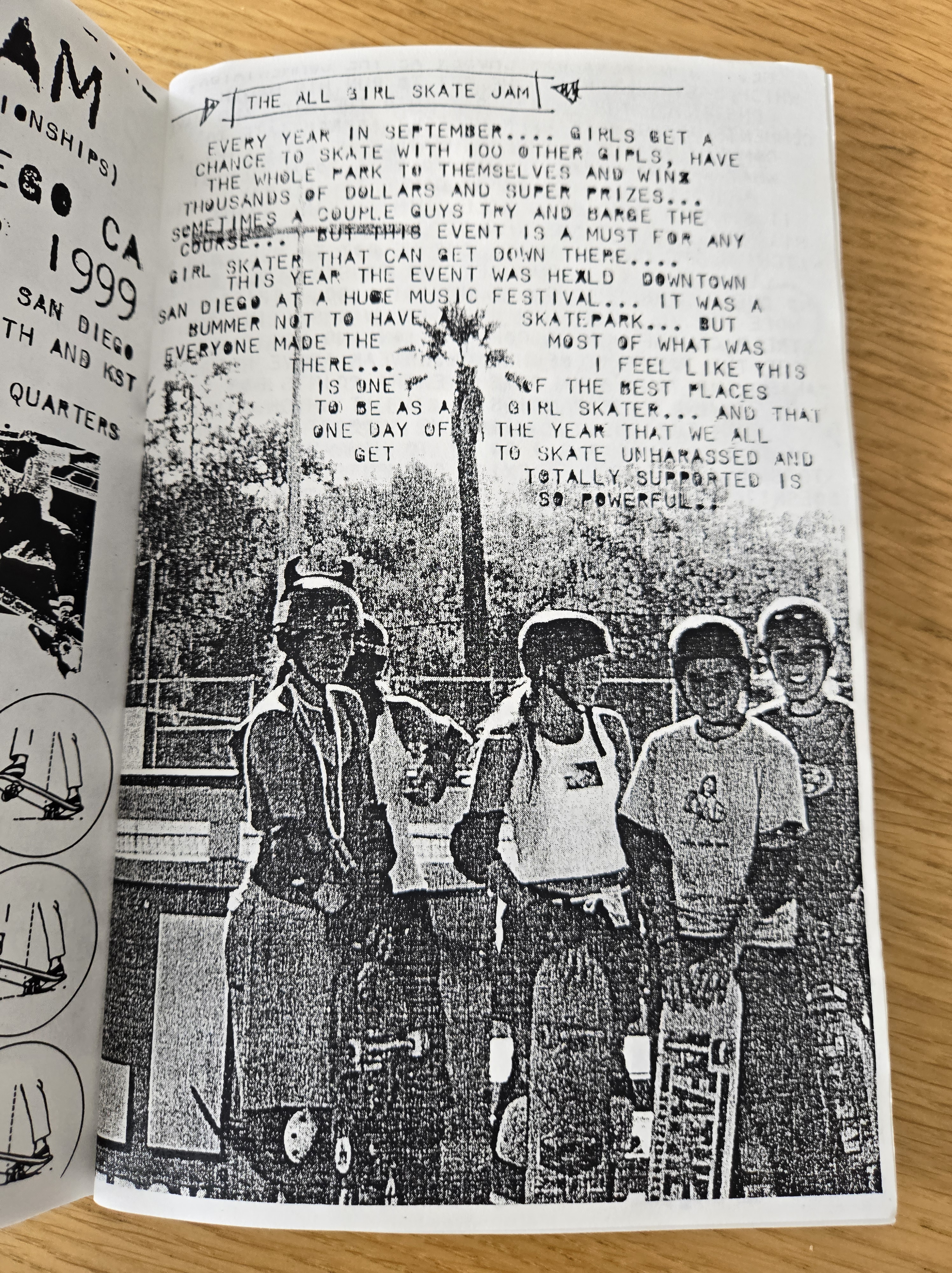
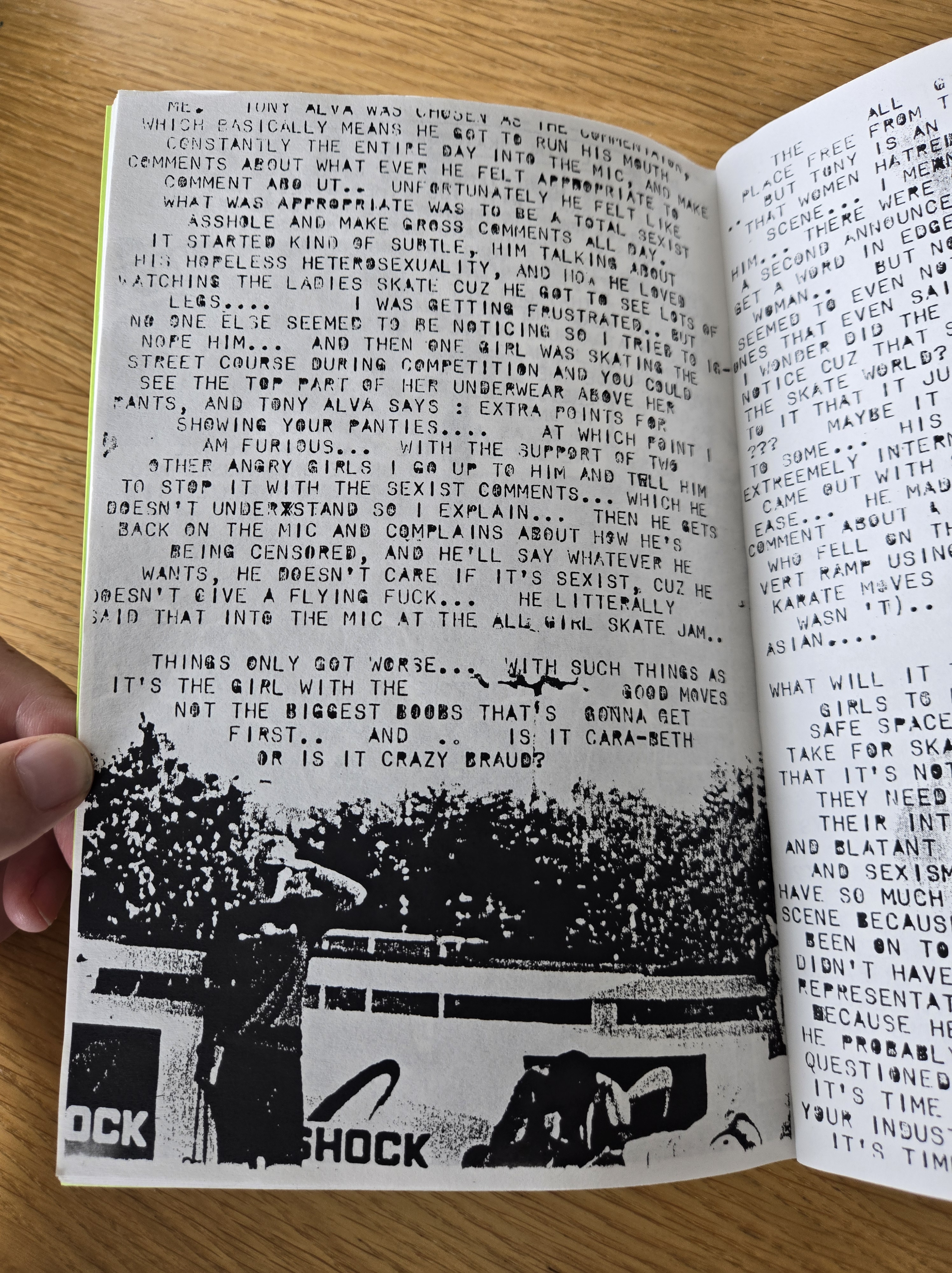
Zanna provided some coverage of the 1999 edition of the All Girl Skate Jam at the Gaslamp Quarters on September 12th and said “this event is a must for any girl skater that can get down there… I feel this is one of the best places to be as a girl skater… and that one day of the year that we all get to skate unharassed [sic] and totally supported is so powerful” (24). The only downer was Tony Alva being an arrogant prick on the microphone, commenting on the girls’ clothing and appearance. When Zanna and other skaters confronted him, “he gets back on the mic and complains about how he’s being censored, and he’ll say whatever he wants, he doesn’t care if it’s sexist, cuz he doesn’t give a flying fuck… he literally said that into the mic at the All Girl Skate Jam. Things only got worse… with such things as it’s the girl with the good moves not the biggest boobs that’s gonna get first.” Good lord!
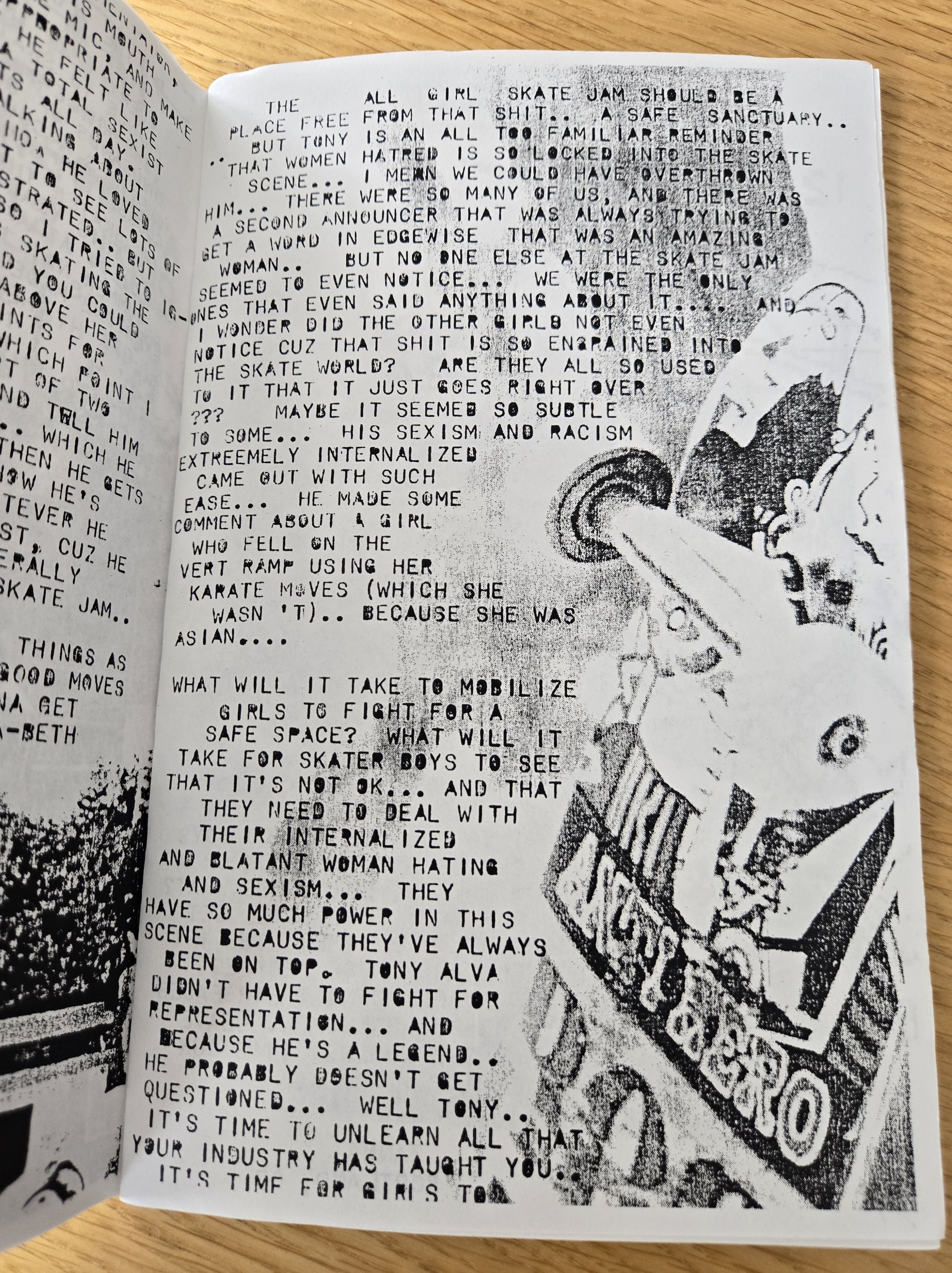
Zanna was pissed because, the AGSJ “should be a place free from all that shit… a safe sanctuary.” The subtle sexism of Tony’s comments grated on Zanna because “What will it take to mobilize girls to fight for a safe space? What will it take for skater boys to see that it’s not ok… and that they need to deal with their internalized and blatant woman hating and sexism… They have so much power in this scene because they’ve always been on top. Tony Alva didn’t have to fight for representation… and because he’s a legend he probably doesn’t get questioned… well Tony it’s time to unlearn all that your industry has taught you, it’s time for girls too” (26).
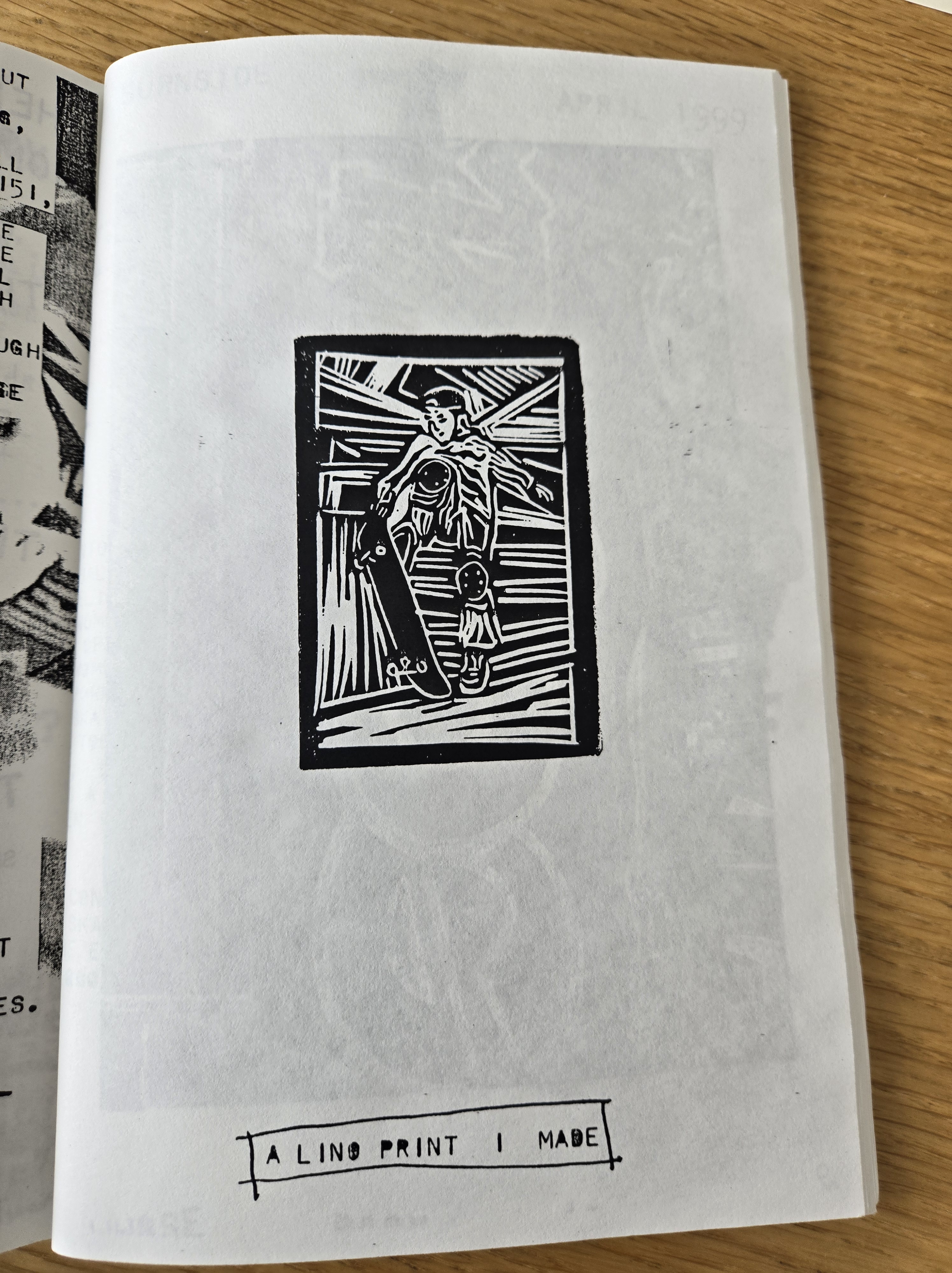
Throughout 50-50: skateboarding and gender, Zanna includes really cool lino cut artwork and in issue 4 of Villa Villa Cola (1998) Zanna’s artwork was featured. The Villa Villa Cola zine was created by twin sisters Nicole and Tiffany Morgan, and their crew of friends based in San Diego starting in 1997, and Zanna was a big fan of the production.
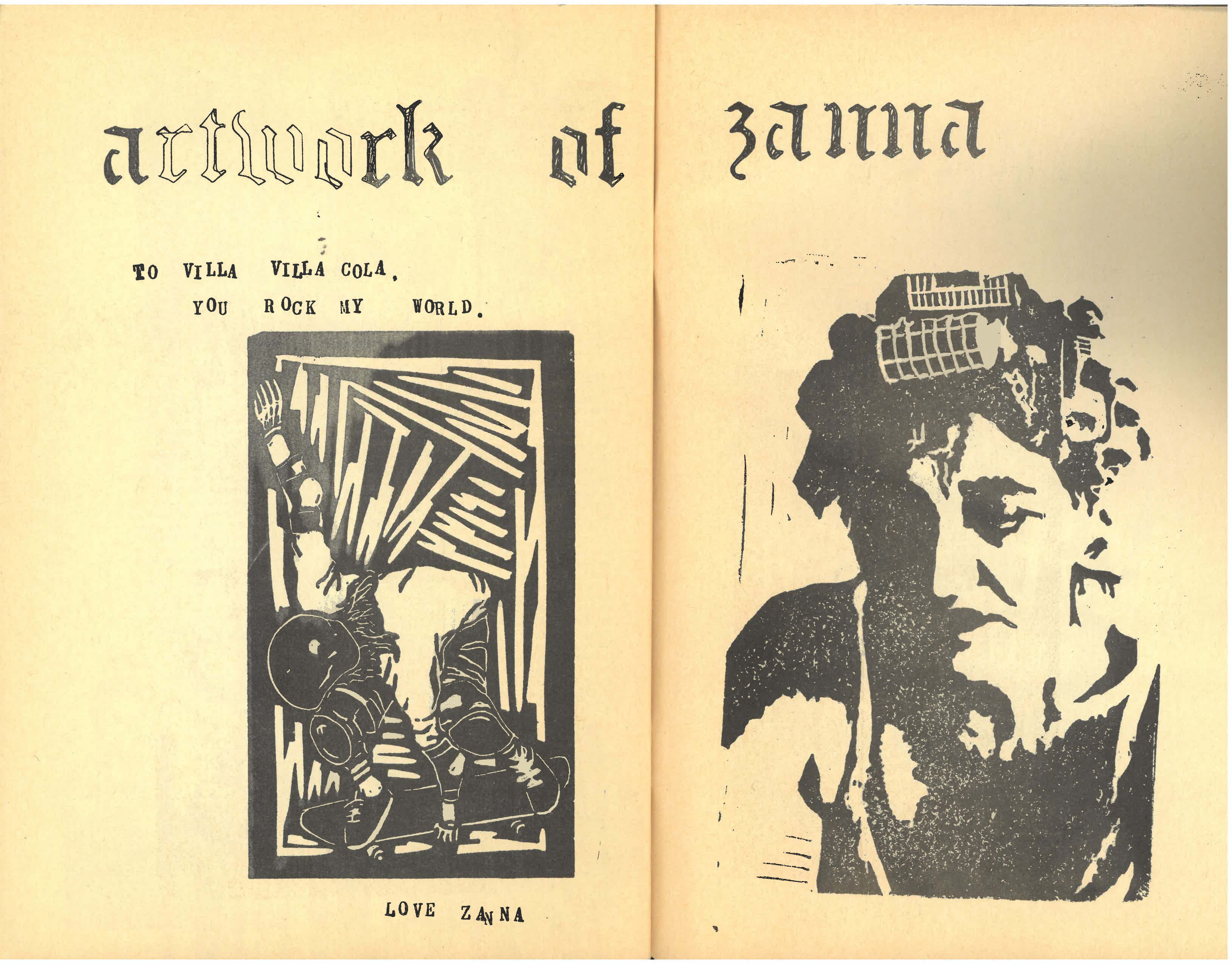
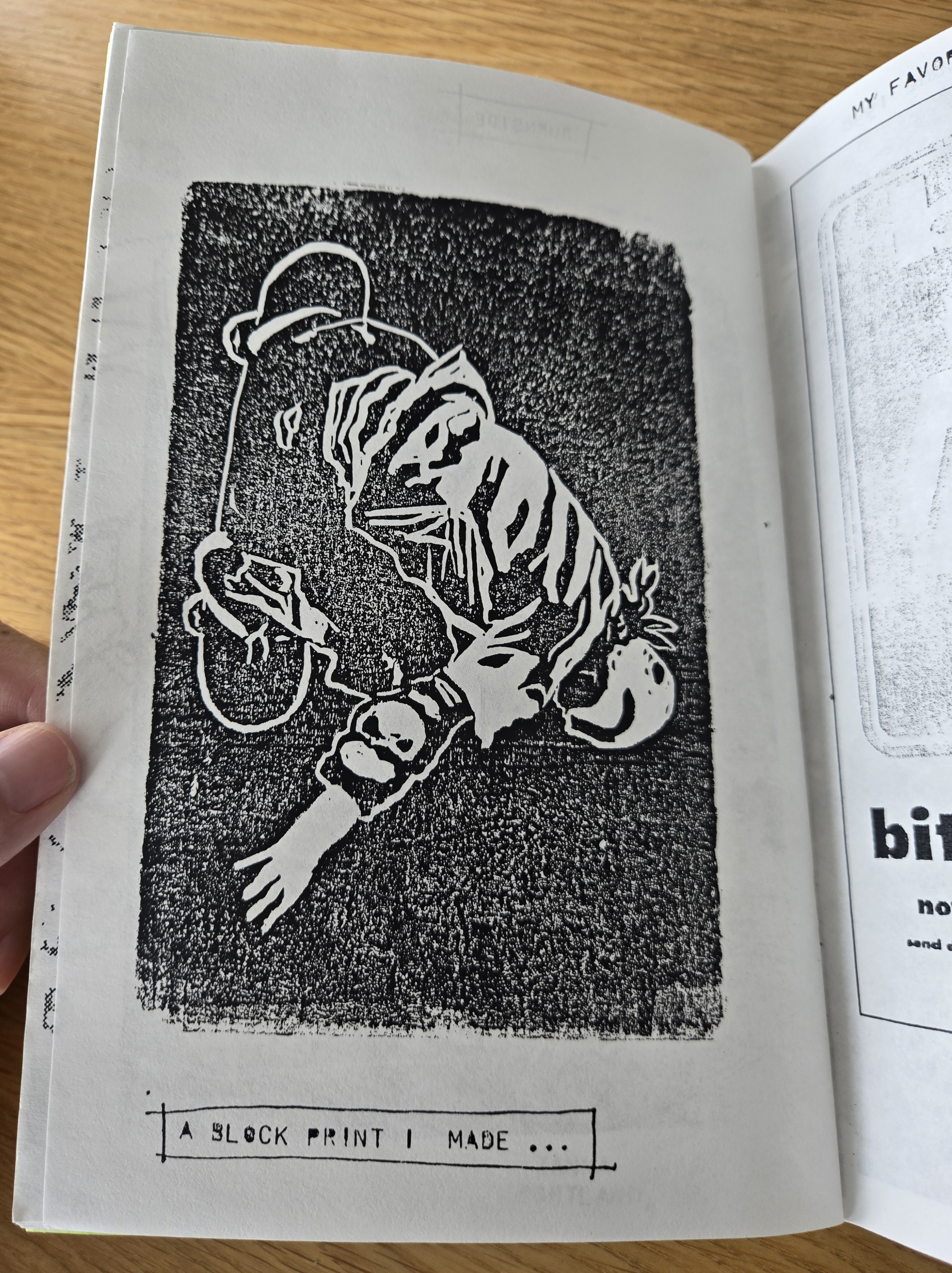
I wonder if Zanna is Zan Gibbs because on the NYU library website there’s a Zan Gibbs who donated the Riot Grrrl collection? The abstract says, “The Zan Gibbs Riot Grrrl Zine collection consists of zines collected by Gibbs while she was involved in the Riot Grrrl movement in the early to mid-1990s, in Washington, DC, Vancouver, BC, and Portland, Oregon. While living in Vancouver, Gibbs started the Canadian version of Riot Grrrl Press, distributing zines through the mail throughout Canada.” It makes sense, since there’s reference to Vancouver and Portland in this zine.
The biography explains that:
Zan Gibbs grew up in Montreal, Quebec before moving to Washington, DC when she was 13. She was introduced to the Riot Grrrl movement in the early 1990s in DC via the punk rock music scene. She attended her first Riot Grrrl meeting at the Positive Force house when she was 16, and remained active in the movement for over 5 years. At 18 she moved to Vancouver BC, and with her already extensive zine collection she began the Canadian version of Riot Grrrl Press, distributing zines through the mail throughout Canada, while Riot Grrrl Press USA handled the distribution everywhere else.
When Gibbs was 22 she moved to Portland Oregon, and focused on starting a queer youth drop-in center for lesbian, gay, bisexual, transgender, queer and questioning youth 24 and under. She helped found and then worked at that at-risk youth center for 12 years, and earned a bachelors degree in social work. She currently works with low-income adults in subsidized housing, and is considering getting a master’s degree in public health.
I think it’s a match, but hopefully I can confirm directly from the zine writer. And, if you ever wanted to view this zine, 50-50 Skate Zine: Skateboarding and Gender yourself, there’s a copy located in New York in the Columbia University Library, Barnard Zine collection with the call # Zines Z25s. You can also view the PDF I created, which has most of the pages except the Punk Planet article.
 Womxn Skateboard History