
Sally Affleck (Felice) of Australia was a competitive skater starting out in the late 1980s, consistently holding her own throughout the 1990s and beyond. In North America, you might have unknowingly seen her within Thrasher in the February 1995 issue that contained a six-page collage of female skaters in the “Girls Who Skate” article, chock full of letters, rants and photos. Unfortunately, the article failed to clearly highlight the skaters’ names, but Sally was in the mix.
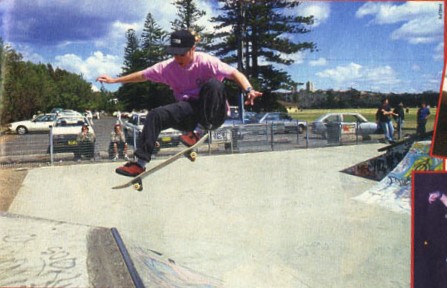
There’s a cool interview of Sally circa 1989 for “SK8N,” which was an afternoon TV show in Australia, where she shares that she started skating around age 10 and was enjoying the St Mary’s mini-ramp and spine for the first time.
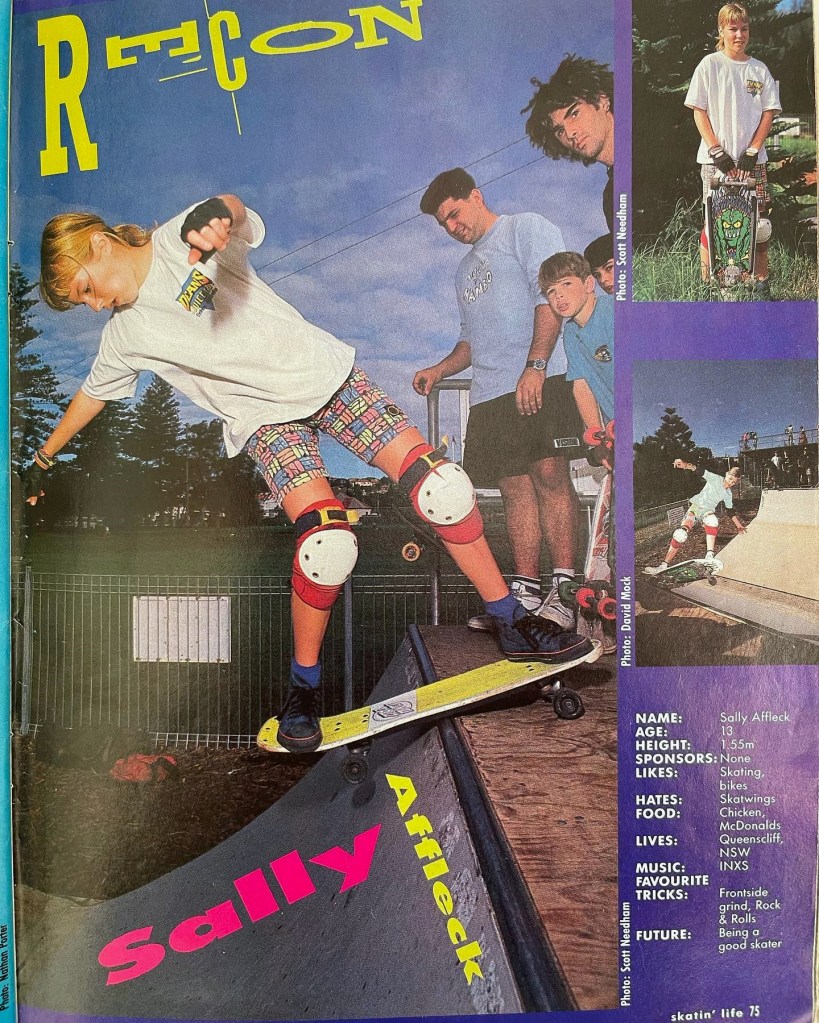
Sally then appeared in the September/October 1989 issue of Skatin’ Life at age 13 with a brief bio, skating her beloved Santa Cruz Gregor Rankine Monster board, which was the first proper pro board that she ever owned. Sally was an INXS fan, was based out of Queenscliff, New South Wales and the photos were by Scott Needham and David Mock.
More recently, Sally featured on the Terrible Happy Talks podcast on October 11, 2023, where she shared a personal account of “growing up in the northern beaches area of Sydney, the challenges she faced as a child of divorce, finding solace and community in skateboarding, what it was like being the only girl at the skatepark for the first 4 years of her skating life… getting sponsored by Kewday distributors and Billabong, entering skate comps, being one of the first skate coaches in Australia with Mick Mulhall, meeting her non-skater husband… and much much more.”
Sally grew up in Allambie Heights, which was a new area for homes to be built but surrounded by what Australians would consider “bush,” or wilder territory. Sally’s parents split up when she was four years old, and around age 11 she moved when her mom bought an apartment unit “literally right across the road from [the Manly] vert ramp, that was brand new. That was pretty mental. I was like a little skate rat… I was teaching myself. I had no idea what I was doing. Usually bum-boarding, then I was up on my feet, tic-tacking. I knew nothing.” Sally was riding a knock-off “Reflex” skateboard, until it was stolen off of her front yard but quickly replaced.


Even though she scored a cool location, with the skate ramp so close, Sally’s home life was not ideal. In her podcast interview, Sally exhibited such grace and wisdom by recognizing that things were not easy for her mom, who had married at age 19, didn’t have solid role models growing up in England, and worked full-time to survive. With the divorce came struggles with alcohol and some bad choices selecting partners and having them move into the family home.
Sally found skateboarding as her outlet but understood that her sister, who is estranged from the family was more present to the domestic violence and arguments on a daily basis. Sally was adamant that she would not be eaten up with bitterness or hold resentment. She also had some awesome memories of going fishing with her dad, and body-surfing in the waves, looking up to him as an athlete, and being “his little shadow.”
Sally was aware of one other woman named Sue who skated flatland freestyle, but there were no girls venturing onto the ramp, possibly for her first four years of skating. Sally gravitated to the vert ramp, but there were a few other sketchy obstacles in the vicinity like a quarter pipe surrounded by rough asphalt and a metal mini-ramp.

Learning to skate vert was a natural progression for Sally from pumping, kick-turns, grinds and roll-ins, and then the drop-in. One of the locals was especially supportive of Sally, and encouraged her to step up and try dropping-in. Sally said she appreciated the big brother vibes and being hassled to try new things – “it was sort of what I needed.”
But there was too much pressure that first attempt, so Sally returned the next day, early in the morning without the crew around. Sally decided, “I’m doing it on my own grounds. And I knew I had to do it. It was well overdue. And I did it and I was so stoked.” Sally was 13 years old when she dropped in on vert!
Here’s some vintage footage of the Manly skatepark in 1988.
Sally also remembered seeing a kid in Avalon Beach jump a curb on their skateboard and being like, “How did he do that? What’s going on?” Without access to videos, Sally was blown away but kept on challenging herself to improve. Skateboarding made Sally resilient, but it wasn’t always an easy ride.

“I was a tough kid. I was a tough chick. I always had to prove myself to the boys… the only comparison I could make was against the boys, and they didn’t want me there… It was a smaller minority, probably a 10%, one in ten guy that would be saying derogatory comments about female parts and jokes like that. I’m not going to be naming names because some of these guys are pretty well known guys in that Manly 80s / 90s era but I’m sure they’re regretting what they did too. There was a bit of misogyny going on, and I was in their territory… it was a boys’ zone. That’s how it was though, different times.”
Sally offered up a specific scenario when boys would grab her skateboard, her beloved Santa Cruz and throw it under the ramp. “It was a big deal because like I said, we didn’t come from money. And this kid grabbed it… I forgive him now but he was quite well to do… he would have a board every two or three months. This was my board that needed to last me until next Christmas. I got it on my birthday, and a massive chip happened, and it was just not cool… no one was giving me any special favours.”
Fortunately, the majority of the guys became like brothers to Sally, even nicknaming her “Sister Sal,” and the tensions were just in the formative years.


Above: A three-paged interview for Australian Skateboarding Magazine (March/April 1998).
Speaking of the 1990s, even when skateboarding went through a lull, Sally didn’t care and persevered through the trends. She noted that some skaters defected and took up inline rollerblading, but not Sally. In fact, in 1994 Sally had a full-page spread in issue #1 of Australian Skateboarding magazine with a “F/S disaster slide over the Keirle Park pimple, Manly Australia.”
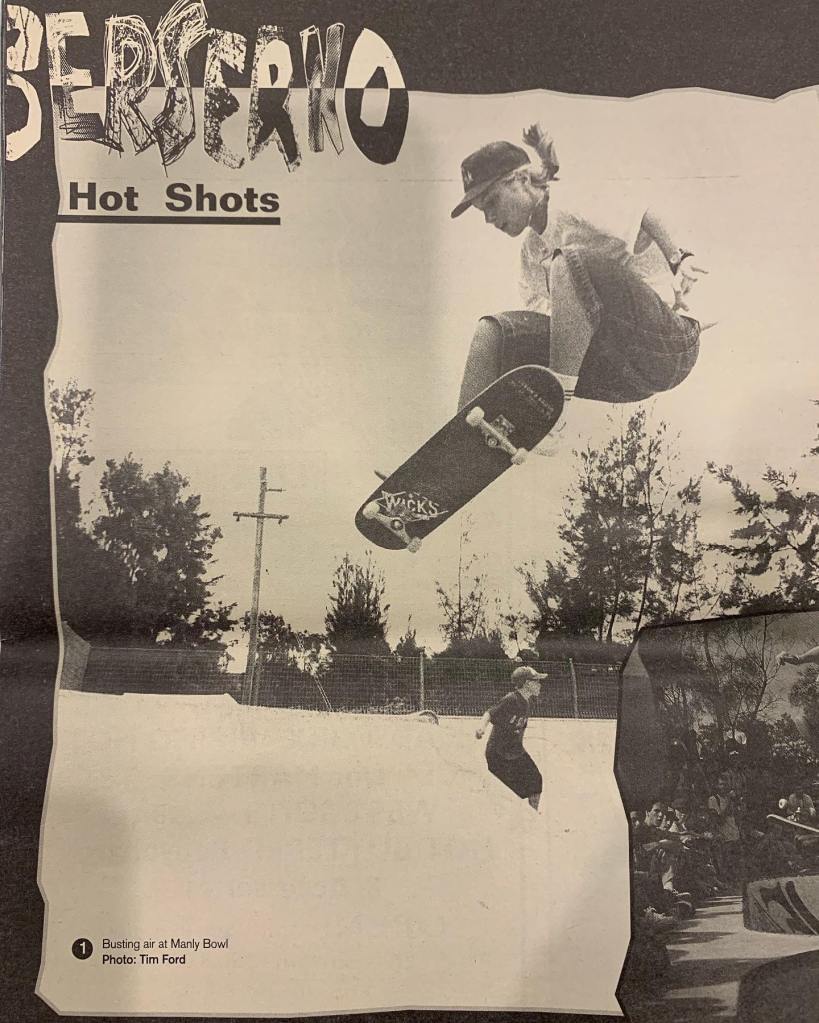
Sally would enter local contests because everybody did them – “it was how you got better and how the sponsors figured out you were around. So, I had to skate against the guys.” But skating against the guys made her stand out, and Sally soon became sponsored with companies approaching her, even tracking her down via skateshops, rather than the other way round. It started with local shop sponsors, receiving clothes and skateboards on occasion, and then evolved into a monthly package with full skateboard set-ups. Sally would be sponsored by Kewday decks, Core technology wheels, B&S clothing, És shoes, and Billabong.
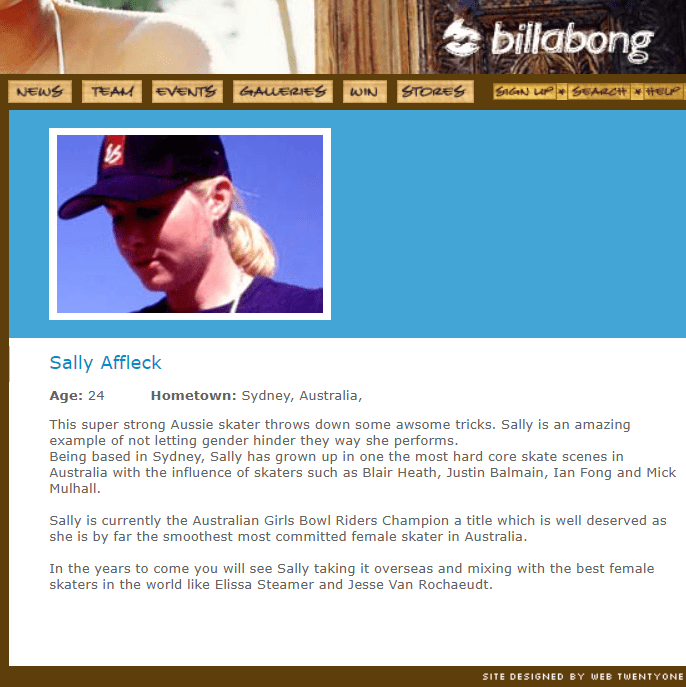
Photo: Screenshot of Billabong website from 2004 featuring Sally’s profile.
Billabong, while renowned as a surf company, wanted a skateboarding team and recruited well-known Australian guys like Ben and Tas Pappas and American vert skater Bucky Lasek, among others. They were also receptive to female skaters, and Sally was their obvious choice (Jessie Van Roechoudt of Canada would also skate for them in the early 2000s, among others). Sally remembered having a proper contract with incentives to do well at contests and appear in magazines. The team also went on tour together, and Sally noted that in Adelaide there was a World Cup qualifier contest where the girls got going at 9am and meanwhile, all her male teammates were still passed out. Sally ended up winning it, even though she never got to skate the course in advance.
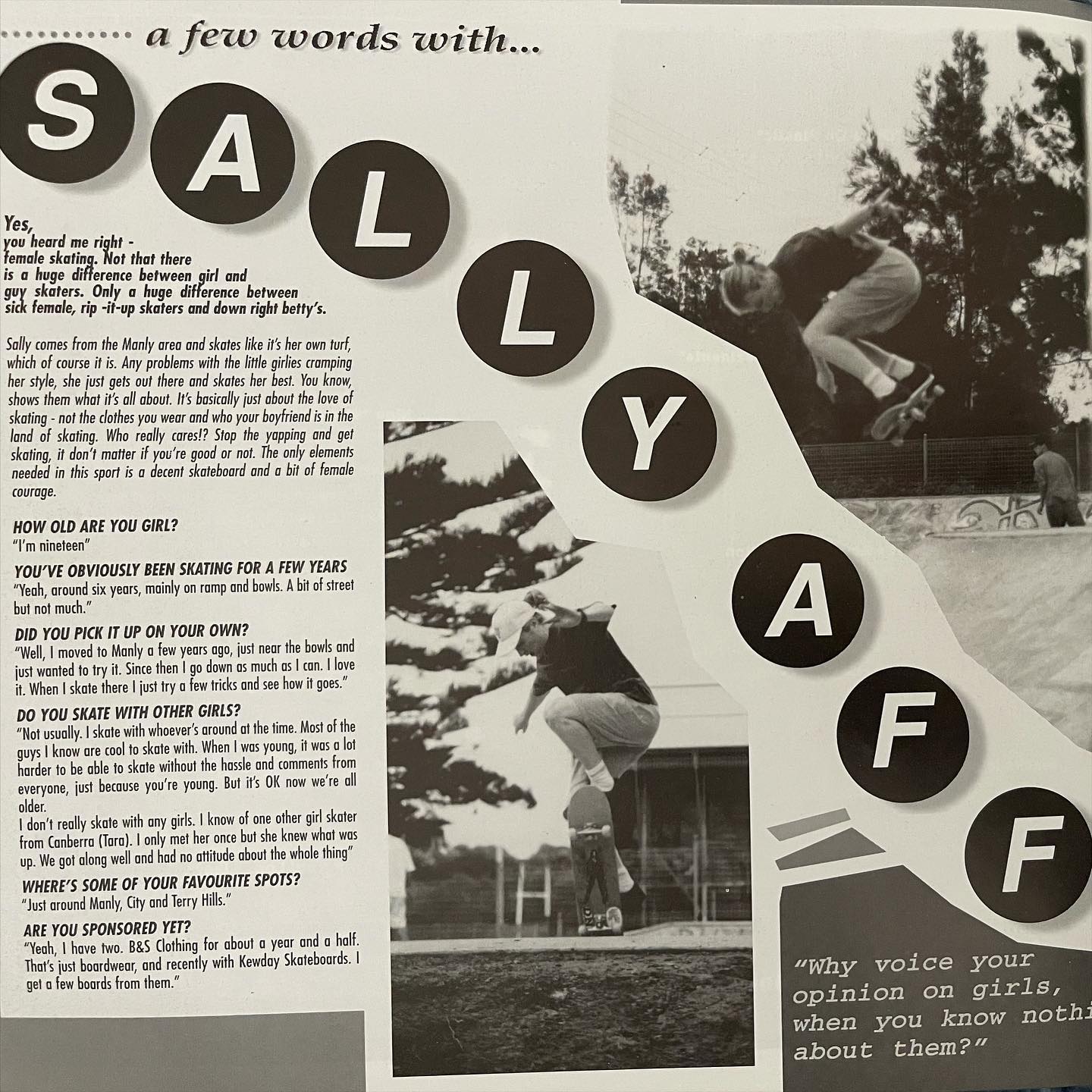


When Sally was interviewed at age 19 for Slingshot magazine in 1995, she mentioned some antiquated attitudes that some male skaters held suggesting that it was inappropriate for a girl to skate. Ultimately, Sally let her photos at Keirle Park do the talking and savored the feeling of freedom skateboarding gave her. “It felt great just floating a lofty BS Ollie up there and waiting to land hard and fast!”
Sally’s cameo appearance in the 411 Video Magazine “Australian Vacation” from the 1997 Manly Warped Tour also validated her skill. Sally wrote, “I managed to get a few tricks in on that video. I remember them asking me to film and I got a bit camera shy and didn’t know what to do and what tricks to go for. I was pretty stoked to say the least to be featured in an American VM before the days of Youtube, Instagram, etc.”
In her podcast interview, Sally gave a shout out to skaters who inspired her like Jaime Reyes, Elissa Steamer, Cara-beth Burnside, and “as girls started coming online I started becoming friends with a few girls.” There was a girl named Tara from Canberra and Alicia Saye from Wollongong. “Hilary Pearce in Melbourne and she ripped, she was awesome – great style… Later on, Monica Shaw, Esther Godoy, Sal Clark, who was a good street skater. There was a bunch of us. That came a bit later when all the Gallaz street contests came along.”
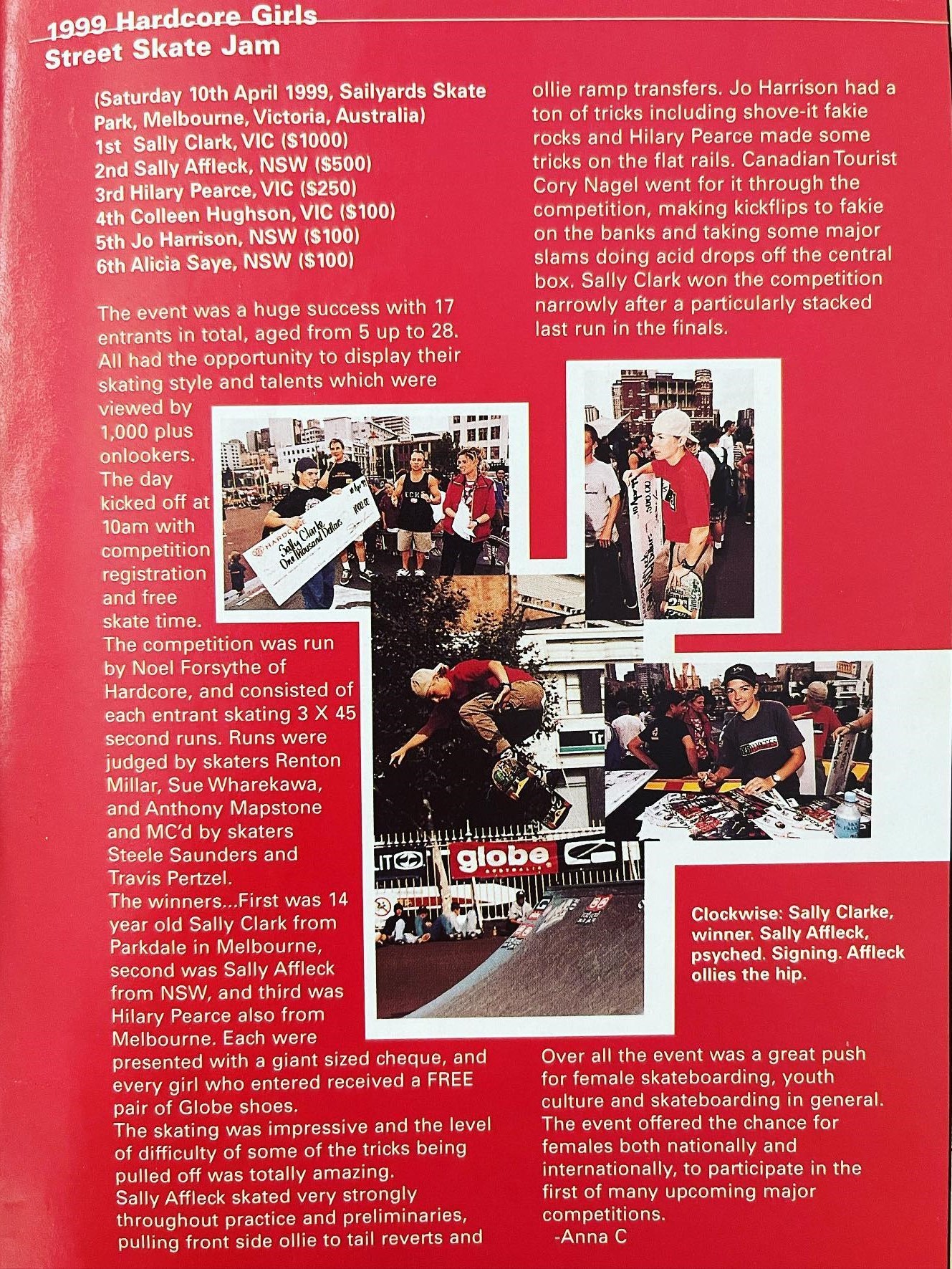
Sally would get to know a whole crew of female skaters (seventeen to be exact) in 1999 at the Hardcore Girls Street Jam in Melbourne’s sailyards, which was reported on in the Australian Skateboarding magazine, and in an article by Colleen Hughson called “Hardcore Girls Street Jam” for Chick magazine. Sally placed second in street, behind Sal Clark, receiving a cheque for $500, even though skating transition and vert ramps was her preferred terrain. Sally would later comment, “Ladies travelled from all around Australia to be there. It has a great vibe on the day with Women Dj’s, graffiti artists and Skateboarders. Proud to have been there and participated!”


Sally would also compete at the Gallaz / Globe World Cup Street contest in Melbourne, but she couldn’t always dedicate the time to skateboarding like the American sponsored pros she was up against. Sally was juggling work and school, which never came easy to her. Sally eventually became a Fire Protection Engineer, building fire safety systems for buildings, and starting a family. Sally is grateful for the stability that she has now in life with a nice home, pets, kids, and a solid partner.
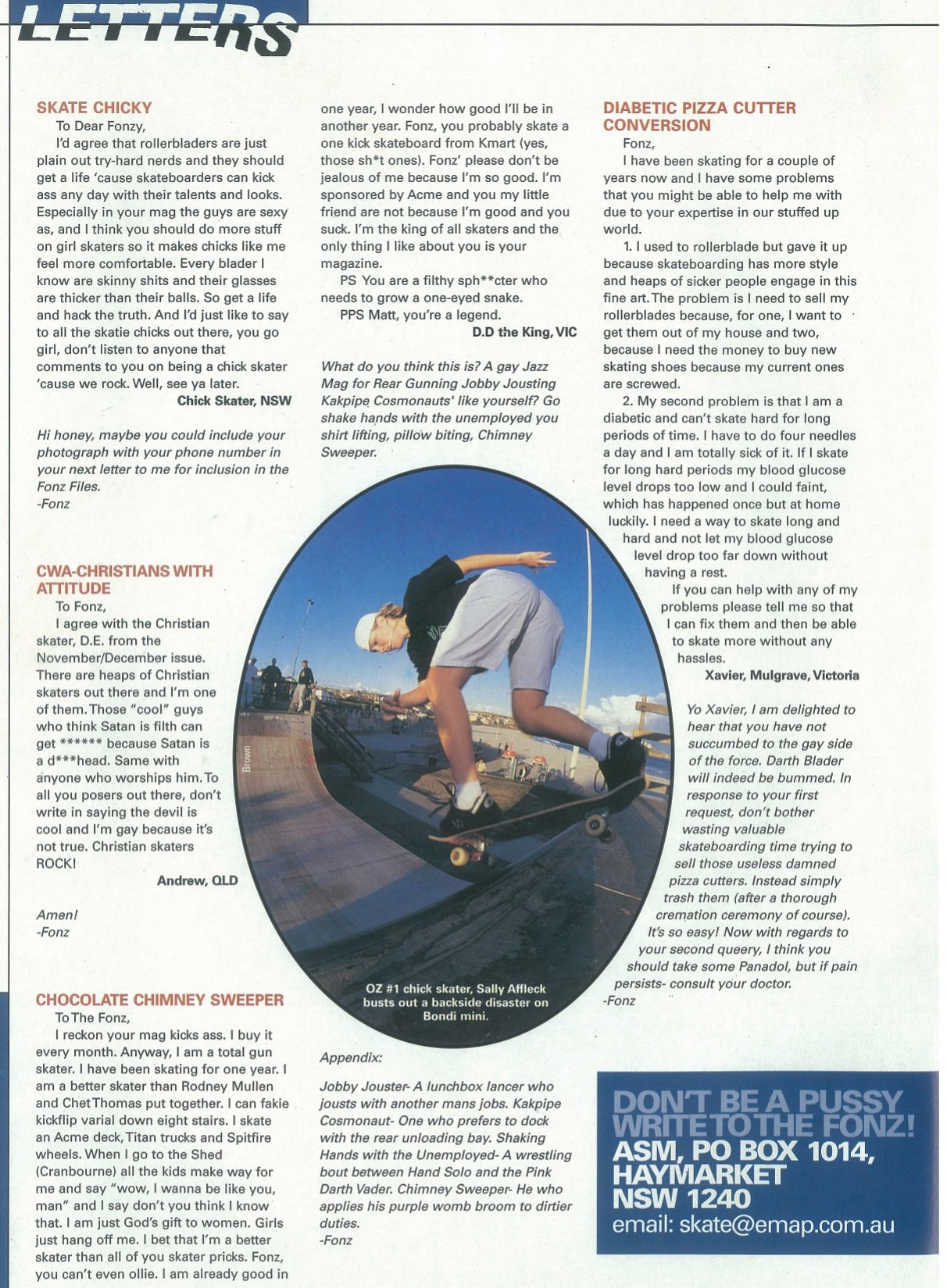
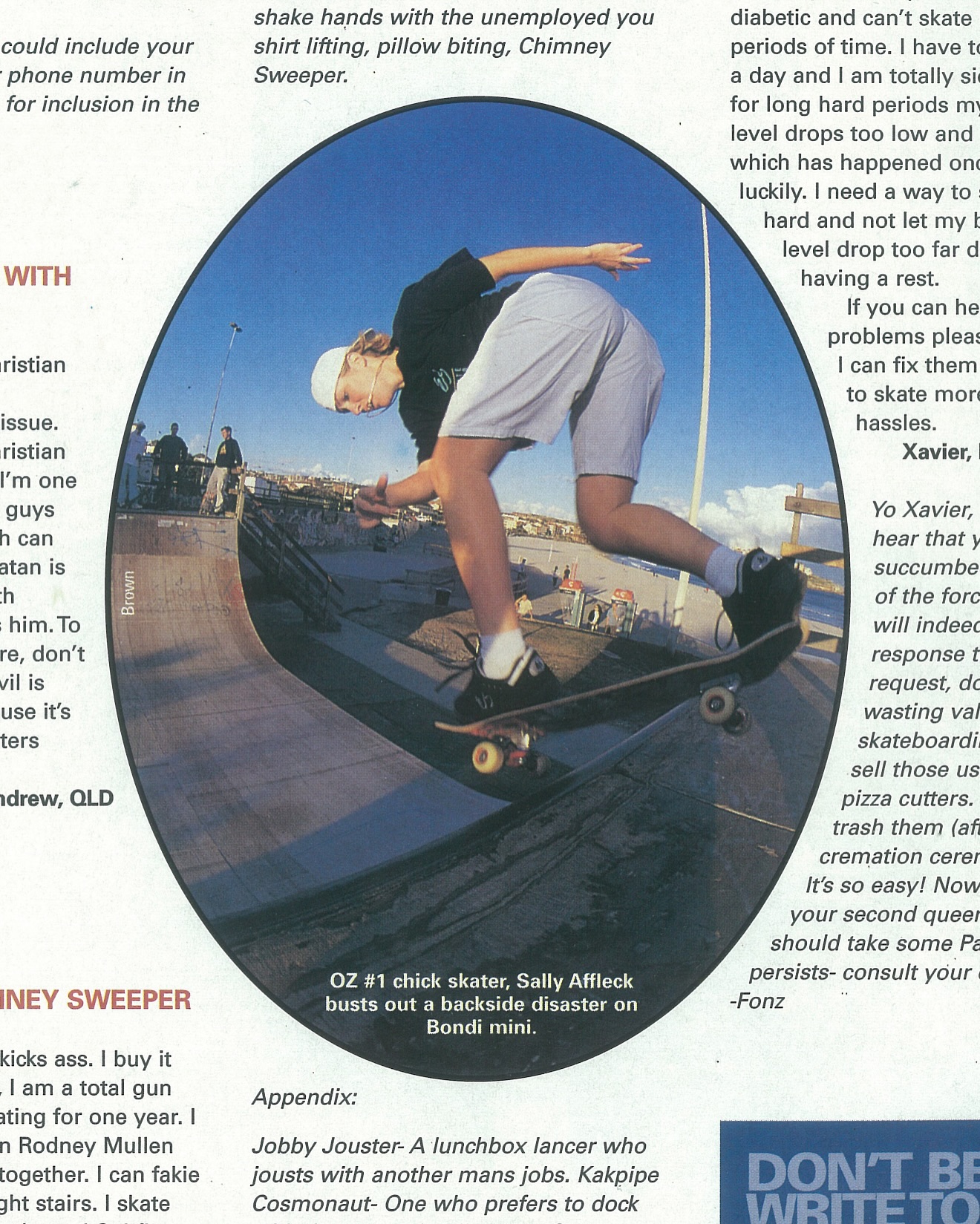
Above: A BS disaster photo within the letters section of Australian Skateboarding Magazine (March / April 1999)
She’s even given back to the community as one of the first accredited Australian skateboarding coaches and just loves bonding with the kids and witnessing their progression. Sally did wonder what she might have accomplished if only she had had a mentor, “maybe I could’ve progressed more quickly” and get over contest anxiety – just someone to say, “You got this” would have helped.
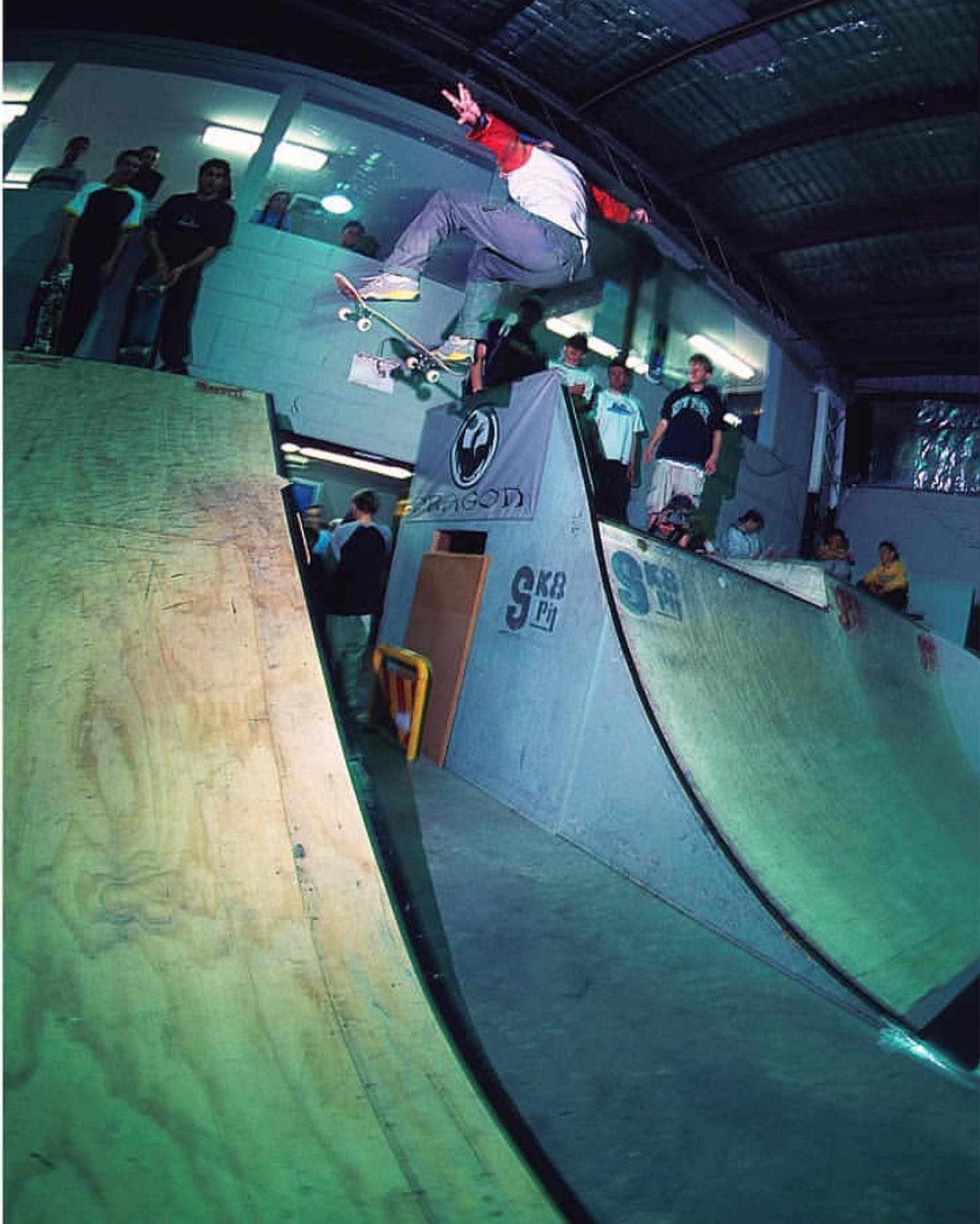
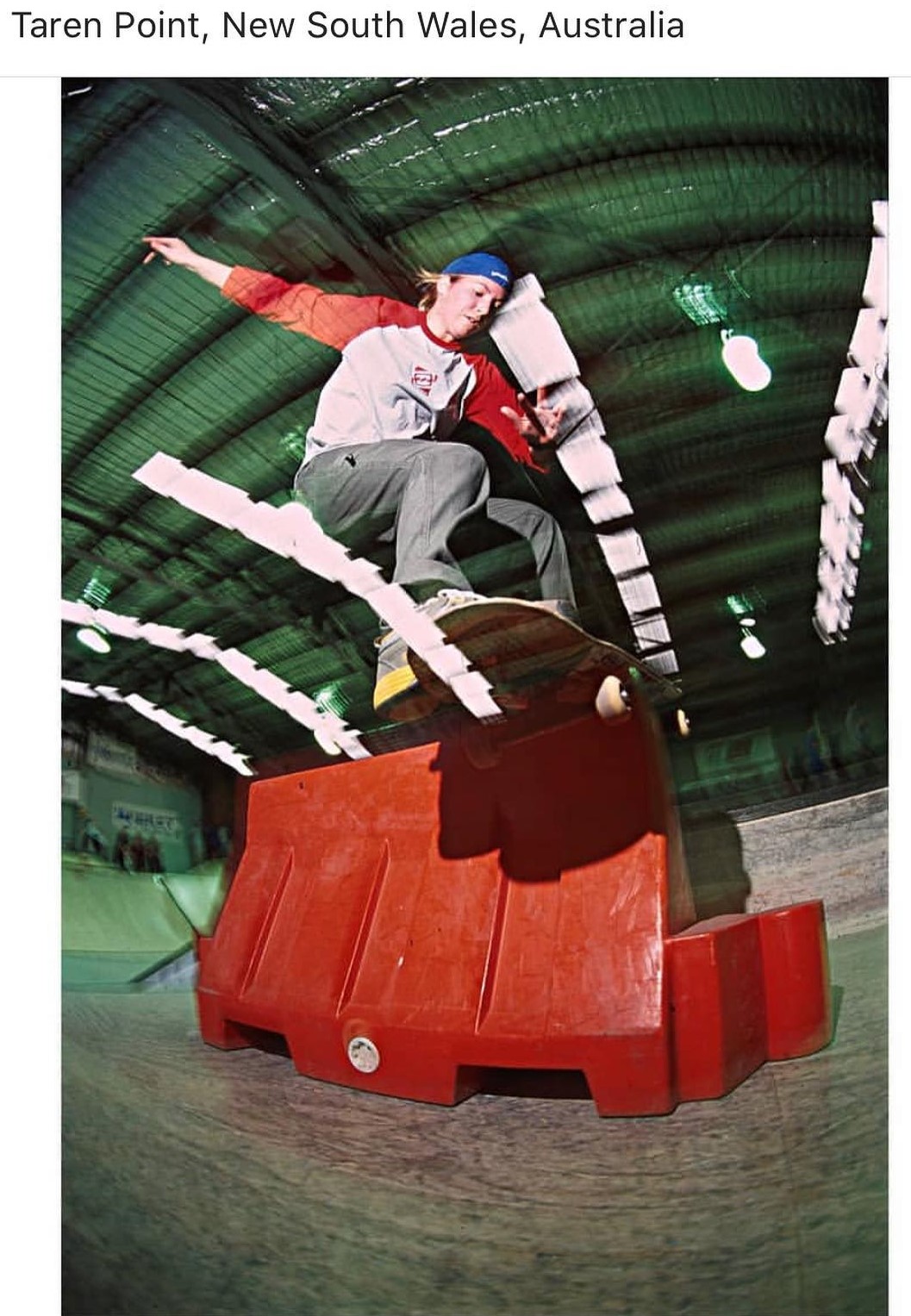

On occasion, Sally still skates a nearby ramp and bowl, but has lost her aggressive nerve due to vestibular migraines that can trigger auras and vertigo. Plus, she also had a major concussion as a kid, ripping around her cul de sac, which has made her a big advocate for safety gear.

Overall, Sally was grateful for skateboarding, for travel and meeting good people including the Bones Brigade, Tony Hawk, Mike Vallely, and Steve Caballero because “people in the skateboarding industry are genuine people.”
As for being regarded as an advocate for women in skateboarding, Sally said:
“I’ve heard a few other girls say to me, ‘I remember you back in the day. I remember that magazine article.’ And I didn’t really realize what I was doing. I didn’t realize I was this person who was a mentor or whatever you want to call it, that the girls were looking up to. It was what they needed to see. I didn’t know that – I’m only realizing more lately.” While Sally was just skating for the love of it, she did have an impact and it’s awesome that she’s now hearing about all the female skaters around Australia who she inspired to give skateboarding a go.
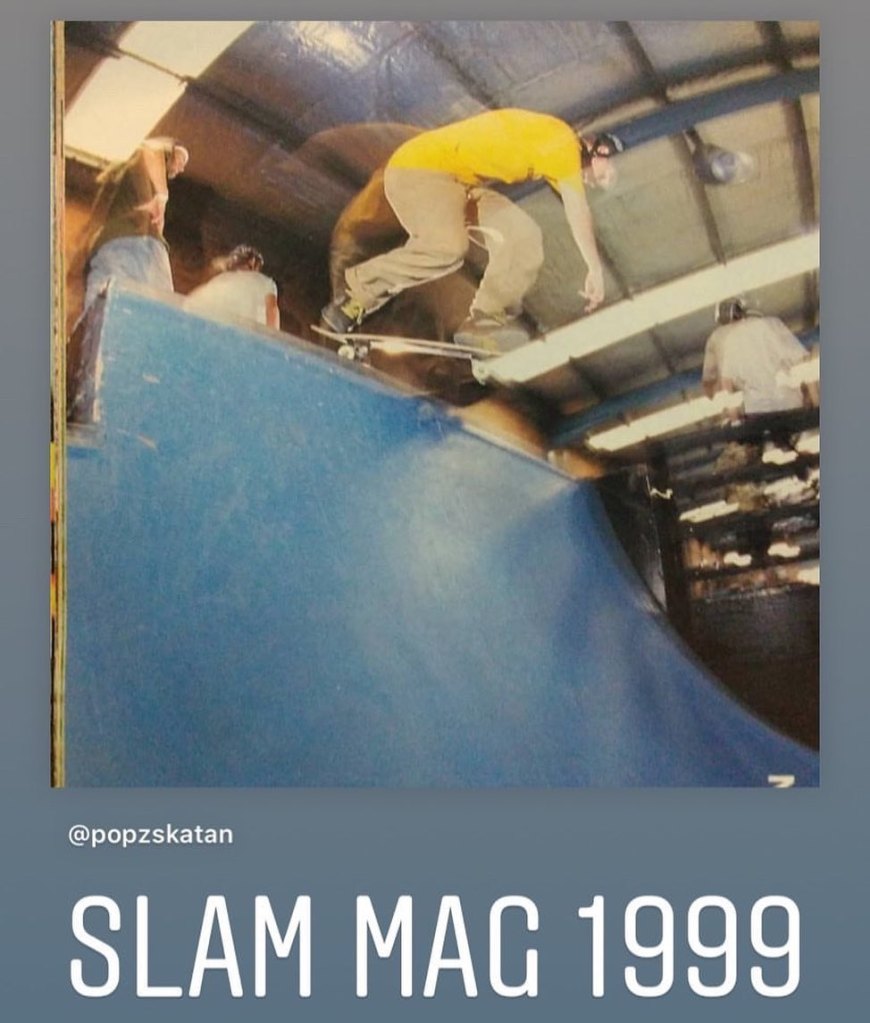
Photos: Scott Needham, David Mock, Dave Adair, Mapstone, Tim Ford, Curtis Mah
 Womxn Skateboard History