
Skateboarding appeals to many because it is fun, it’s social, it can be an escape from whatever drama is happening at home, and typically it’s performed away from the prying eyes of adults. The idea of children playing in the streets hasn’t exactly been condoned by most adults, but there were times when there was literally no other place for kids to come together.
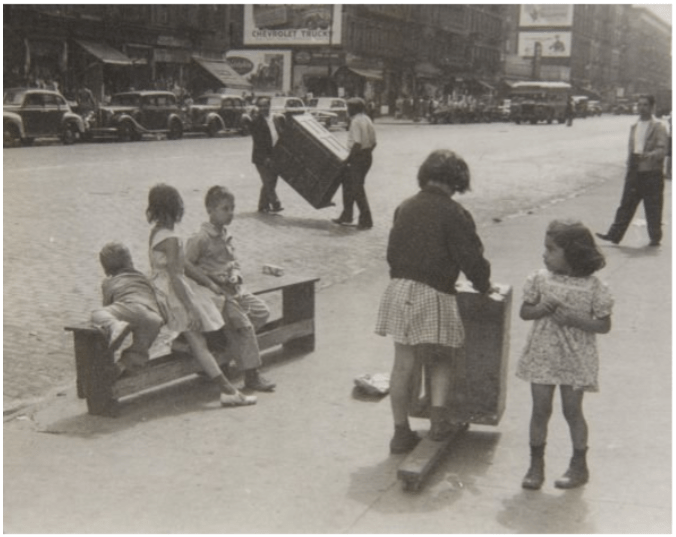
The photo above was taken in Brooklyn, NY in 1940 by Helen Levitt whose work was described by the New York Times as “fleeting moments of surpassing lyricism, mystery, and quiet drama.”

Photo: Todd Webb, 1946
At the turn of the 20th century, when labor laws started to improve the situation for factory-working children in crowded New York City tenement neighbourhoods, the streets were buzzing with kids at play. Growing up in poverty also meant innovation when it came to games and toys, using whatever was at hand.


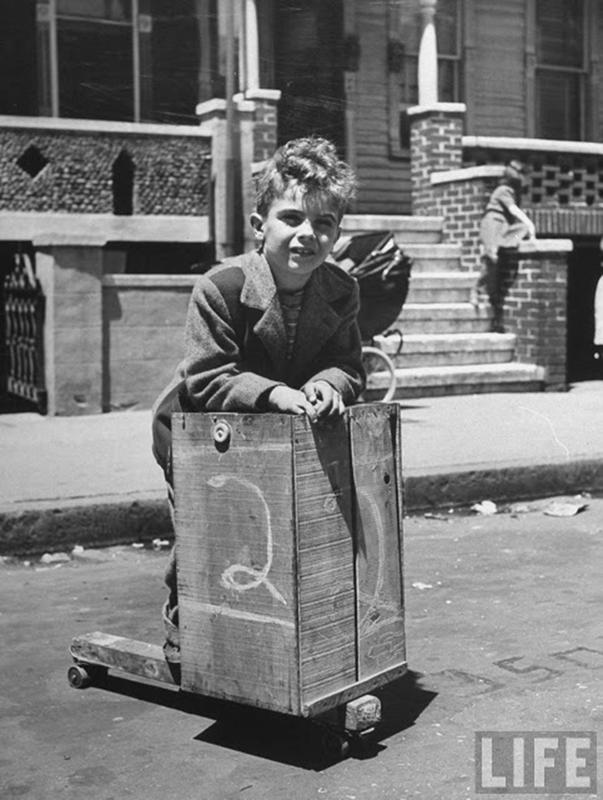
Photos: Ralph Morse, 1947
In the 1940s and early 1950s, children primarily from the Lower East Side began customizing fruit crates, adding a 2×4 plank, attaching roller skate wheels and DIY handlebars, to rip around. While photos by Todd Webb in 1946 and Ralph Morse in the June 1947 issue of Life magazine show only boys innovating these designs, there’s several girls who appear in the mob scenes of the annual “Anything on Wheels” derby which was hosted by the Children’s Aid Society – Sloane Center.
Apparently, there’s something universally appealing about skulls and crossbones to kids – I think it’s the pirate connection. Perhaps pro skateboarder Jamie Thomas was channeling his inner pirate when he came up with the Zero logo in the 1990s.
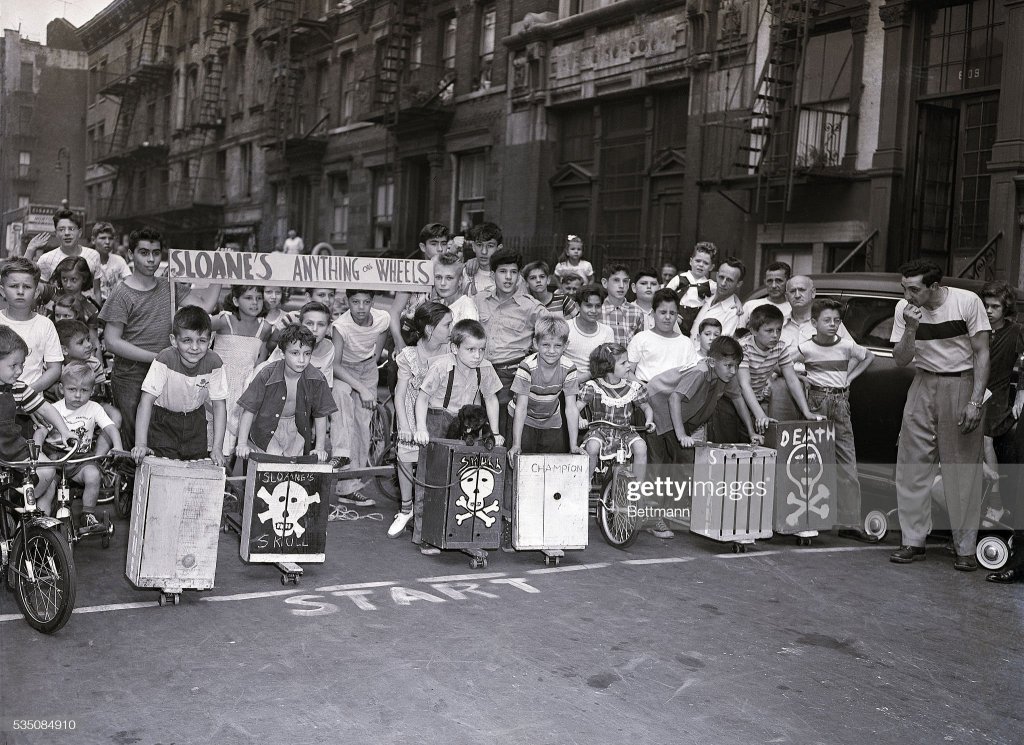
Legendary photographer, Dr. Otto Bettman captured the derby line-up on August 15, 1950, and the caption reads: “With the skull-and-crossbones design setting the cheerful mood of the racers, the 12th annual ‘Anything on Wheels’ derby is about to begin, sponsored by Sloane center, one of the 7 New York children’s centers maintained by the Children’s Aid Society. Over 100 East Side small fry showed up to race and everything from scooters to baby buggies in the rolling pandemonium.”
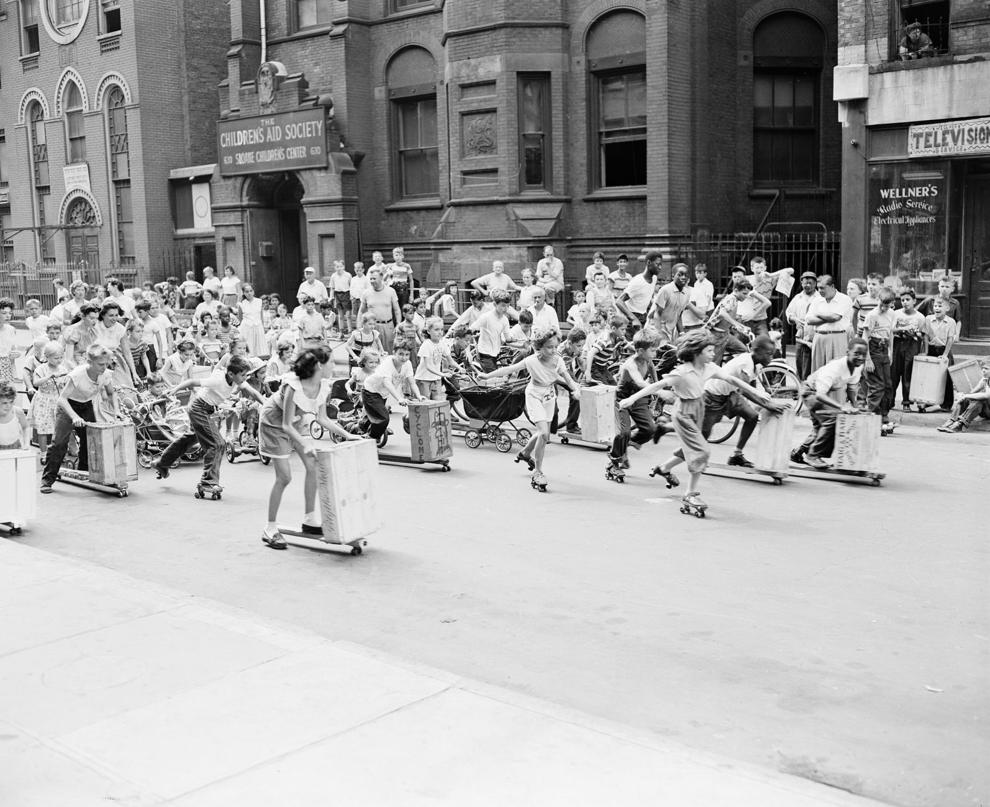
Two years later, for the 14th annual race on August 6, 1952, a photo by Carl Nessensohn shows several girls keeping up with the boys on their roller-crates although the majority are pushing strollers, and a few are simply roller-skating. Given the era, games like hopscotch and rope-skipping were the vetted outdoor activities for girls, but it appears that no one was stopping them from joining the crate skate fun.
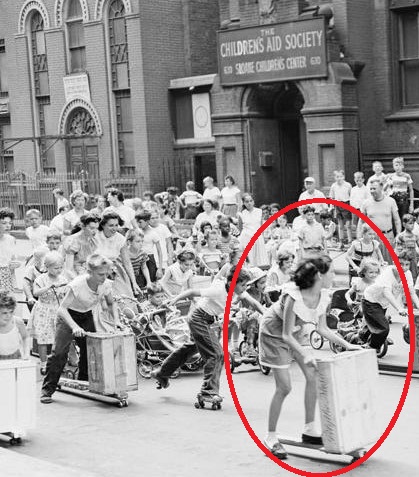
The image even appeared in Thrasher, within the final pages of issue February 2000.

It might be argued that customized fruit crates were more a precursor to scooters, but by the late 1950s there’s no denying that skateboards had officially arrived (see: Leigh Zaremba 1959!). And I love how skateboarding was equitable, introduced as a child’s toy for anyone to pursue, especially if you were crafty and could dismantle your roller skates in shop class and hammer them onto a 2×4. Skateboarding was accessible and required minimal intervention of an adult.
Update: Thanks to the Black Archives, I’ve also included two photos from 1970, taken by Clinton Wright. The images are of a fruit crate skateboard race in Las Vegas, Nevada among Black youth. There were even trophies!


Reference:
- NYC Parks, “History of Playgrounds in Parks,” New York City Department of Parks & Recreation, 2011.
 Womxn Skateboard History