
In the late 1980s and early 1990s, Saecha Clarke proved to be the leading female street skater, among a small but elite crew. She grew up in Huntington Beach, CA and the local High School was a destination skateboarding spot, so she would skate there with whoever was hanging out.
Saecha shared in Jenkem Volume 3 that, “My dad was a surfer and had an old ‘70s style skateboard in the garage that my brother and I used to try to do 360s on when we were kids, but I didn’t really start skating until around 1986” when she was in the 6th Grade in Junior High. Saecha lived across the street “from this really hard compacted dirt bank that a lot of the neighborhood kids would skate. I would sit in my living room at the window and watch people skate. I was pretty shy and didn’t know how to skate at all, so when people left I would grab my brother’s board and go outside and try to skate” (White).

Early photo of Saecha in Huntington
In no time, Saecha was making progress, learning to carve the bank, kickturn and ollie, and she was hooked. In an interview for NBD_Archive, Saecha shared a funny story about how she first started receiving skateboards:
“I first started getting boards from John Lucero. I don’t think I was sponsored really but just getting flowed decks from him. It’s a funny story how I met Lucero. Around the same time when I first started skateboarding I was also on a cheerleading team. We had to go door to door and sell chocolate bars in our cheerleading uniforms. I didn’t want to walk around from door to door so I skated and ended up knocking on Lucero’s door. He asked if I was the girl always skating the dirt bank up the street and he said I was pretty good and gave me a board. I remember being so psyched to meet him and get a free board. I had skate ads of Lucero on my walls and had heard he lived in Huntington but had no idea he lived right down the street from me. I didn’t expect to knock on his door.”

There was a lot happening in the 1990s, and Saecha described the scene as “an explosive and creative for skateboarding in general.” She was also fortunate to be in Huntington and part of a thriving community. “There was a huge skate scene there. I have very fond memories of skating Huntington High and this place called Pay N’Play. Every weekend skaters would come from all over the surrounding cities and bring their jump ramps and PVC rails and set them up at the basketball courts and skate all night” (White).
Saecha got to meet her hero Mark Gonzales who “has always been my favorite skateboarder so it was definitely a trip meeting him and getting the opportunity to hang out and skate with him” (Bradley). She was also in the vicinity of Jason Lee. Saecha said that even though they went to different schools, they both skated the local spots.
Footage courtesy of NBD Archive, which was edited from a longer video by Andre Walton in 1990 of “Arise Skates.”
While not a typical sponsor, Saecha explained that, “Arise was a Christian skateboard company and ministry that my friend Andre Walton did. I was apart of his skate ministry. We would travel around to different cities and do skate demos at churches. Looking back, it was actually a lot of fun traveling, skating, meeting new people, and getting kids hyped on God and skating.”
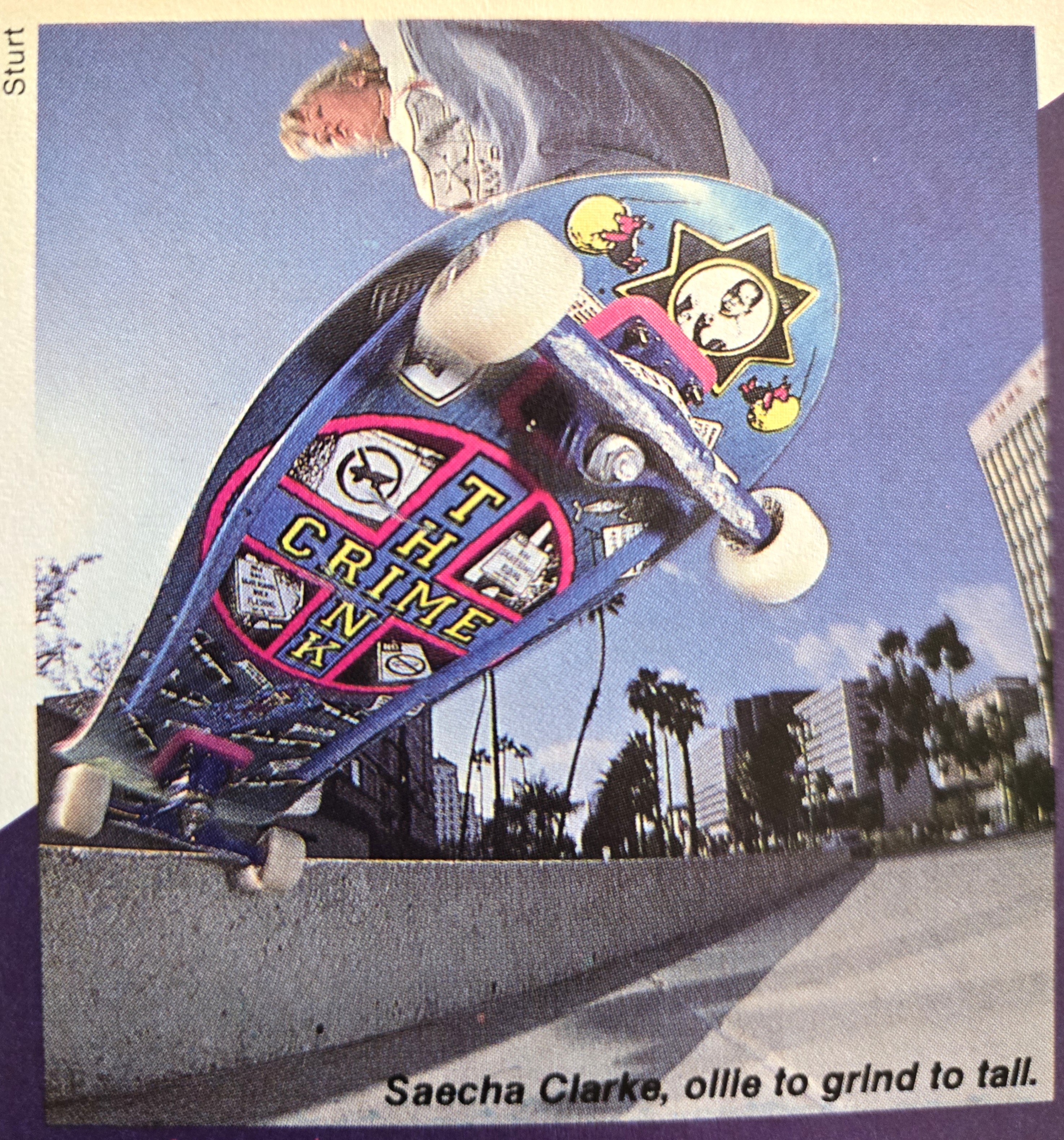
Saecha noted that, “The first photo I ever got in a skate magazine was an ollie grind to tail on a small ledge outside the Long Beach Convention Center. It was taken during a trade show by Dan Sturt for Poweredge Magazine [March 1989]. I love the Think Crime board graphic I was riding at that time, it was such a cool graphic from World” (Bradley).

The ad appeared in 1989 and a year later Saecha became officially sponsored by World Industries at age 15 because, “I was at a [CASL] contest in Long Beach and my friend Christy [Jordahl] and Jason [Lee] who rode for Steve Rocco were telling me I should ride for World and that Steve wanted me on the team” (Araujo).
Regarding World Industries, Saecha shared with Milton that, “I think I was hesitant at first just because I was getting free boards from my friend Andre who had a Christian skateboard company at the time [Arise]. But I couldn’t pass up an opportunity to ride for a company like World Industries, it was my dream.”
“I remember getting my first package from World. I was hanging out with Deanna Templeton when it showed up at my house. It was a gigantic box of decks, wheels, a bunch of gear, and a ton of stickers! They were not stingy and had so much cool product, World stickers were the best back then too! I can’t even explain how psyched I was getting that first package. It was better than Christmas morning” (White).
Saecha also became sponsored by Venture Trucks and Vans shoes.


Saecha was first interviewed for the ‘zine Equal Time (Volume 2, No. 1) in 1990, edited by Lynn Kramer. A 15-year-old Saecha shared that she would take her brother’s skateboard to do kick-turns on a dirt jump (she emphasized dirt!) that some boys were skating in front of her house. She liked to skate at night when she had the most energy and was adamant that “skating is just skating. It’s not a boy-girl thing. It doesn’t matter.”

Saecha explained that, early on when she started competing, the California Amateur Skateboarding League (CASL) didn’t offer separate divisions for female skaters, which meant that she often competed against the guys but according to her Equal Time interview, it wasn’t an issue for her. CASL finally announced, in the April-May 1989 CASL NSA Newsletter, that the girls’ division would be reinstated.
There were some exceptions, like the contest at Long Beach called the “Zimbabwe Skate Safari” on November 12-13, 1988. Saecha came second to Christy Jordahl, but ahead of Germany’s amateur vert champion, Nathalie Richter visiting the U.S.
Photos and ads from her sponsors appeared in mainstream skate mags like:
- PowerEdge Magazine June 1989 doing an ollie-to-grind-to-tail.
- Transworld Skateboarding March 1991 boardsliding a handrail in San Diego for Tony Hawk’s column called “Beyond.”
- Thrasher March 1991 doing a boardslide for Venture
- Thrasher December 1992 popping an ollie
- Big Brother No. 2, 1992 World Industries “Bread and Butter” ad with the amateur team
- Skateboarding: the ultimate guide to tricks, ramps, gear, setting up – and letting go! (1994 by Kevin Wilkins) with a backside 50-50

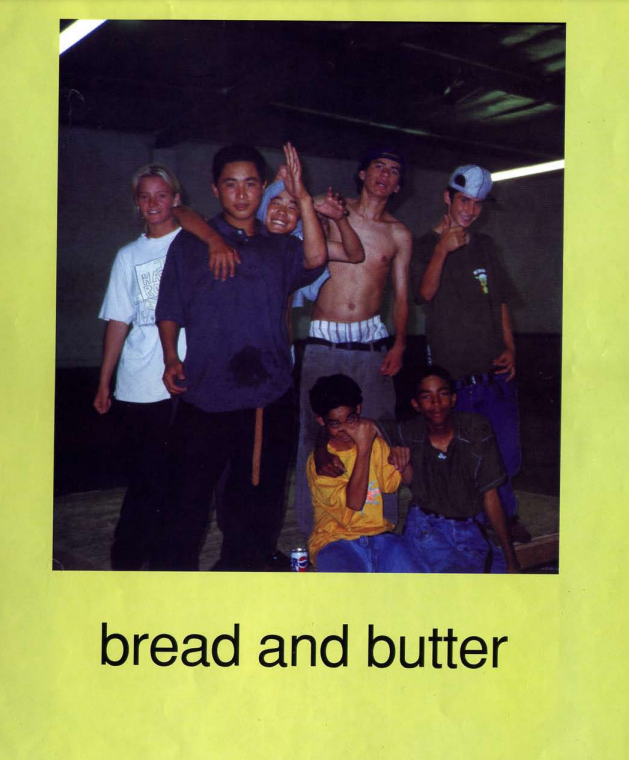
Regarding the “bread and butter” World Industries ad, Saecha said “you can clearly see the contrast between me and the rest of the guys. Despite how it might have appeared, none of the World guys ever made me feel like I didn’t belong.”
“Back then, there were girls that freestyled and skated vert, but there weren’t many girls who skated street. I only knew two girls that skated street, Christy [Jordahl] and Anita Tessensohn. I think Anita was pretty much the first girl street skateboarder. Anita rode for Powell Peralta.”
The two skaters competed against each other in April 1989 in Tempe, Arizona as reported in Vol. 1, No. 3 of Equal Time zine. Kramer wrote, “Saecha pulled a stale fish launch, ollie kickflips, and ramp to wall rides,” but it was Anita who pulled off the win.
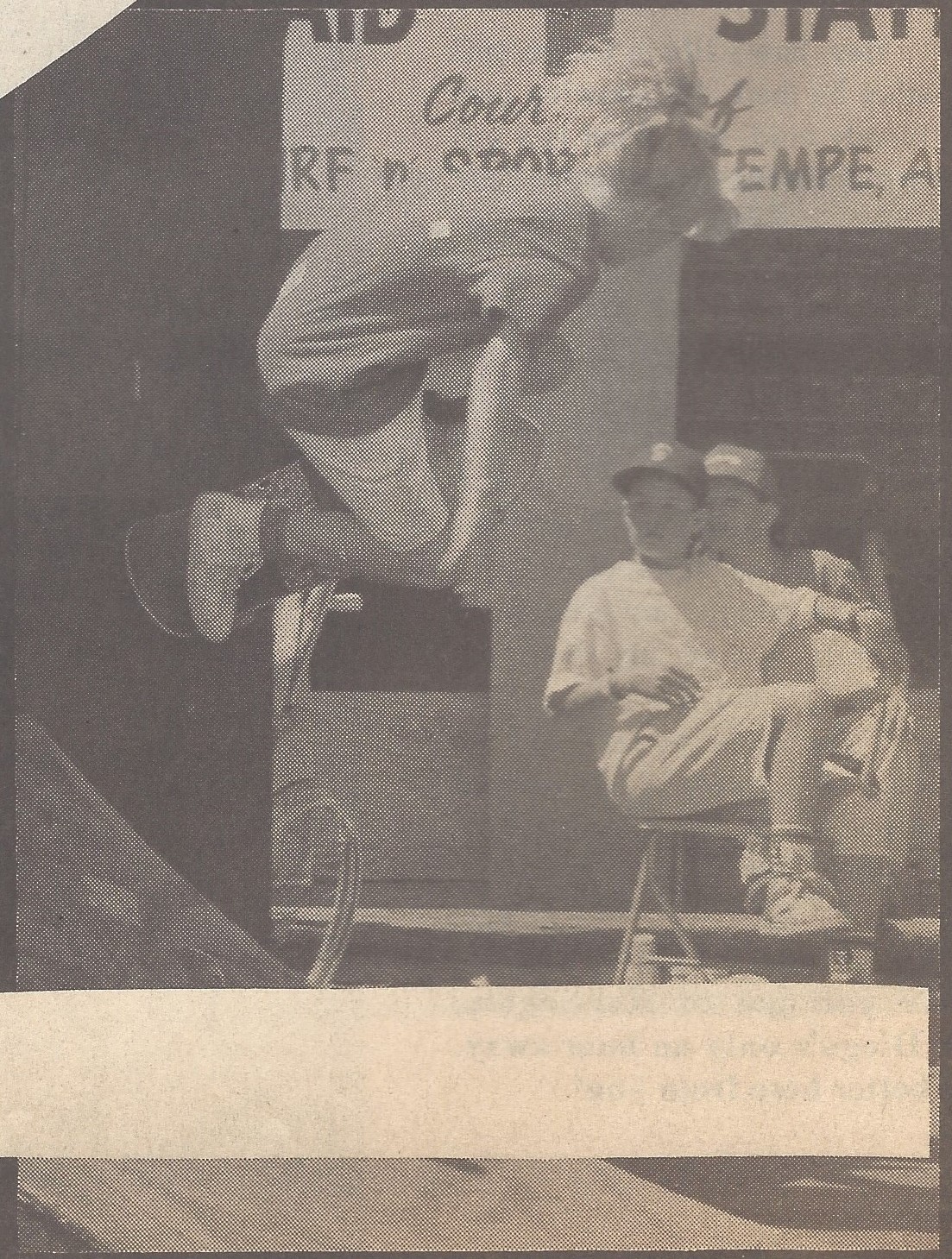
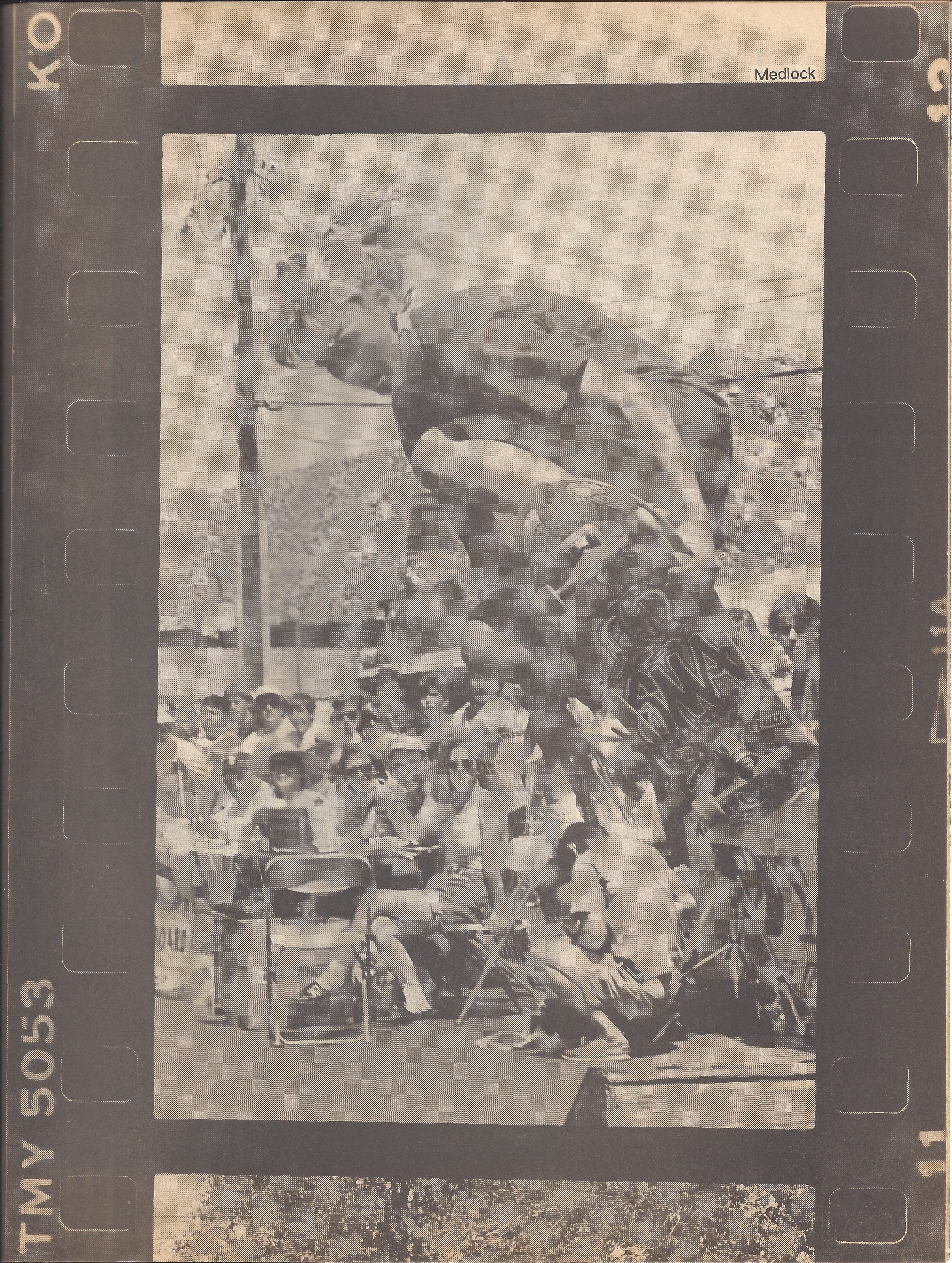

Photos above are by George Medlock from the Tempe contest in 1989 for Equal Time zine, with a few colour photos below, including a great shot of Anita, Saecha, and Deanna Templeton.


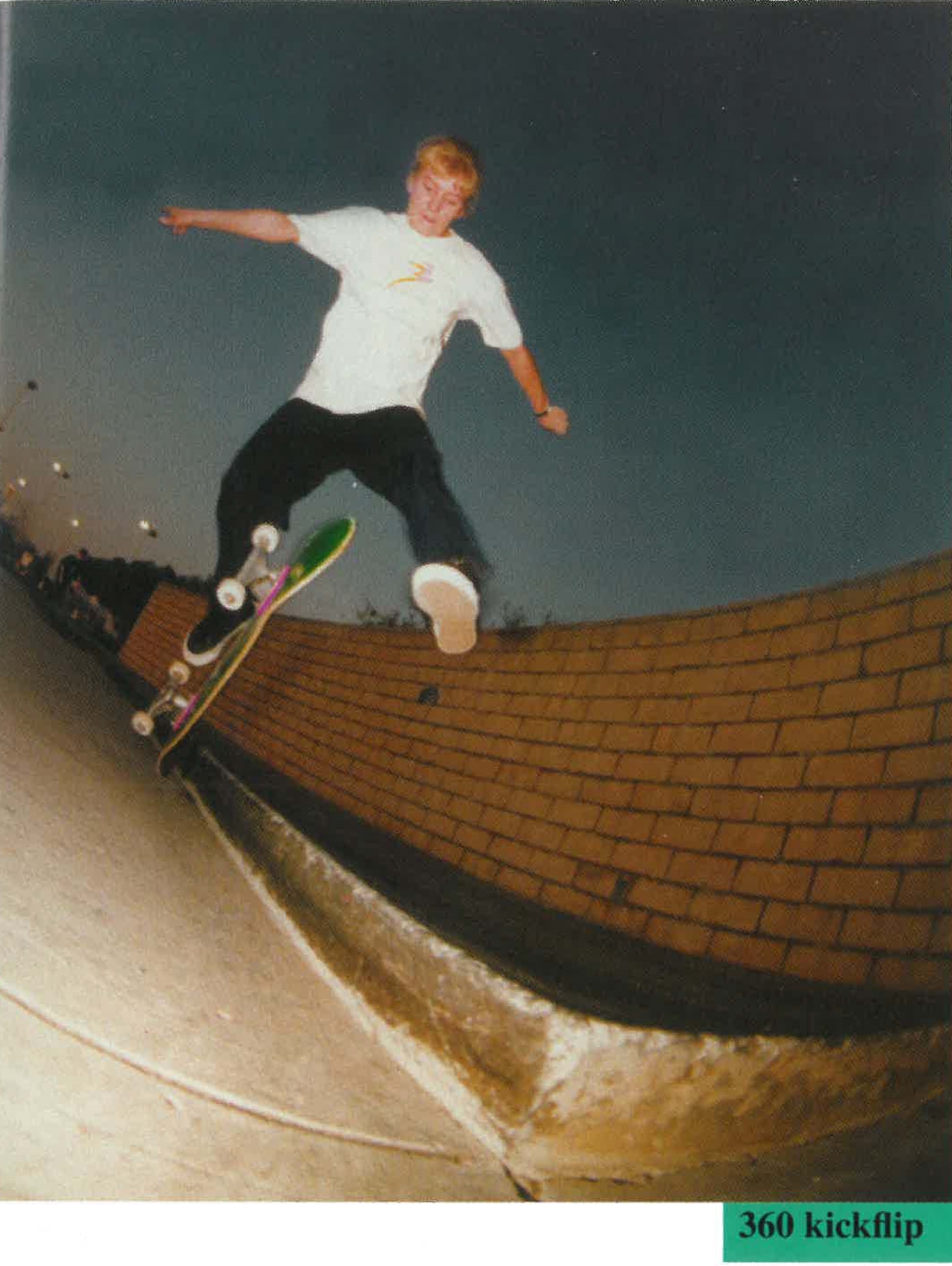
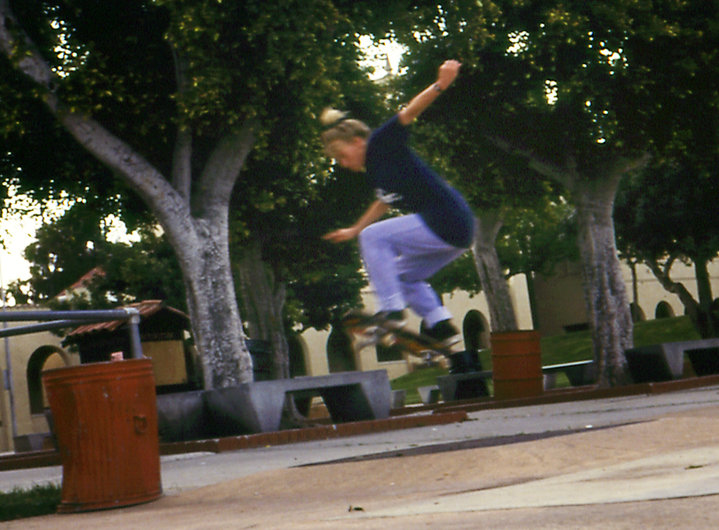
Clarke also appeared in a video called SK8HERS (1992) written and directed by Ethan Fox, which included skate legends Diane Desiderio and Cara-Beth Burnside. She has flip tricks, grinds, big spins, varial flips, and loads of style on those parking barriers, which must have been mind-blowing for the early 90s.
The director, Ethan Fox also took some stills of Saecha skating street while filming her part in 1991:

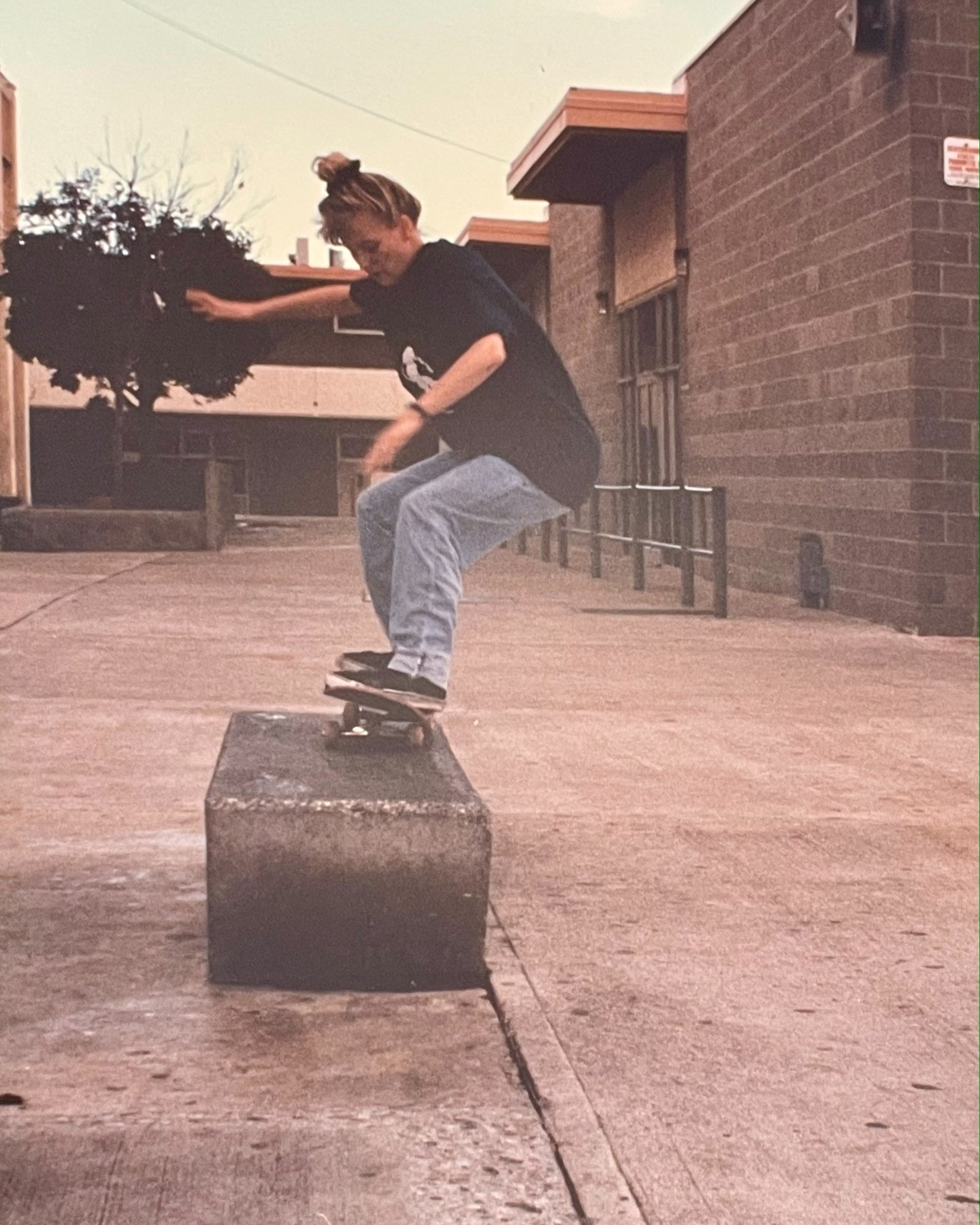

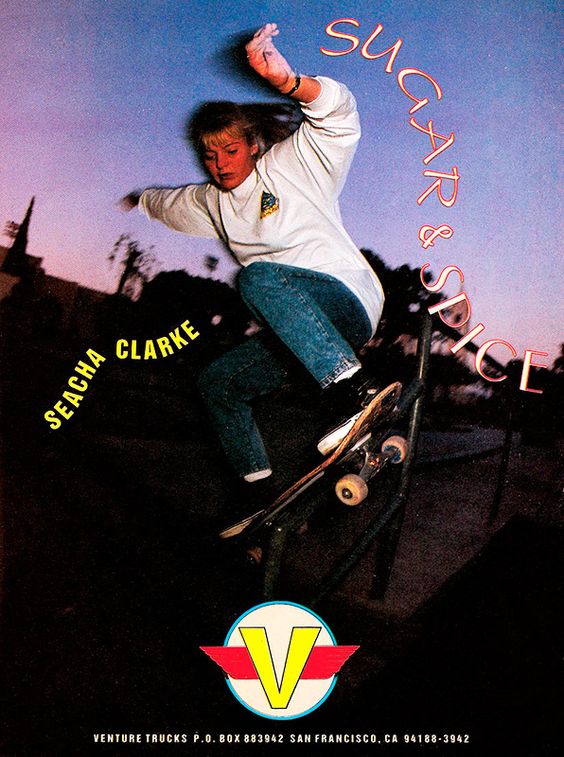
Regarding her first handrail, Saecha said, “I think I was sixteen at the time [1989]. I started doing contest handrails then, eventually I learned how to do it on a real handrail. It was definitely an accomplishment for me” (Araujo). Saecha’s team manager at Venture trucks, Greg Carroll also thought it was worthy of documenting. “He was like, let’s get a photo and run an ad. I was so psyched to get an ad in Thrasher. It had a blurb about ‘sugar and spice,’ playing off of that nursery rhyme about boys and girls. I do remember feeling a little funny about it, only because I felt like people would draw attention to the fact that I was a girl skateboarder. In some regard, it made me feel funny or like a spectacle at time. I love that ad now” (White).
Saecha’s friend, Christy Jordahl confirmed that while they were both board-sliding obstacles, Saecha was the one board-sliding handrails. They two Huntington Beach skaters had a great time together, and Christy explained that one of their favourite spots was “Hell Curb” conveniently located near a Dunkin Donuts, which they enjoyed!


Occasionally Saecha got a hard time from her teammates, like the pranks Ron Chatman tried to pull, although he later redeemed himself when shared his real opinion, which was complimentary “that I was like the Rosa Parks of female skateboarders. That is a pretty funny analogy, but it made me feel good” (White).
To Liza Arauja, Saecha recalled one frustrating experience during a session. “When I was skating at Huntington High one night this kid rolled up next to me and he had his board marked up with a paint pen that read ‘girls should be on beds, not boards.’ It pissed me off, but I just laughed at him and didn’t really let it get to me too much.”

Early photo of Saecha, taken by her friend Roger in front of his house in Huntington
There was also the time Saecha got a package from World sent to her house, “and the outside of the box was plastered with torn-out magazine pages from some pretty graphic porn magazines, very crude stuff. The sender specified it to be signed on delivery. Normally my packages were left on the porch and never had to be signed for. I remember seeing the package and being so embarrassed having to sign for it. To this day I still don’t know who the culprit was” (White).
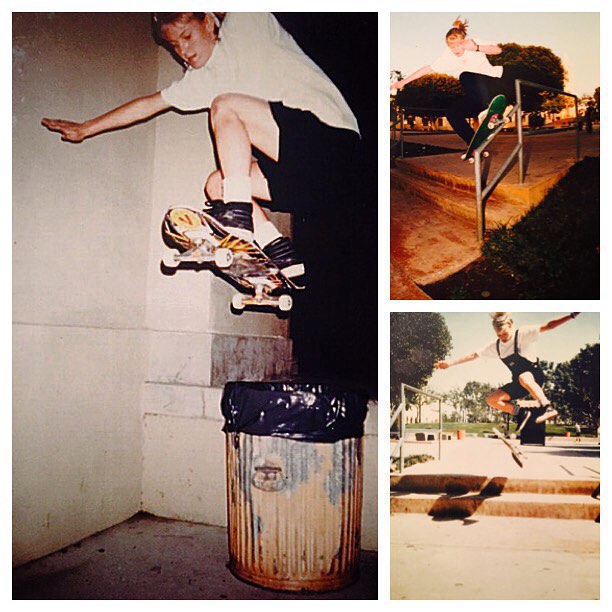
Here’s a great selection of photos, mostly around her neighbourhood in Huntington, posted on Saecha’s social media… my favourites are the one’s where she’s launching over her sister!:
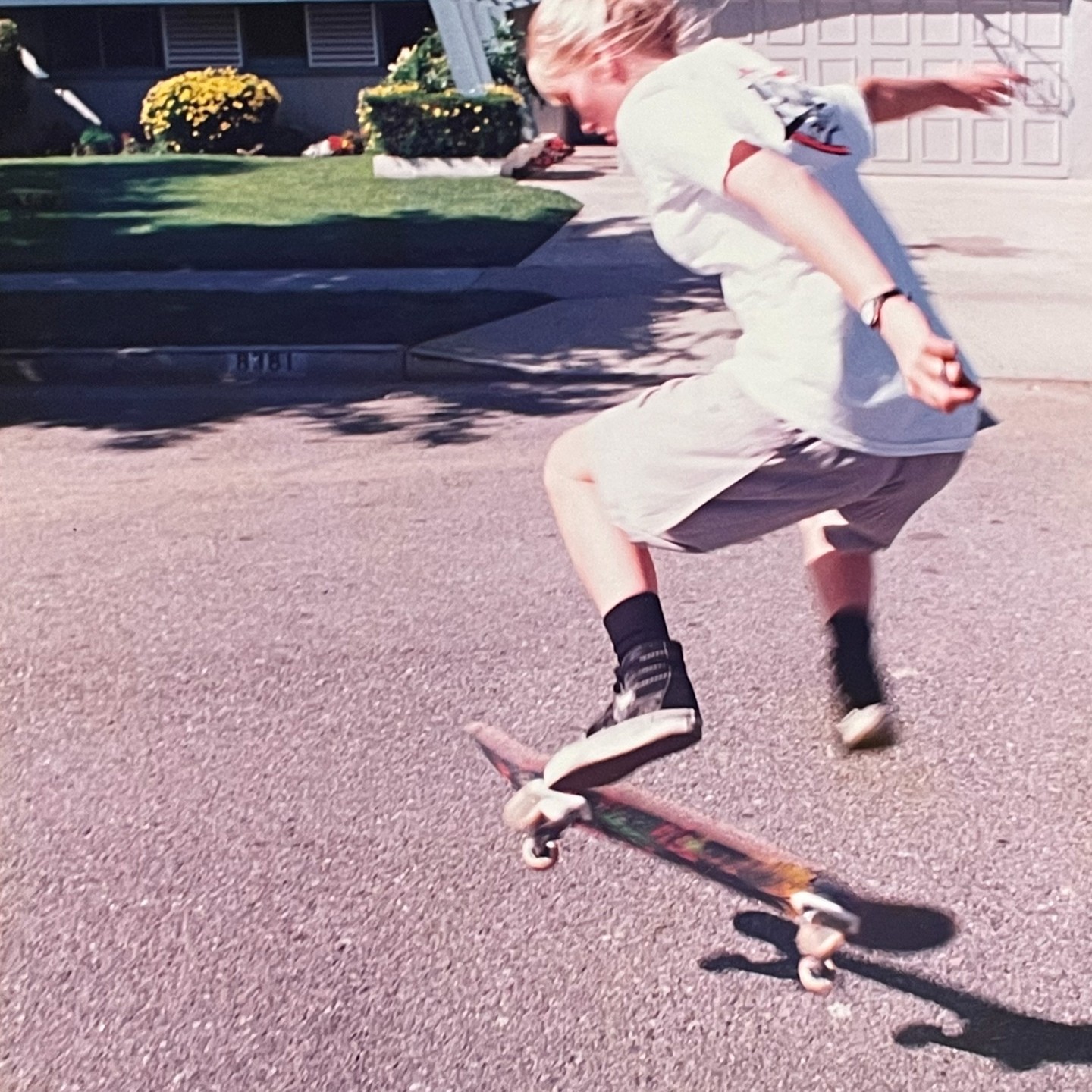


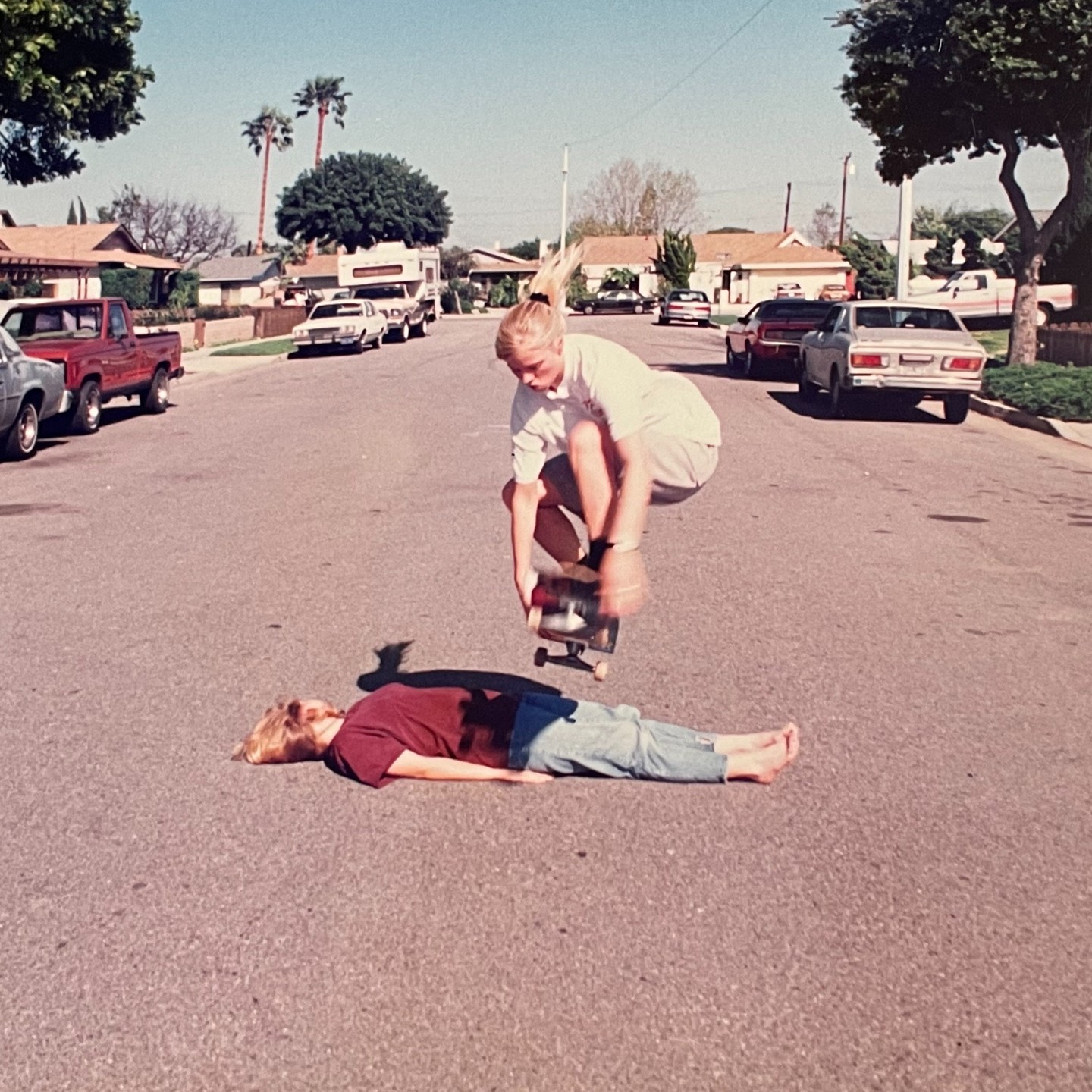
Unfortunately, Saecha experienced a series of painful injuries that prevented her from progressing. “I tore my anterior cruciate ligament and meniscus cartilage. I had a pretty bad ligament tear called a bucket handle tear where the ligament completely separated from one side of my knee. I had also torn my cartilage. When I learned that I needed to have surgery, it was a very sad time for me” (White). Even after rehabilitation, her knee was never the same and would often need to be drained of blood and fluid from the swelling by her doctor. “I should have gone back and had a full reconstructive surgery.”
By 1993, Saecha started college and was pursuing fashion design full-time and working part-time, but she still stayed involved with the skate community. She worked at Marge’s skate shop, and in the sales department at Sole Technology, and eventually worked for Emerica shoes.

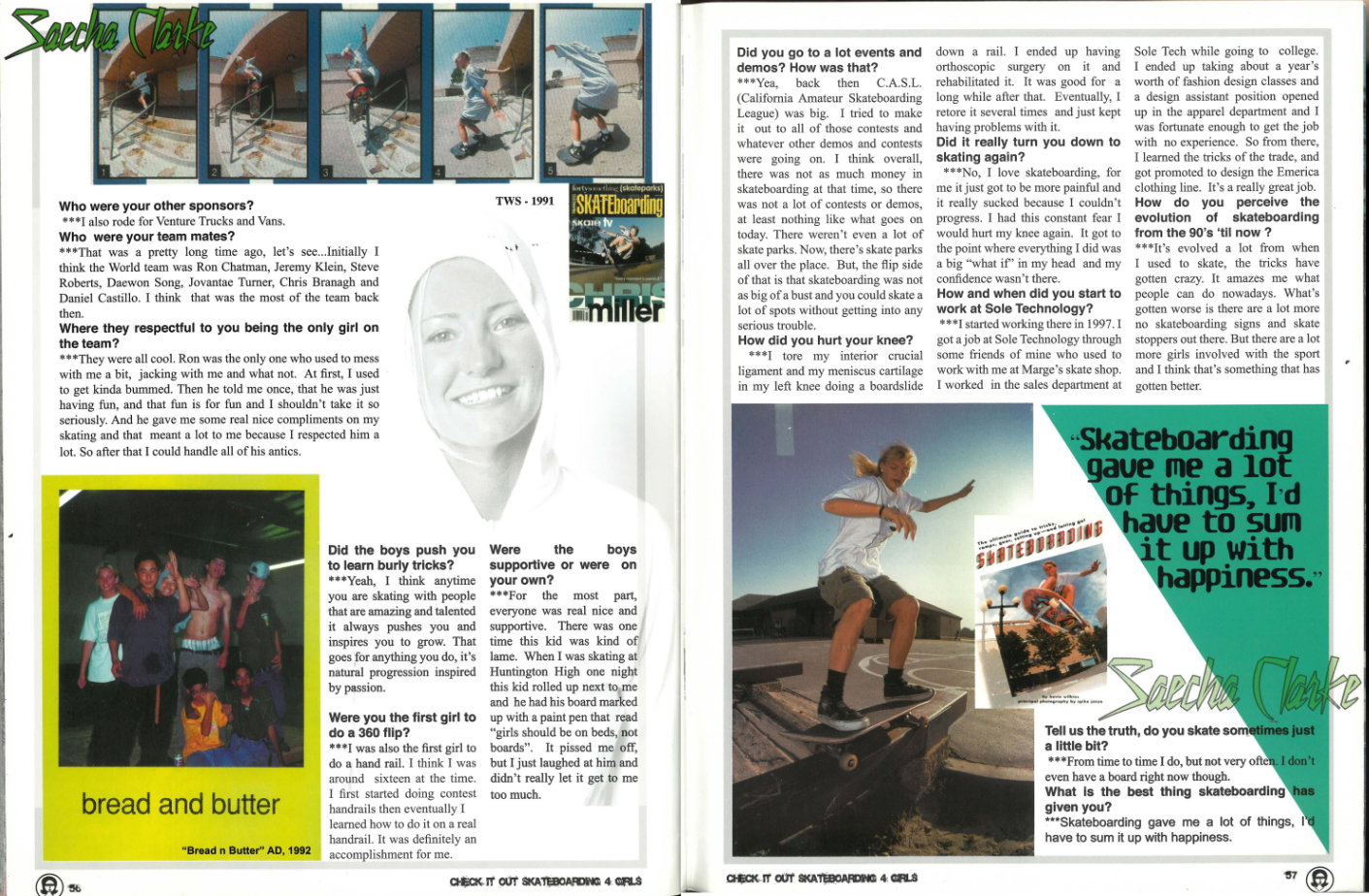
When the interview with Liza Araujo for Check It Out magazine was conducted in 2004, Saecha noted that, “there are a lot more girls involved with the sport and I think that’s something that has gotten better… Skateboarding gave me a lot of things, I’d have to sum it up with happiness.”
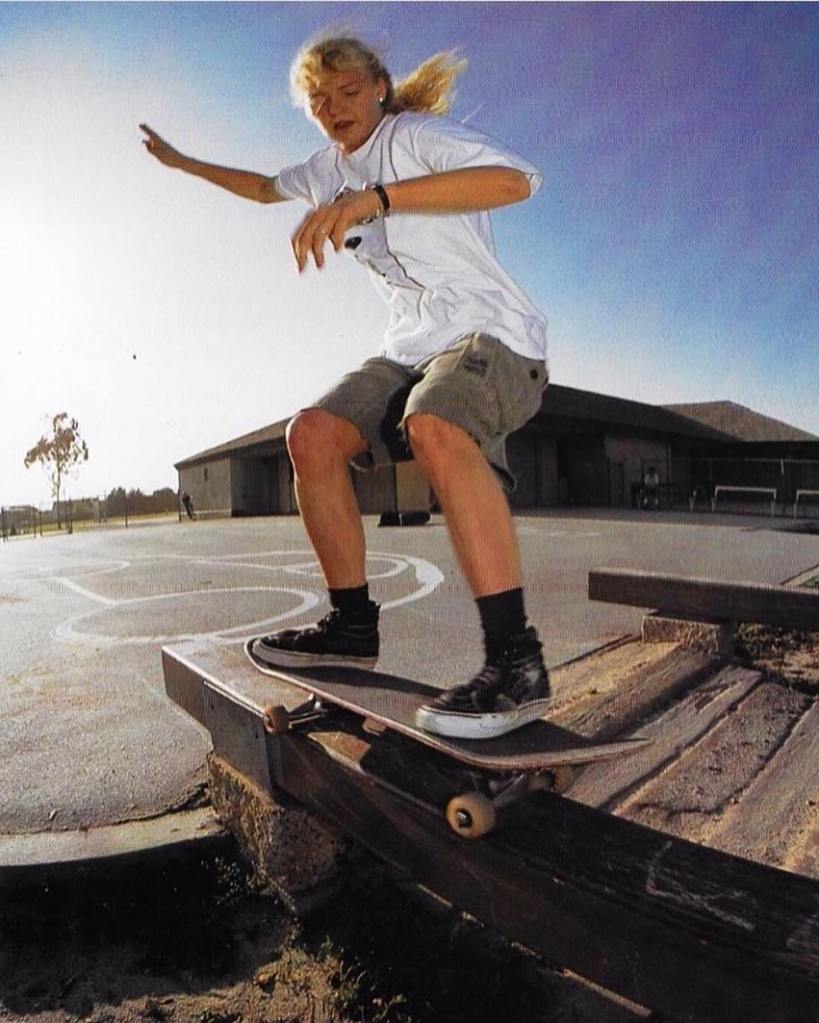
Photo: Spike Jonze published this photo of Saecha from the 1990s in reverse (I’ve flipped it back).
More recently, in the June 2019 issue of Thrasher, Michael Burnett interviewed Saecha where she shared more of her history, like skating for Rocco at World Industries, and some words of wisdom she wished she could have told her sixteen-year-old self. A fantastic feature!


Updates: In 2023, Saecha was inducted into the Skateboarding Hall of Fame! Congratulations!!
And, just in… Josh Sabini of The Village Psychic conducted an interview with Saecha on August 28, 2024 called “You need to know who Saecha Clarke is,” which is a thorough backstory in Saecha’s own words.
Photos: George Medlock, Dan Sturt, Jose Cerda
References:
- Araujo, Liza. “Saecha Clarke.” Check It Out magazine No. 16 (2004), pp. 54-57.
- Bradley, Milton. “Saecha Clarke Interview.” NBD_archive. December 1, 2019.
- Burnett, Michael. “Lest We Forget: Saecha Clarke.” Thrasher. June 2019, pp. 58-59.
- Kramer, Lynn. “Saecha Clarke.” Equal Time. Volume 2, No. 1 (1990), pp. 4-7.
- White, Alex. “Surviving World Industries with Saecha Clarke” Jenkem Book Volume 3 (2023): 222-227.

 Womxn Skateboard History