
Does anyone remember Frontside Betty website and Push skateboard magazine? Both were created by Denise Williams in Halifax, Canada in the early 2000s. The world wide web was a gamechanger and Williams was motivated to reach other isolated women skateboarders, to shift the ratio of representation, and be a resource.
Here are the three digitized issues of Push in PDF:
- Summer 2002 (free insert inside International Longboarder Magazine)
- December 2002 v1 no1
- Spring 2003 v1 no2

Above: an advert to subscribe to Push in the International Longboarder magazine featuring Isabelle Fried (Caudle).
Denise wrote on Frontside Betty:
“Once upon a time, I was a lonely girl skater in a big city. I went to the indoor park a few times a week, but there were never any other girls there and the guys seemed to want little to do with the girl in the corner teaching herself kickturns. As much as I loved skating, it was necessary to give myself a serious pep talk to get motivated to go back to the park each day.
On the wall beside my desk there was a picture of Jessie Van [Roechoudt] that I’d torn out of a magazine, one of the few pictures of a female skater that I’d seen in print. Each time I needed motivation, I looked at that picture and it reminded me how much I enjoyed skateboarding, how much I had a right to be a skateboarder, and how it wasn’t worth it to let loneliness and lame people get I the way of that. I went back to the park” (D.W.).


In the April 2003 issue of Transworld, a short review of “Frontside Betty” was featured. It said, “A whole Web site devoted to females on skateboards? Yep. It’s pretty damn cool, too… Overall, there’s excellent pictures and coverage, a good links section and a Web forum to keep everyone in touch.” It was a kind gesture to acknowledge the website but amongst hundreds of pages of ads and articles featuring male professional skaters, it was buried. You had to be in the know!

Denise then launched Push in 2002, which was a fantastic free magazine in full-colour with a focus on women skateboarders, launched. The first edition was a supplement within International Longboarder magazine, featuring nine-year old Alexis Schempp on the cover, launching herself off the roof of a parked vehicle, possibly a limo or a mini van, followed by an interview.
This issue also included an advertisement for the All Girl Skate Jam, an interview on Peggy Oki called “The Lady of Dogtown,” some product review and photo of Isabelle Fried (Caudle) powersliding downhill.


The magazine also received some odd attention, like a “Pick of the Week” review from one Matt Dakin in The Coast Magazine in January 2003. Dakin’s awkward review reads, “Girls skateboarding. Hmm. The idea kind of reminds me of a wet dream I once had. Girls riding skateboards has always been a difficult subject to deal with. How do you relate to a woman you want to fall in love with who wants to go skating with you when you need to go skating by yourself?” Lord, help me. Dakin at least acknowledged that Push was filled with valuable information, even though he foolishly thought that the freedom of skateboarding was a secret kept by men.

Cover: Vanessa Torres for December 2002 by Patty Segovia
Push offered well-written articles, hilarious jabs at the mainstream skate industry and poked fun at industry dudes, including pro skaters and those who submitted editorial “feedback.” For example, in the 6-page coverage of Slam City Jam 2002 by Rhianon Bader, the “boyzz” are offered a tiny blurb. “The boy skateboarders had a great showing this year, with Rodil Junior beating all the other boy skateboarders with his good skateboard tricks…” haha! There’s a wee photo of Eric Koston – inspired to try a flip trick after witnessing Lauren Perkins compete.

Cover: Jessie Van Roechoudt for the Spring 2003 issue of Push mag with a photo by Bryce Kanights.
In the May/April 2003 issue of Clamor magazine, Myriam Gurba included Denise Williams in an article called “Betties on Board.” Gurba explained that, “Williams’s magazine grew out of her initial experiences covering the female skate scene. ‘I got really up in arms,’ she says, ‘But after a few years I just realized that people don’t listen very well. Pointing out that people have a bad attitude towards female skaters isn’t going to help. Showing them the reality of what it means to be a female skater by putting a magazine in front of them that shows girl skaters as we are will do the job though” (26).
Gurba also explored the frustration of “girl skaters” being viewed as a novelty, and Williams commented on how there was a shift to being seen as marketable but that “people often cover the scene badly when they report on it. We want people to stop thinking in the stereotypical ways that outsiders have and see it from the girls perspective” (26).
Gurba recognized that, “Through Push, Williams hopes to have created a space where places like Toy Machine can advertise in a gender-neutral context. She also wants to show the industry that women aren’t necessarily interested in gender-specific products. ‘Retailers might think that girls want a board with a flower on it or pink trucks that that’s not the case. Companies haven’t gotten it into their heads that girls are interested in getting gear, not the feminine design of it” (25).
While the magazine folded after three issues, it made an impact, introducing readers to the latest ripping skaters and legends like Peggy Oki. Push provided in-depth coverage of contest results, product reviews, and sponsor updates. Flipping through the pages you’ll see ads for Cherry Skateboards, Nikita clothing, Rookie Skateboards, and features on Villa Villa Cola zine / crew, the All Girl Skate Jam, Gallaz Skate Jam, Slam City Jam, etc.


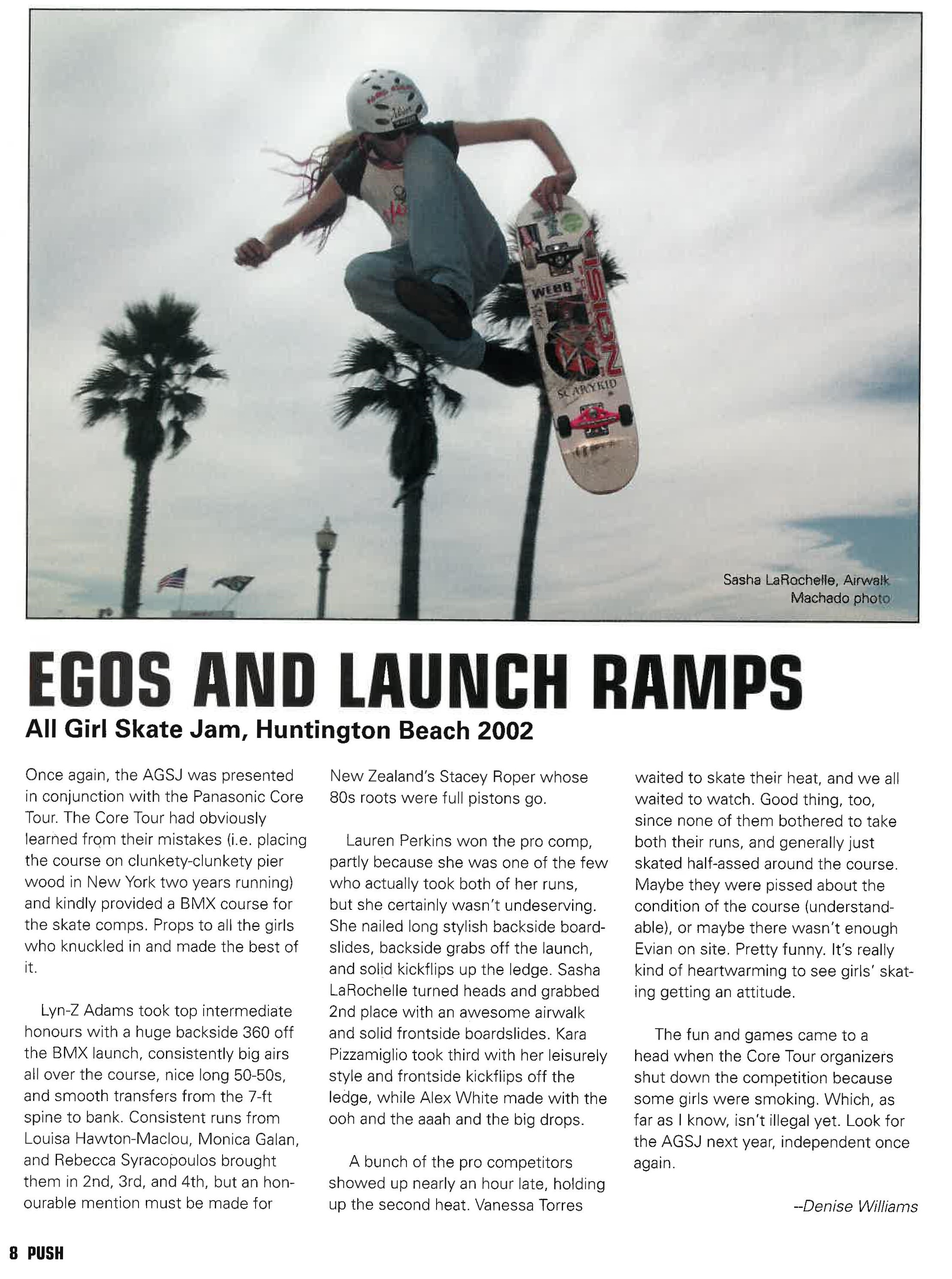
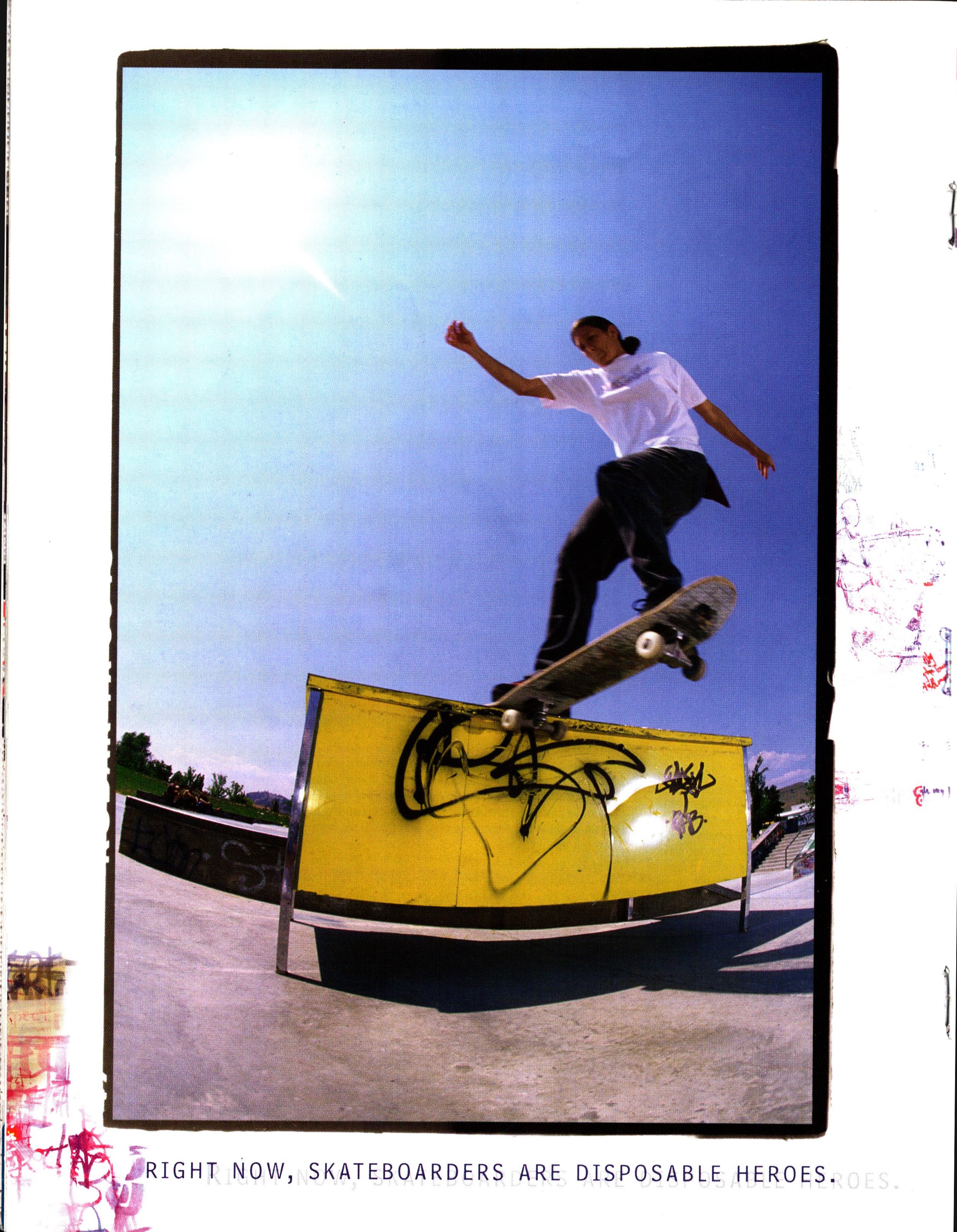
Williams also contributed an article for Concrete Wave magazine (Winter 2002) on the progress of women in skateboarding and coined the idea that we had created a “scene within a scene,” or “subculture within a subculture.” She explained how it was difficult to generalize the universal experience of a skateboarder, and the same goes for women, but “the truth remains, however, that the divisions are out there, whether they exist in your scene or not. And they’re discouraging girls who want to skate.”
Williams’ efforts meant so much to my friends and I. In my thesis paper, I explained: “I was skating at Jarry in Montréal with five other girls when the [Push] Spring 2003 edition was distributed to us by a friend. We pored over the 32 pages, discussing the interviews, product reviews, letters, mock horoscopes, and photos, and were inspired by what we saw because finally this was a magazine just for us that was not tainted by an outsiders’ conventional view of what it means to be ‘extreme’ and feminine.”
Thank you @lettergrade
Cover photos by: Bryce Kanights & Patty Segovia
References
- Bird, A. “Webslingers.” Transworld Skateboarding. Vol 21.4 (April 2003): p. 94.
- Gurba, Myriam. “Betties on Boards.” Clamor Magazine, March/April 2003, p. 24-26.
- Porter, Natalie. “Female Skateboarders and their Negotiation of Space and Identity” (2003).
- Williams, Denise. “A Scene Within a Scene.” Concrete Wave. Vol. 1.3 (Winter 2002): 14-18.

 Womxn Skateboard History